#022 Dr. Ben Jones
In this episode of the Decoding Excellence Show, I am joined with Professor of Sports Physiology and Performance at Leeds Beckett University and Research & Innovation manager at the Rugby Football League, Dr. Ben Jones.

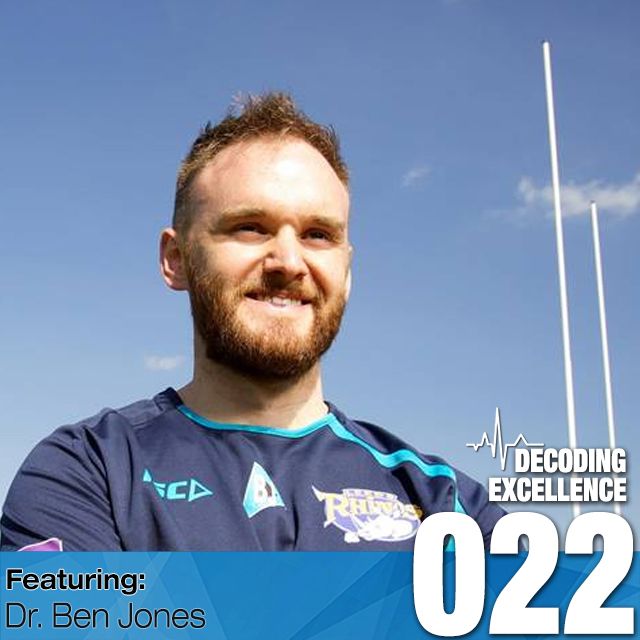
In this episode of the Decoding Excellence Show, I am joined with Professor of Sports Physiology and Performance at Leeds Beckett University and Research & Innovation manager at the Rugby Football League, Dr. Ben Jones.
Ben's primary research involves investigating the training load, match demands, fatigue responses and recovery profiles, physiological adaptations, nutritional requirements, injury and illness occurrences and the physical development of youth athletes. Ben's research involves working with National Governing Bodies, professional sports teams and schools to help inform policy and practice around the optimal player development pathways.
Ben also holds a well-developed and successful consultancy portfolio. He holds experience in professional football, and currently still consults to professional rugby league and rugby union teams. He has also worked with numerous international teams and athletes. Ben is also involved in many different research projects exploring: thermoregulation in occupational settings, nutritional supplementation for weight loss, carbohydrate use during ultra-endurance cycling and multi-disciplinary sports science support for athletes to name a selected few.
On the show, Ben & I discuss A LOT:
• Background into his research/practitioner background.
• Roles in university, governing body, and club.
• Applying (or translating) the laboratory to the playing field.
• How to better connect professionals on the same team.
• The genesis behind his intense thirst for knowledge.
• How to formulate better questions during the research process.
• Influential mentors, and lessons learned, in his professional journey.
• The power of observing how others work.
• Why bravery is important in the research process.
• The critical skill of communication that improves sport-science.
• How to get the right research into the right hands.
• Is it better to professionally pursue depth or breadth? Or both?
• How to avoid distractions that keep you from your best work.
You can catch up with Dr. Ben Jones on Twitter at @23BenJones
In addition to those social mediums, you can head over to AdamRingler.com/Newsletter and sign-up for my weekly newsletter. This is a newsletter for the curious. It's chalked full of interesting articles I've read through the week, things I'm exploring and finding fascinating through my week, and a collections of thought experiences and resources I've cultivated. It's essentially a Birkbox for performance-related articles and musings.
Thanks again for listening to the Decoding Excellence Show! I appreciate all the support growing this Sport Science, Strength & Conditioning, and High-Performance Coaching resource. If you have taken anything away from the show, please login to iTunes and navigate to the Decoding Excellence page and leave us a review.
Key Takeaways
- Translating the laboratory to the playing field is a skill in itself: the research is only useful when practitioners can actually apply it.
- Communication is the critical skill that improves sport science: getting the right research into the right hands matters more than producing more of it.
- Formulate better questions before chasing answers: the quality of the research process starts with the quality of the question.
- Observe how others work: watching skilled practitioners and researchers in their environment teaches things no paper can.
- Bravery belongs in the research process: asking hard questions and pursuing uncertain lines of inquiry is how the field moves forward.
About the Guest
Dr. Ben Jones is Professor of Sports Physiology and Performance at Leeds Beckett University and Research and Innovation Manager at the Rugby Football League. His research covers training load, match demands, fatigue, recovery, and youth athlete development, and he consults with professional rugby league and rugby union teams as well as international teams and athletes.
Listen and Subscribe
Find this episode of the Decoding Excellence Show on Apple Podcasts and Spotify, or use the player above.
Go Further in This Episode
Enjoyed this conversation? Here is how to get more from it:
- Read the transcript below to revisit key ideas at your own pace.
- Share this episode with a coach or colleague who would benefit.
- Subscribe to the Decoding Excellence Show on Apple Podcasts, Spotify, or your favorite app.
- Join the newsletter at adamringler.com/newsletter for weekly insights on human performance.
Episode Transcript
This transcript was automatically generated. While we strive for accuracy, some words or phrases may be misheard.
[00:00:00] You take the blue pill, the story ends, you wake up in your bed and believe whatever you want, you take the red pill, you stay in wonderland, and I show you how deep the rabbit hole goes. Sport Science, Strength and Condition, High Performance Coaching. Welcome to the Decoding Excellence Show. Hey guys, it's Adam. Today I'm going to forego having a show sponsor for the Decoding Excellence Show, and instead of what I'm going to do is talk about my newsletter. Head over to AdamRingler.com forward slash newsletter and drop your email into the little input box and you'll receive what is otherwise the birch box of email newsletters. It's a collection of my weekly thoughts, my weekly musings of everything I'm finding fascinating. Check it out at AdamRingler.com forward slash newsletter and sign up today. It mean a lot. Today on the show, I am excited to be joined with Dr. Ben Jones. Dr. Jones is a professor at Leeds Beckett University, and he is also the research and innovation manager at Rugby Football League.
[00:01:38] Dr. Ben Jones joins me to discuss all things academic research, how to ask better questions. I know for me that is something that really resonated with me and I took out a bunch of notes on in my notebook. And we start to discuss what we can do better to help sort of bridge the gap between the laboratory and the sports field. This was a really exciting conversation for me because I think we need to do a better job as practitioners, as a sports scientist, as coaches, really taking what the research says and trying to apply it in a way that best fits our environment, our context, our athletes that we work with. This was a fun conversation. Dr. Jones shares a lot about his background why he got into academia, how he approached it through the vehicle of sport and why he ultimately chose this sort of profession. We go through this and explore his background, his journey into high performance sport. So grab a pen and paper, grab a notebook, you're going to want to write down some of the things that he talks about. I know I certainly did. So without further ado, here is my fun conversation with Dr. Ben Jones.
[00:02:56] Ben, welcome to the Decoding Excellence Show. How are you? I'm great. Adam, how are you? I'm doing really well. I know this has been what seems like months in the making as we've sort of gone back and forth, but I am absolutely stoked to finally get you on the show. This has been a show that I've been been waiting for for a number of weeks and months here. So I'm just thrilled that you you could make it on, man. How are things with you? Yeah, no, thank you. It's a great pleasure to come in and chat around the applied sports science world and it's good. We're all good here. We're busy. We've got lots of applied research projects going on. Some bigger projects and smaller projects. It's been a great place at the moment. So it's exciting times. That's awesome, man. And again, the whole reason I wanted to have you on this show is because number one, I find a lot of similarities between you and I.
[00:03:53] And I followed the work and what you've shared and just the mediums of your publications for quite a while now. And with that, there's a lot of things that just really resonated with me, with the materials and the things that you've curated on your social feeds and elsewhere that I just wanted to pick up the phone and have this conversation with you. And sort of peek behind the veil and hopefully get to know you and to allow the audience to get to know you a little bit more intimately and personally because you're phenomenal. And I just want to share that. So I love for you, if you could for me, man, to just give me kind of a give me or give the audience, give all of us just sort of an update of what you've been currently up to in the last couple months. So in the last couple of months, I've actually been, I spent most of my time traveling. I've been actually in Cape Town for a week. We've colleagues out at the University of Cape Town and then I was over presenting at the Australian Strength Foundation Association in Australia, then over to the spring conference in New Zealand.
[00:05:04] So, but that's not a normal month before then, I spent my time at the moment balancing my current roles, which are within a university, a governing body and a club, which are a great combination of roles to allow what I feel to actually make a genuine difference in applied sports science, because I think we need to move away from dichotomies right and wrongs and kind of real strength. Strong views of things and for me, I'm in a really fortunate position that I can actually hopefully make an influence through that work. I think what's really fascinating, and this is sort of maybe in the United States, somewhat of the disconnect that I see so much, is that we have such tremendous, very clinical sports side professionals that are doing tremendous work, quality work. And then we have the other side of the continuum, which might not be the farther side of it, but on the other side is the actual practitioners, and sometimes there's this huge disconnect. And I think what is fascinating about the roles and the responsibilities that you share is that not only do you service and hold this position as a professor and a researcher, I'd say innovator, but also you have this applied practitioner role from ahead of a academy at science at Carnegie. So like you're surfing the entire continuum, and I got to imagine that has to be really not only enjoyable, but the most optimal way of sort of applying, taking the laboratory, translating that into a very applied setting.
[00:06:47] Yeah, yeah, it's for me, it was the only way I could truly understand all ends of the spectrum. And I think that for me, I get frustrated daily, and it's not around why what people are doing wrong. It's the fact that what people aren't considering because they don't know, and it always goes back to who's lazy looking at things from. And one of the reflections from my recent travels where it's conference, when I was talking to it, it was Brian Mann and Laura Landau from your side of the water. And they also shared the view and it was Brian and Laura were talking about it. And it was trying to get away from this fact of it's not about who's most right. And actually, you see this a lot and you see people disagreeing on detail, when actually from a higher level, there's actually a real shared interest.
[00:07:47] And actually, if the journey in the mission are actually aligned correctly, we'd make so much more progress. And I think for me as well, when I sit in the middle of these, when I sit in different meetings with these different hats on. One of the big thing that always rings bells to me is just because I'm right doesn't mean you're wrong. And when you look at the same problem from different perspectives, every single person in that room or outside of that room or in another organisation can be 100% right. But everyone can be 100% right and actually it just depends on what lens you're looking at through. And that's for me that one of the real kind of interests I've got at the moment and it's around, how can we genuinely join the dots on what is in effect networks and organisations of people who work unbelievably hard and invest so much emotionally into it.
[00:08:46] Everything into their job to make something work, yet it just feels that our system at the moment, if you say a system as a gubernating body, a club and an academic institution, they're so inefficient. If everybody just actually took a step back, breed, slowed down and actually went back to why we're doing all this. I think that it would be so much easier and more enjoyable. You know, I think for me too in this and there's a lot in that that resonates with me. But I want to rewind the tape a little bit because I much like yourself, you know, when you're sitting in these conversations and these meetings and you're hearing these different sort of disciplines talk so passionately about whether it's a particular problem or a different approach or a principle or protocol. And they are right and everybody's right in the same room, but rather than sort of viewing it from a specialist standpoint, I think there's a lot of strength into being almost that 30,000 foot view and appreciating all the different approaches that everybody's bringing to the table and to the table.
[00:09:53] But I'd love to maybe understand a little bit greater, maybe wear this idea or your philosophy or this concept comes from. And I think a lot of that comes from maybe the way that either were raised or why we got into sport or why we found ourselves resonating in this direction because a guy as smart as you as brilliant as you could have probably applied to a hundred different professionals. Professional pursuits and and found success in either of them. So I'd love to maybe ask you if you could set the the genesis or set the story or the scene for why you got into sports. I mean, what was the what was the interest? What was the genesis behind your story? So I started I went the traditional route from an undergraduate degree and I didn't under graduate degree so I was I was playing sport as a junior.
[00:10:53] I probably enjoyed it more than I was good at it and then and then as I as I started to realize that I started to enjoy the gym side of it and going to the gym and actually genuinely, you know, when you when you realize that something has a genuine impact and makes a difference. You become passionate and you believe in it and that's was something around for me and it's as simple as just going to gym going to gym made me stronger. It didn't make me much bigger but it made me stronger which therefore you kind of you you you buy into that model and then use and then or you buy into that belief so that was my first driver to why I love the theory of sport. So going to an undergraduate degree I my goal then was to be it was more personal training at the time and Joe my undergraduate degree I worked as a personal trainer. I had a small business with an end of one employee which was me and I did I started this at the end of my first year and that was one of the points actually that that started allowing me to kind of really apply what I'd learnt in the classroom to clients and that's you know this is real simple stuff in terms of how long you should exercise you know do I do cardio before I do weights with my with my clients.
[00:12:15] Yeah and then I finished my degree and I love a genuinely love personal training I was working with some brilliant people mostly become friends and then I got that feeling of I'm 21 I've finished my degree of full I was I was working however many hours a week as personal trainer and I couldn't and I couldn't fit any more clients in and then that was when I actually thought I'd like to go and apply this to sport I'd like to go and see if I can make sport better and probably at that point I thought I was going to be more interested in the high performance the 1% is the fine detail so I went back to do my master's at university and Joe my master's I got involved with a professional club was working in the professional club and working in the youth department and again probably going back to that feeling I got when I started going to the gym was the fact that you can generally change a youth players career because actually with you know a 346 month training program they look different and the caveat to that is yeah they're going to get stronger whatever you do but actually this is a real nice I felt a real reward from working working with those and again I finished my masters and the jobs that I wanted to get with in professional sport they all said you need three years experience so I felt frustrated at that time I was working on a minimal part part part part part part time basis in this professional club so for me I was like well actually if I'm going to invest three years in building a CV and profile to work with you in professional sport I want to challenge myself academically so then I did a PhD and I think at that point then I was really interested in applying
[00:14:19] Applying coaching working with people and I would say almost the art of it you know the things that you don't really know why they work but they just do and you enjoy the athlete enjoys it yeah and the flip of that was the I'm not going to say at that point it was research it wasn't it was trying to increase my knowledge by reading and doing research to increase my knowledge to then try and then be better in the field and and I suppose problem and it was probably the second in the second year my PhD was when you've done some when you've done research and you start to understand the research process much better I was getting pushed at that point right so for depth and it was to go and find something that was deeper in terms of knowledge but at that point there I got this feeling that actually what I'm going to go and search for here isn't relevant for the real world and I remember having this conversation with my supervisors who who probably felt quite frustrated that I was trying to almost be I'll use the word superficial in my approach because I was there was too many other things that I felt that weren't understood enough if that I needed to understand before going to this depth yeah
[00:15:36] And you know going through the PhD right so I went with the debts finish my PhD and and I was still working at the club at the same time I got a little bit more roles and responsibilities but you know it was still a hands on the ground coaching and under 19 side and I finished my PhD and I went into the club and the coaches you know very interested in in what I do when you wear white coat but not really understanding that that's what that's me what I've been doing so I said I've finished my PhD I've submitted my 100,000 word thesis and they said to me what did you find and my findings were based on a PhD in fluid balance and sodium homeostasis in rugby players found that rugby player should drink when the thirsty and at that moment they look on the face and the feeling I got which again going back to probably I've obviously you know the examples I've used around my gym and the athletes you know
[00:16:38] Probably crave a part on the back every now and again the look that they gave me I thought I've just ruined the academic and practice bridge here I'm not surprising that they actually look at academics and think you do not answer any questions that are relevant for us you just go and find out things that you think are interested and at that moment then I remember coaching thinking I've got to be able to do something more helpful than that and that was that was probably one of the the real pennies that dropped and I use that story a lot a lot with people in its own and I think it's it's it's nice now Joey is someone that speaks to him a lot who's obviously over your way and he's in some fantastic work and we always talk about you know this real applied research and these becoming more academics that are doing that in the real world
[00:17:30] But I would still go back into a lot of university and talk to people and they're still trying to understand the why the mechanisms you know the depth and actually it doesn't change what people are doing so that that was probably my story to where I'm now which was which was actually I need to I need to find a way in which I feel that I can genuinely contribute within policy which is governing body practice which was in a club and knowledge which is an university how I can genuinely contribute here and have a balanced view of everybody's perspectives
[00:18:09] And I think that's probably where I am now man there's just there's so much in there that I I want to chew on and go down a couple different rabbit holes here and and the thing that you let off with this is sort of thirst for knowledge and I'm just curious what do you I mean was there any mentors was it family was it people that was very influential around your sort of upbringing or adolescence or in university I mean where do you think that thirst for knowledge that sort of seeking of wisdom
[00:18:41] Or that drive for research for that sort of academia and knowledge comes from yeah it's I think that's a really interesting question genuine no one's ever asked me anything that I think on reflection so I come from a family where you know my dad was very successful he was it was in finance he was and ended up being a chairman of a company and you know we're not talking super super rich but you're talking about very well you're comfortable you know we had nice holidays and older brother and younger sister and other and and the mom as well
[00:19:20] And I suppose that one of the things that I I was really passionate about was whatever I chose to do I wanted to be good at it now my mom was really and and her dad who supported me a lot in the sport they were really really supportive of do whatever you want as long as it makes you happy where my dad was probably a little bit more hard-nosed on don't waste your time doing anything that's not going to go anywhere and I think those those blend of those
[00:19:53] Messages probably created a little bit of stubbornness in the fact that being honest I don't think my dad wanting me to go and do sport science at university because it didn't make sense to to someone like that who who was doing a profession where I was encouraged to go and do something I was interested in probably by my mom so actually I think that that blend of whether it's a thirst for knowledge or whether it's a determination to whatever I wanted whatever I'm going to do I want to be good at it
[00:20:23] And I think that those two things you know trying to be good at it but also loving what you do I think naturally probably the knowledge comes after I don't think at any point I deliberately set out to become for the knowledge because I actually if I'm completely honest of you sport 21 who knew me prior to my PhD they wouldn't have described me as an academic person I was very practical I was very hands on it's probably very annoying at times in the classroom but actually I think that I did have this
[00:20:59] Belief and this drive that I wanted to be good at it and actually there was moments when I finished my my masters and I remember reflecting on this on I had a choice to make when you finish a master's what career I wanted to do whether that was sports performance or clinical and I remember something and I actually applied for some clinical jobs and I remember actually turning them down thinking that if I went to a clinical job I'll never be as good as an MD
[00:21:31] A medical doctor yeah they're actually if I went to performance job I have all the I have as much right ambition you know to be actually really good at what I do by just by working hard so I suppose those are some of the beliefs that I've applied and actually that's you know this is the first time I've spoken through these book they potentially make sense to why I'm doing what I'm doing now in episodes past I think I shared a similar story where you know my father was and still
[00:22:03] Is a small business owner and and was in government and I remember a very critical turning point where in university for myself it was you know I went down sort of this business administration economics personal finance pathway if you will the first two years sort of squandering because that was what I thought would make him happy right like or what would please him or what was the acceptable you know choice and then but really my my passion was sport
[00:22:36] And athletics and it I remember a very sort of turning conversation at the that kitchen table where you know almost like I got not spoken permission but like relieved of any sort of pressure that I might feel following a particular career pathway and and that was sort of the turning point for me to be heads on full effort towards what is otherwise my my passion what I feel like my calling isn't and you know you spoke so much about this time of going
[00:23:09] Through and you mentioned a couple different advisors and your PhD but was there anybody particularly influential mentors advisors at that particular time that you could look back and sort of retrospection and and say maybe led you down a pathway that that you know essentially delivered you to the sort of the the I say success this to the success that you have today yeah I think that one of the one of the most influential people my whole career has
[00:23:43] Been my colleague and how I work with a lot now which is Dr Kevin Till and so I so my supervisors were Professor Roderick King and Professor John O'Hara and both are very very good academics and I think that one thing that joined my PhD and when you talk a lot about I could talk to academics join those early kind of research career you see elements in in different people that and the bet the probably their best bits that you're like I
[00:24:16] Want to steal that part I don't want everything I just want that part and you know that's in terms of you know the depth of knowledge in terms of how somebody writes in terms of how some interprets data and then coming to the end of my PhD Dr Kevin Till had finished his two three years earlier and Kevin was Kevin was outstanding at turning an idea into a into a study and something on paper he could go from we we would chat over coffee
[00:24:49] And you'd ask a question he'd be like let's do a study on it if you got some data and by the end of the week you would have a draft manuscripts and he's Kevin's phenomenal and he's like that now so I think that Kevin help Kevin help inspired me to actually make things happen that way and and I think again probably you know when you speak to different academics different people and you can start then identifying what what their strengths are and and hopefully
[00:25:25] Blending yourself on those key things I think I think Ben that's probably again where I am now which is I try and genuinely every person I speak to I try and learn something from and I think that that allows me then to almost collate other people superpowers into something that's that's quite efficient but yeah definitely my supervisors were brilliant but but the yet working with Kevin and I still work with Kevin now if you look at our publications we supervise
[00:25:54] Most students together and work together and and is a good friend and I think he's he probably gave me the confidence of making research real and actually turning it into into something quite quickly which was good yeah yeah I whether it's Kevin or or maybe somebody else or maybe just something that you've applied in your your normal day is there any particular pieces of advice that they shared with you or he shared or someone else shared that either really resonated
[00:26:27] With you or shaped the way that you approach your work today no I don't think so I generally don't I don't remember anyone ever sit me down and kind of pep talking I think it was more watching people and how they work and I think that you know watching working with Kevin but then also the blend of that as well that I that I try and I try and spend time as many different people as I can and whatever their background and whatever work whatever their roles because I
[00:26:57] Generally feel that everybody has something really special to contribute and it and it became in spending time with different cultures some who were very successful some who weren't I found it interesting when the ones who I felt were doing things better in theory were less successful than those that were doing things that were worse in theory and that again allowed me to to to probably start to claim this idea my head around it goes back to you
[00:27:27] Know just because I might doesn't mean you're wrong and actually you know it's not about who's most right and and that allowed me to almost create this real balanced view of actually no one really knows what they're doing we're all navigating our way through it as we go along and we are and and every day you kind of do something that that allows you to to learn something new and and actually the people who were at the forefront of these organizations they're probably just
[00:27:53] Braver than was was below that are actually still still not brave enough to go and do something so I think that and I think that spending spending a lot of time with really good academics with really good cultures with really good athletes athletes are so driven they're unbelievably smart some of them they're actually you know athletes are really good for me because they ask what we will plus has done questions you know we do something the turn around on the
[00:28:22] Go why we're doing that and actually this is when you turn around the go yeah I don't know someone showed me and I've carried on doing it ever since and and that's and that's for me that's it's it's really refreshing to be able to say I have no idea why we're doing that and and going back and some of those are not basic things you know I remember an athlete once and an interesting thing within the the UK especially rugby is that a lot of rugby players when
[00:28:54] They're post 18 they do sports science degrees so they probably end up where they're confidence in sports science probably overtakes their competence in the first couple of years but that but that makes them really challenging you know why we're doing that drop jump why we're doing a single leg or double leg or why you're making sit down for a jump and it really challenges you're your basic principles and your philosophy is to actually go back and make sure that you
[00:29:20] Do understand why you're doing something you're not just doing it because it looks off feels right I love the fact when you were discussing just that that sort of natural curve as as a person goes through sort of their professional career of those initial early years when when confidence trumps their capability of performing the task if there was somebody coming out of university and they are approaching whether it's you know they're an adjunct professor and they're
[00:29:50] Just starting off and granted that they probably have their own mentors but like what what do you typically see I mean what piece of advice would you recommend for them you know the smart driven motivated young sport scientists just starting out in the field ready to embrace the world the real world for all of the complexity that it presents away from the laboratory well what advice would you recommend for them I think the the first
[00:30:23] Thing for me is you've got to build relationships with people our our industry is fantastic because we work in sport science which is technically science but we work in an area which I disagree with people say it's a science it's not it's an art winnings an art it's it's subjective we don't know why some people do things at certain times we can explain with science afterwards but if you over science things I think you turn cultures off and I think the
[00:30:53] First thing that we've got to do is we've got to go listen understand why people do what they do from experience just because they don't they may not understand the science the mechanism behind it but let's just understand why they do what they do and then look at where we can contribute and actually contribution is contribution could be through joining the dots on lots of lots of superficial things which could be you know rest recovery
[00:31:27] Nutrition resistance training or it could be on on some depth and the depth could be you know if you tweak because if you change your resistance training program the reps the sets the tempos that actually that could could it could help the performance program but the first thing has to be understand the environment and go go and understand that the person's view their lens and why they do what they're currently doing because I do find it really interesting and I
[00:31:56] Was that person I went into the club and I watched and I was I came home and probably overconfident under competence and and thought well that doesn't make sense that's wrong and just because I didn't understand it thought it was wrong and actually you know some of those things have changed and they probably weren't right they weren't wrong but they probably weren't you know the word optimal but actually I think we've just got to understand other people's views and
[00:32:22] I know you've said this in a number of other sort of publications and podcasts but just discussing sort of the complexity of research as it relates to sport performance and and this athletic world that we live in and I'd love to ask I suppose I mean is it a challenge is it a problem that we are industry researchers whatever are trying to ask questions that aren't necessarily pertinent or relevant to the sport and the context of sport or
[00:32:58] Are we trying to ask a more complex question that is what is otherwise needed or is it some other multitude of problems or challenges I'd love just to maybe have you expand or sort of your academic and your researcher side of how we can make this more applicable and how we can transfer what is otherwise the the great research that in pockets people are doing to where it matters the most which is the the pitch or the playing
[00:33:32] Field or wherever. So this is probably from the highest level that I have some strong beliefs around some strong views around this I think that you're a hundred percent right that the research question has to be relevant and the research question has to be relevant from what somebody wants to know and if somebody wants to know something they will allow you to do it and it will it will help them and I think that coaches organization players whoever you want
[00:34:01] To include in that practice continuum they learn so much more through the research process and the do from the research findings and it makes sense because they look at how we deal with data how we standardize things how we design questions and that actually helps them make better informed decisions elsewhere because if you go back to the fundamental principles of research and I'm talking about research in the broadest sense not as an academic research now
[00:34:30] It's it's one question it's well controlled and we design a study to actually have our independent dependent variables in which we can then make meaningful conclusions from that. Now it makes no sense in our industry because and I use a slide for our for our undergraduates that are teaching also and I've been living at conferences and if you ask somebody who who's played sport who's been involved in sport who believes who genuinely believes that sport is only
[00:35:06] One by psychology only psychology or that it's only one by by mechanics or only one because of physiology or only one because of nutrition and everyone will say no one and they'll say it's a blend of all of them so then you ask the question why do we work in silos is disciplines in academic research why do we only publish in the majority of research published in unidiscipline journals and actually why is a so few multidisciplinary research projects going on
[00:35:42] And the answer is because they're really hard to do and they if you do them they lack depth they have great breadth but they lack depth so then the next question is why well why don't people just go for breadth and not depth and the answer to that is that actually academics institutions are judged on their ability to contribute to knowledge they're not but they they it's it's looking now like they are judged on their ability to to make things happen and make things and have
[00:36:13] Impact but fundamentally it's not it's knowledge is who can do the most complex paper with the most complex that's with the most complex design to actually find something out that we didn't know before and and I feel really passionate about this because yes I from my academic job I have to produce high quality scientific papers but I'm really honest around that my highest academic scientific papers are the least useful for people who I want to
[00:36:42] Use them and and they are like you can read them and people won't understand them because they don't make sense to in the real world and it's and it's not unique to sports sciences you know I remember our old associate Dean who was a prolific researcher in her area and she did a PhD 20 years ago and it was on it was on female participation rates in PE and how females during school you know stopped doing PE because of various reasons they still do they still don't
[00:37:17] They still drop out of PE so if they knew that 20 years ago why have they spent so much time and the same in our industry tell us all the reasons why not to try to make them do PE and it's the same with obesity with injury you know we know fundamentally around energy balance we know we know so much around metabolism yet we don't know how to implement it and it goes from efficacy you know we understand the theory to effectiveness we're really poor
[00:37:44] That making change you know it seems like even at the university level you know while within athletic departments and I speak of somewhat of the American system that while we are gun hoe to try to combat the sort of silo effect and really bring in a multidisciplinary approach it seems like still the higher ups proverse deans really put a high value aren't obviously the complexity and the depth of knowledge from a publication standpoint from a contribution
[00:38:18] Of knowledge standpoint so it's it's this tail waggs the dog of chasing complexity which never applies chasing maybe an applied more general approach that could apply but is of sort of little valued IE value with air quotations around it to the university but even either either or both papers are still stuck behind academic paywalls that the you know you 16 coach academy can't access unless they have you know the funding to be able to do
[00:38:52] It so whether it's complexity or general there's still limitations or still challenges from getting this in the hands of the right people to make a real significant impact and I love to just kind of turn that around from to to you I mean if you could wave a wand over any sort of system I mean what what would be and this is a daunting question but what would be your steps to try to limit this and maybe get the right information in the right
[00:39:23] Hands yeah 100% so I'm going to so the best analogy I've ever ever heard in a present in its professor even from Hargan who does some fantastic work and injury from Amsterdam he presents the model of an old fashioned car 50 years ago and a modern day car now an F1 car and talks about that's that's efficacy that's making something better in maybe it's making something faster powerful and then the next slide he brings up is a picture of a bumpy
[00:39:57] Muddy road and actually the bumpy muddy road the old car would have been faster than the F1 car because then actually the bumpy muddy road is our in my opinion it's our world it's our environment at the moment and you 100% write the model of let's get academics to do academic research polisherman academic journals are only the academics read and then try and claim impact from it doesn't make sense so my my solution of my my thoughts on this
[00:40:26] Are that we need to go back to I think we need to rethink the system and I think that one thing that's for me really interesting is the best academics aren't the best disseminators they're brilliant at science but they're not great talking to cultures and equally some of the best cultures aren't the most patient and don't listen to scientific scientists talk to them in words they don't understand so let's let's let scientists scientists and let's let
[00:41:01] Cultures be cultures and let's for me let's co fund and and join to point research practitioners research translators who can actually generally make it all come to life and I'm not talking about the person that you invite in on a Thursday afternoon when when all you culture finish and presents to you some memes and some deviations I'm talking about the person that's embedded in your club half the time and actually as you're going to make
[00:41:28] Your coffee in the morning and says hey Adam I read this study either the day that I think that it shows that if we do if we do X and Y we can improve recovery do you think that's relevant and then actually that creates this this dialogue of yeah actually that sounds pretty cool what exactly was it they go back and they understand more and I think in sports science and strengthen conditioning we need to start doing what's what's right not just what we can do
[00:41:59] And actually by understanding you know what the challenges are so come back to that conversation of you know Adam I found this and you could turn around and say yeah yeah that makes sense but actually you know our players aren't contracted at that age so we don't have control of their playing programs okay longer whether that would work in something else and and that two-way dialogue with that person in the middle who is genuinely the research translator from
[00:42:26] Both ways and acts as a filter for me just makes it such a phenomenal system because I genuinely believe that you need really good scientists doing doing really good scientific work publishing it in journals that other scientists can read and they can develop the knowledge that makes complete sense and that makes complete sense for the next generation of sports science graduates that come out that they come out with a higher level of knowledge but let's
[00:42:57] Make it quicker let's put somebody in the middle to actually help translate that and then it goes back to it's not around you know reading papers it is around nudge behavior it's around you know the small conversations the genuine you know tell people what they need to know what not what actually you know what you know and what the paper shows and I think if we do that I think that people would be more open minded they'd be more open minded to
[00:43:20] Studies they become more inquisitive they'd allow research to happen and that that creates this for me this kind of fantastic holistic ecosystem where knowledge science research they're all the same thing because basically you know going back to what we started talking about why we're doing it well I think we're doing it to make athletes better from a welfare, from a performance, from an injury and make sport better
[00:43:47] Well who doesn't want to do that everybody does. I guess maybe my next question or thought as we kind of go down this whole little bit is that you obviously have you know this experience as a senior lecture and being in sort of the classroom and mentoring as you know I've asked you many questions about your mentors but you serve as a very active role in mentoring many many others and I guess I'd love to maybe
[00:44:15] Ask you the next question of being you know what what type of advice that you think resonates or maybe in the echo chambers of Twitter or elsewhere do you hear that's being retold or retweeted or whatever that you think that maybe the next generation of people should avoid actually. Great question yeah I don't I don't know to you. You know I don't know I think and I've always tried this thought
[00:44:55] Experiment of juxtaposing these questions turning them around and answering them but in the last 10 years or so it seems like there was a very big push to be specialized in very disciplines and I think then you started to see at least in America you started to see more universities hiring people that had a both a depth of knowledge but also a very wide breadth of different disciplines because we're sort of I think recognizing the fact
[00:45:26] That it takes a village to raise an athlete at this point and that the more you can cross multi-disciplinary approaches and use evidence to lead what you're doing from a training perspective and be able to speak coach and that vernacular in that language and and to be able to talk with academic researchers and talk with physicians from a return to play or return to competition models that the more that you can both share this sort of
[00:45:56] Yin yang teeter totter of depth and breadth the more that you're going to be prepared and I just think that we or maybe the system here in America because of the stringent sort of experience necessary because of a surplus of labor force and people wanting to get into athletics that a lot of people continue to specialize specialized specialized specialized but often times then get into a position where they're so specialized that it's
[00:46:30] You know it then it kind of comes to the same conversation I think we have when we're sitting around you know sharing a pint with each other and we're talking about you know people 101 and people skills and talking and how to how to speak to different people and that relationships and how to form these things and this is sort of the you know I know it's cliche but the art and science well we're so invested in the science aspect that we're
[00:46:57] Losing our ability to communicate and so maybe that's at least on this given day my response of how I would answer it but you know I just know that you have people knocking on your door that's you know probably asking you for advice and I would I just was like I'm sure that there had to be something you know that that you hear that you're like you know personally I disagree with yeah I'm still I'm again I'm in a really
[00:47:30] Fortunate fortunate position that I'm now in in some roles where I have an influence but I I'm genuinely like I feel such an obvious 99% of the time and I'm still figuring it out and and each day I each day I come home and I and I think I think I figured something out in the next day I don't so my advice does vary day to day and I think that I 100% agree with the kind of the the generalist and the specialist and I think that we're probably in a
[00:48:02] In a phase at the moment of actually the emergence of the the generalist and I think when there's and and I actually probably class myself as this at the moment and and it's I think people quite like the generalist because it because they don't all complicate some things but imagine then when people feel comfortable with generalist they'll go back to wanting some more depth with the specialist but I'm not sure whether and I'm talking for about the UK now that and we're
[00:48:30] Going to go into politics now are you ready for this yeah it's almost that you know this is an anti-expert approach sometimes that the anti-expert is so many experts are there that just preach and and actually I think people at the moment actually don't they're not listening to the experts anymore because the experts what they're preaching is obvious and and yet it makes what makes sense but it goes back to the car analogy that I use but actually like this this
[00:48:59] Genuine reasons why the we're all not fit and healthy that we're all not you know we're all not active that we're all not in the right way we're all not you know in jobs and and wealthy these reasons like that they're actually quite complex and and an experts and sometimes the answers that they provide aren't realistic so I think the advice that that I would have would be around you know try try and get as much experience and and as many views as you can and say
[00:49:33] Yes just much as you can I probably say yes to too much which is why the reality is that probably I won't be able to do these these three roles forever because I don't have no social life but it's but actually that I feel at the moment I feel that I learned so much from that that that overspills into each one that that I can't say no to anything that that comes from either one so you know so and and and opportunities create further opportunities and you know
[00:50:07] That this is this is an example I'm you know when you you're giving me that answer a hundred percent agree that I learnt something that I didn't know before and that up you know that's an opportunity that came from you invited me to be on the on the podcast so yeah I don't I think I'm still trying to figure it out there's something in that too that I I think that resonates with me and you said it and I'm just gonna go down this hole is that for me my philosophies
[00:50:34] Has so much been about trying to say yes to so much because I just look at it very much like your advice right which is you know just just gain the gain the experience from it you know you're gonna be better off from it and I I a hundred percent agree with that I think that you know especially as you know a person coming right out of university you should say yes to any miniscule thing that is being offered to you whether it's you know experience
[00:51:06] To do this if you want to help out in this club you want to work in this academy it might be the smallest role it's the as you said a part part part part part part time position here or there that you should embrace it because yeah opportunity begets more opportunity and you just never know what's gonna come of anything and I think this is that the hard part as I turn this question around on you is that as you become more I don't want to say proficient
[00:51:36] But you've you've you've taken on more responsibility and you've sharing this sort of three-headed monster of different roles and responsibilities and things that you have to do what have you been what have you become better at saying no to and how do you avoid the distractions or the invitations or just the things that come up that maybe pulls you away from doing what is otherwise your best quality of work within those three disciplines.
[00:52:07] Yeah so I'm really I only get in get try I only try and engage in work now that I feel has a genuine impact and and leaves a legacy on something and that's probably taken me away from so I so any research projects anything that actually creates a position for somebody anything that actually you know allows somebody to move into a better position anything that actually improves the the the running of a sport the organization of a club
[00:52:41] Like that for me leaves a legacy because if I wasn't there tomorrow then it's better than when I started it's probably taken me away from more things like fitness testing of athletes in terms of you know coaching of athletes and and you know writing programs that type of work. I work with genuinely the best team ever every single person within within our team whether they're you know a real hands on the ground SNC coach or
[00:53:14] They're you know a real hard car scientist or anywhere within that continuum I think that everybody within the team naturally organically adopts a real influential role whether that's our social secretary organising our Christmas day on Saturday or which keeps everyone spirits high and actually that's going to get every week or the people who are the good at stats and I think that without was ever sitting down and saying these are all
[00:53:43] Your roles you know don't cross your swimming lanes into others people have people have found their strength it actually allows people to be really efficient and that allows me to be efficient so you know they if there's a testing session if there's a session that they are with their group of athletes that need covering I know that the guys will ask me but only when it's the last resort and actually they've exhausted all
[00:54:09] The coaches and then I'll do it where probably two years ago three years ago I would have been I would have probably wanted to to know every problem when it's when it's head first popped up which was you know an SNC coach has got to go and do something somewhere they're cut therefore can't make a session and at that point I'd be like right I'll do it where now you know that the team the team help look after that and then
[00:54:36] Like I said if it can't be fixed then they'll come and knock on my door and then I can help. Yeah that's so great. I kind of reminded me you spoke about sort of the genesis of why you got into athletics and sort of your background and your own sort of personal journey and what really resonated not only in that response but just your last response and that when your personal training you have essentially 24
[00:55:06] Potential hours in a day and if you're scheduling for an hour you have potentially 24 lives that you can impact and change but the challenge with that is scalability right and I had a mentor of mine that you know really sort of expanded on and expounded on me that you know like to to truly I don't know I don't want to say be effective because those lives those 24 lives would obviously be effective but to spread or to
[00:55:36] Scale perhaps your effectiveness to a larger demographic is for him and in a very sort of coach environment he's like I'm a coach of coaches I want to coach you guys to coach even better so you guys can spread your ability and I just think that's phenomenal and you know when you just shared what you shared it's you know taking a very strategic approach to affect potentially policy that can then affect
[00:56:05] Hundreds if not more people rather than the potentially the one or one and I think that's a tremendous and very efficient way of utilizing your knowledge and your wisdom and your experience and being able to scale that across an entire academy or through your research and your publications to scale it across an entire industry and exponentially allow you to affect you know countries and states and and and they're you
[00:56:37] Know for much much more but you spoke about you know obviously this being a very sort of a typical time in your annual year with traveling and and all the various different sort of polls that you have and you know I know that having just gotten off a plane and and feeling sort of overwhelmed with the preparation of getting things together and getting prepared for this next sort of week and scheduling
[00:57:08] And just logistics that you know I beg to ask you I mean a do you ever feel overwhelmed or unfocused balancing or you know sort of juggling these various roles and and if so what do you do and what's your sort of personal way that they that the guy behind what the world knows of I mean what how do you handle this and how do you regain your focus so that you can do your best work.
[00:57:37] Yeah and probably I think that the way that so trying to blend the three so you know a job at a university as a professor which is is leading research and trying to drive that versus you know a support role which is a research innovation manager in a company body versus you know what it's probably in effect now manage you within a professional club there's such a range of tasks that I need to do and the first
[00:58:09] Thing I go about to say that I genuinely have the best jobs in the world and the blend of them are amazing so I generally love what I do but I think that these times when the times I do feel pretty jaded and exhausted but actually you know that's the time but then at the same time one of PhD students may send me through a paper to review and actually it's on something that I'm really interested in that I
[00:58:35] Want to read and I want to learn about and actually by reviewing that for them and obviously you know contributing that way I feel like I've learned something which at that moment in time kind of inspires me to do work whereas you know we all know the admin the paper work the things that we all need to do that we put up you know they're the things that I leave until I
[00:59:02] Leave until I do feel probably more motivated to get those out the way so I think what I've done what I'm good at now is understanding the task that needs to be done and when I can best do it so for example if I so I travel quite a bit at the moment if I've got a plane on a train on at the end of the week I won't read anything until the end of the week and actually you know I've got them a
[00:59:29] Reading list and when I'm on that plane or on that train you know I look forward to actually that quiet time where I can read and get rid of that part of my to do list where some of the other parts of the week when you know it may be some more editing documents some planning some you know meeting people which you know naturally we spend a lot of time doing so I think that the the short answer
[00:59:51] Question is I always find something that I can do at that moment to make sure I'm always doing something productive the long answer is they're probably the most honest answer is and I'm still learning and I'm still learning around when I sit in my office for three hours I realize I've done no work and it's late at night and actually I should have just gone home so you know I'm still
[01:00:17] Navigating that as well yeah I think same with me you know as I'm dealing with sort of a different role is really sort of best understanding how to get my stride within the given week and when I can sort of puritize the type of work that I want to do in sort of the cycle the micro cycle of my week to week and and where best to fit my reading or where best to fit my my deep work in within the
[01:00:44] Within the week and within the coaching that's required of it. And I take you as a you know obviously from what you shared and what you know your background and this sort of deep thirst for knowledge that you come across as a very proficient and deep reader and I just be curious I mean outside of the various papers the academic sort of responsibilities of having to read and edit and do
[01:01:09] I mean do you read for leisure and if you do I mean what what maybe some of your your past favorite books or books that you've gifted or or really resonate with you today I mean what are what are some of those favorites and what are you currently reading. The answer is the answer it should be yes but the answer is actually no I'm really I'm really I don't do enough of that
[01:01:34] That work and it goes back to the goes back to my legacy comment earlier on doing some of the legacy and I feel that if I'm doing that I'm not actually I know that long term it should be making things better but I'm but I prefer to be I have that many papers from you know co-authors and collaborate yeah that I need to be working on or when I get ideas the only two the two books that I read
[01:02:00] Recently that I loved one was start with why the Simon Sinek book which you know again it's a great book and we've worked on a research paper that's the goes back to asking the right research question actually if we start with why we're doing it in the first place so hopefully that's going to be submitted for review soon and then the other book which I would recommend
[01:02:27] Is the end of average which is it it's a nice thought provoking you know challenge in our conceptions are yeah our conceptions around things but you know there's there's there's always times you know so I super as a lot of PhD students when a thesis will come in and you know there will be some drafts to read so I do been honest I do struggle
[01:02:53] At times reading anything that's not worth work related even on holiday my holidays are I can I'm really happy to go and sit on a holiday and be on a beach and read someone's thesis because I enjoy reading it and it's different but I probably spend less time reading other things than I should yeah I think you know when you talk about leaving a
[01:03:19] Legacy that is something that resonates with me because I you know given on a given day it sort of fluctuates but the internal battle the strife that I have is consuming verse creating and a lot of the times you know there's this battle while I'm consuming something I wrestle with the idea of maybe maybe I should be creating instead and really
[01:03:44] Trying to help rather than you know selfishly reading and I go back and forth and you know you ask me tomorrow and I might be somewhere different so I'm that's something I'm continuing to struggle with but it definitely resonates when you say that I could see exactly the vantage point the perspective that you're sharing well hey I want to be
[01:04:06] Respectful of your time and I know this is sort of a wide ranging show but the whole idea of this is to really ask questions to be able to to get to know you and to really share maybe some of the commonalities and the similarities that that we all have in a profession and and to draw out maybe some of the nuances and the personalities and the
[01:04:28] Things that that people and I might not know about you and I just I really really respect you and I wanted to thank you for coming on the show it is there if somebody had a question and they're maybe wanted to formulate better questions and they're going through the academic system and they're researching and they're just about ready to do it
[01:04:49] And they just needed that last little push of you know should I pursue this should I go down a different route I mean is there a best way for the audience to reach out to you and ask you a question is there a preferred medium for them to contact you? Yeah I prefer probably first goal to is probably
[01:05:09] Through Twitter which is at 23 Ben Jones and then usually if it's requires more time or thought I usually just give out my you know my number my Skype on my email then we can follow it up further but I would say I was a first part of call I would I would recommend Twitter Absolutely okay and I'll make sure to include your
[01:05:33] Your Twitter handle in the show notes so that if somebody has the drive to reach out that they have the ability too but I would also recommend if you're not following you already then shame on you because you are a great curator and and a great not only researcher and lecture and coach but you do a really great service for the
[01:06:00] Industry and for all of us whether you are you know overseas or wherever you're at I think quality information is quality and it is through social media and some of these other mediums that we can help transfer what is otherwise being done at one academy at one club and have a even greater influence to the world of sport so
[01:06:25] Ben I can't thank you enough for coming on the Decoding Excellence Show I appreciate your time and I look forward to chatting with you here again soon. Thanks Adam and thank you for the invite has been great and I probably learned more than you on when actually answered the questions.
[01:06:41] I appreciate I look forward to next time thank you. Thank you. I want to thank my good friend Dr Ben Jones for coming on the Decoding Excellence Show and sharing his wisdom and his experience and the lessons that he has learned over the course of his career building through sport
[01:07:02] Through academia from hoarding a variety of different high performance positions including his academic position as a professor at Leeds Beckett University and also as a research and innovation manager at Rugby Football League. I took a lot away from this fun conversation with Ben just from his process as he goes through the research cycle
[01:07:26] And how he formulates better questions and really sorts to try to dive deeper into finding what sort of questions actually hold some relevancy and how we can best apply what is otherwise the laboratory to the context of the playing pitch or competitive arena. Ben goes ahead to share some of the best pieces of advice
[01:07:51] That you receive from some of the mentors through his not only athletic career but through his academic journey and this was just a fun wide-ranging conversation so if you've taken anything away from this discussion with Dr. Jones and I I would highly advise you please log on to iTunes and navigate over the Decoding Excellence Show
[01:08:14] And leave us a five star review. This is our way of just simply moving through the ecosystem that is the Apple iTunes charts and it allows for other practitioners, coaches and sports scientists and researchers to find the show and the more that people can find the show and listen to incredible guests like Dr. Jones
[01:08:35] And some of the many many many others that we've had on the show already the more that we can share this information and share the wisdom and share the lessons that all of these great practitioners and researchers have shared. So please log on to iTunes check us out and leave us a five star review that would certainly help us
[01:08:53] And would help again spread the information to other coaches that haven't yet found this show. Hey everybody I wanted to remind you that today I'm sending out my weekly newsletter and what this newsletter consists of is just a couple sentences, a few paragraphs that is describing some of my favorite things.
[01:09:16] Some of the things I've been finding interesting online could be research, it could be things I'm exploring, books I'm reading, things I'm listening to. I think you're going to get a lot of value out of it. It won't spam your inbox, it comes out once a week and it's a great way to stay connected into the world
[01:09:33] Of what I'm thinking and what I'm exploring. So head over to AdamRingler.com, pop in your email and you'll begin receiving the weekly newsletter immediately. And if you haven't already, please pop over to facebook.com, start to follow Adam Ringler where you'll receive any of the updates and the latest podcast and decoding excellence show materials online.
[01:09:56] So check it out at facebook.com forward slash Adam Ringler.