#009 Nick Littlehales

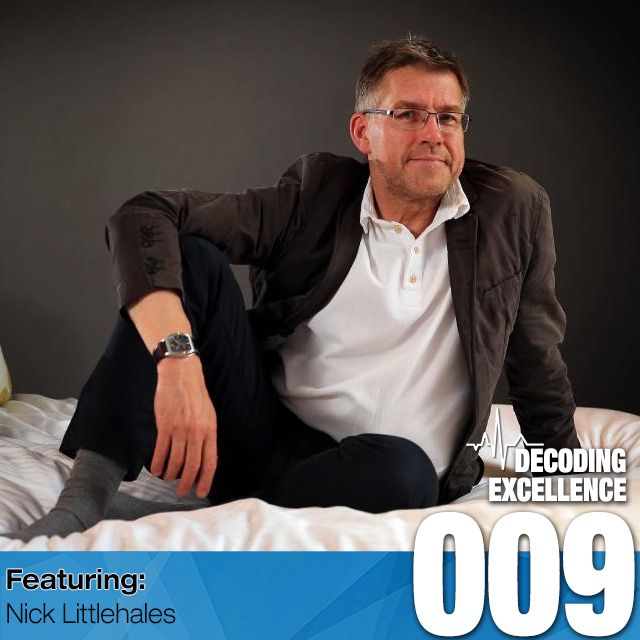
In this episode of the Decoding Excellence show, I am speaking with Sleep Coach and author, Nick Littlehales.
Nick is a leading industry expert with over 30 years experience in the world of sleep, sleeping habits, and product design and over 15 years dedicated to elite athletes and professional sport.
Recently, Nick authored a fantastic book on the importance of sleep and recovery titled: "Sleep: Redefine Your Rest, for Success in Work, Sport and Life".
Having read the book, it's a tremendous and practical guide that all coaches would benefit from reading and applying the simple lessons provided in the text.
Nick's book is available on Amazon.com, Audible, iBookstore, and Google Play.
Nick and I discuss:
- Importance of Sleep in Athletic Performance
- Discussions surrounding his book
- The concept of aggregation marginal gains
- The R90 Sleep Method
- Simple & Real World Sleep/Recovery Tips
- Understanding your Circadian Rhythm
- Identifying your Sleep Chronotype
- How Sleep affects Recovery & Regeneration
You can catch up with Nick on Twitter at @SportSleepCoach or his website at SportSleepCoach.co.uk
This episode of the Decoding Excellence show is brought to you by Vald Performance, the makers of the NordBord, DashBord, and the GroinBar. They can be found at ValdPerformance.com
Stay updated with the podcast by following me on Twitter via @AdamRingler
In addition to those social mediums, you can head over to AdamRingler.com/Newsletter and sign-up for my weekly newsletter. This is a newsletter for the curious. It's chalked full of interesting articles I've read through the week, things I'm exploring and finding fascinating through my week, and a collections of thought experiences and resources I've cultivated.
It's essentially a Birchbox newsletter for performance-related articles, research, and daily musings.
Thanks again for listening to the Decoding Excellence Show! I appreciate all the support growing this Sport Science, Strength & Conditioning, and High-Performance Coaching resource. If you have taken anything away from the show, please login to iTunes and navigate to the Decoding Excellence page and leave us a review.
Key Takeaways
- Littlehales explains why sleep is a performance pillar, not a recovery afterthought, and how it drives recovery and regeneration.
- The conversation introduces his R90 sleep method and the idea of understanding your circadian rhythm and sleep chronotype.
- Littlehales shares simple, real-world sleep and recovery tips coaches can apply immediately with their athletes.
About the Guest
Nick Littlehales is a sleep coach and author of Sleep: Redefine Your Rest, for Success in Work, Sport and Life, with over thirty years in sleep and product design and fifteen years dedicated to elite athletes and professional sport. He and Adam discuss the importance of sleep, marginal gains, the R90 sleep method, circadian rhythm, and chronotypes.
Listen and Subscribe
Find this episode of the Decoding Excellence Show on Apple Podcasts and Spotify, or use the player above.
Go Further in This Episode
Enjoyed this conversation? Here is how to get more from it:
- Read the transcript below to revisit key ideas at your own pace.
- Share this episode with a coach or colleague who would benefit.
- Subscribe to the Decoding Excellence Show on Apple Podcasts, Spotify, or your favorite app.
- Join the newsletter at adamringler.com/newsletter for weekly insights on human performance.
Episode Transcript
This transcript was automatically generated. While we strive for accuracy, some words or phrases may be misheard.
[00:00:00] Every year, every month, every quarter, every season that comes along, any little opportunity for users to put little things in place that were not there before, just keeps aggregating up every year as you keep going through. Every time something changes, the impact will be far less on you.
[00:00:21] Sports Science, Strength and Conditioning, High Performance Coaching, Welcome to the Decoding Excellence Show. Today's episode is brought to you by VOD Performance, the makers of the Nordboard. If you haven't checked out their website yet, I highly suggest you head over there, whether it's return-to-play, injury prevention, or just plain performance testing. VOD Performance has the tools that you need. Check them out at VODPerformance.com.
[00:00:52] Today on the show, I'm joined with Sleep Coach and author Nick Littlehills. Nick is a world-class sleep coach to some of the biggest names in professional sports. Teams include British cycling, team skies, record breaking, cyclists, top premier ship and international football teams and players, rugby union, and rugby league, and last and not least, Olympic and Paralympic athletes. In addition to counseling, many of the world's best athletes, Nick is also the author of Sleep, the myth of eight hours, the power of naps, and the new plan to recharge your body in mind.
[00:01:30] A handbook and applied guide to helping athletes and students and all people sleep better and more restfully. This is a monster of an episode, and one you don't want to miss if you're trying to improve the abilities of your athletes to recover, to regenerate, and recharge between workouts, fixtures, and pouches. We discuss everything from the R90 sleep method. Some of the simple and easy tips that people can immediately improve their sleep if they adopt. And just the importance of sleep in this circadian rhythms and understanding what your sleep chronotype is in determining the
[00:02:10] Best times for you to go to bed. If you have any interest in making your athletes perform better, helping them to achieve greater performance excellence, and allowing them the opportunity to recover more efficiently in between training bouts, this is a show you cannot miss. So without further ado, here is my conversation with Sleepcoach and author Nick Littlehaels.
[00:02:40] Nick, welcome to the show. It's great to be with you. It's great honor to be talking to you and all your listeners, and really look forward to it. Yeah, look, I've been a big fan of yours. I say fan that you've posted via Twitter, and obviously the book that you've wrote, sleep the mid of eight hours, the power of naps, which has been something that I've shared with our coaching staff here. Some of the materials I've shared with our student athletes, but it's just I am humbled to get you online today. So thank you so much for agreeing to come on the decoding
[00:03:17] Excellent show. How are things? Thanks. It's great. We're just trying to react because we've just shifted daylight saving time clocks one hour forward over over the weekend, which always causes a little bit of a disruption in sport and in the general population, because we're now into full on summer, and the daylight's there right into the early late evenings. So all our habits change and everything else. We're just enjoying that at the moment, but I'm very well, but extremely busy. Yeah, I can I can relate certainly on that aspect and having us gone through our own sort of
[00:03:55] Shifting of times of times, just the implications that that can have on performance and when you spring forward and lose an hour asleep, wow, it's designed maybe socioeconomically, but the unintended consequences of that that manifested self in performance and fatigue and readiness. It's crazy. Yes. I think when you when you start to look at sleep, I think we mentioned it a little bit earlier on. It's always been one of these natural performance enhancers, but because we just take it for granted over the years, people have just
[00:04:34] Got away with it. So it's very popular subject at the moment. I think there's a lot of people trying to jump into this window to make some money, particularly on the tech side and things like that, but it's very much what's outlined in that book. It's more of an educational process that's got to start with everybody to open up their minds to what this whole mental and physical recovery period is all about and how to maximise its benefits. But we are literally going back to to school, you know, first class and parenting to try and get a better handle on this. You suddenly
[00:05:10] Can't just jump into it and become a superstar on sleep. No, by all means. And that's essentially the show for today and what we're going to discuss. And I think there's no other person better than you to bring on the show and discuss some of the commonalities between excellent performers that take their sleep serious to some of the simple solutions that people can do to optimise their sleep and their recovery. And you've outlined, you know, a number of different strategies that I know will get into a little bit later in the show from a technical standpoint. But for the audience
[00:05:53] Members that might not follow you on Twitter or might not be exposed to your book, can you give them just a brief update of what you're currently up to and how you found yourself in a position to write otherwise a book and provide these strategies to optimise people's sleep? Well, a little story of how I got here. I think, you know, I've been involved with the industry for a long, long time. It's up to 30 years now and I sort of fell in spirit of trying to be, you know, like a lot of young teenagers become a professional athlete in any sport I could get my hands on. So it all
[00:06:32] Had a relationship with it, but I fell into the world of sleep working for a very big company. I rattle through their ranks to become their international sales marketing director at 32 years of age. And it was involved with the sleep industry. And because it was an international company, I wondered around the world, looking at all the various different sleeping habits and products and environments. I worked on the clinical side with some professors and also founded the UK sleep council and was chairman of that for a while. And my UK office was in older Manchester
[00:07:09] And maybe a little bit of a mid-life crisis sort of point, but I sat there and thought, you know, all this, all the information and experience that I've gathered at the end of the day, it's having very little effect, if at all, on the population as a whole. So one of two things happened, which sparked me off to write to the local football club, which happened to be Manchester United. I mean, the optimum word there is right. Adam, we didn't text or email in those days, you know, late 90s. And I just, I wondered if sport had something going on that I could tap into
[00:07:48] And translate that back into into my world as a sales marketing director. And it started a conversation off with the club. And I think where we sit today with all our data analysis and technology and insights into human performance, that was a very different world back in late 98, sport science and data collection. And how particularly football in the UK, which would have been probably, you know, of a similar nature to maybe NFL or NBA as sport was, had a lot of things that have available to them now, which was not there. So is the open-mindedness of the manager Alex Ferguson
[00:08:37] To maybe what's coming in the future and to have a conversation about sleep and sleeping products. And from that particular point, you know, I decided to leave my job in the as a director move on and do something else. So I was working out a contract, but and this happened during that period of time. So my company just let me get on with this. So I had some dialogue. I worked with one of the players on a product side with lower back issues. So the first sort of sleep coaching I did was about postal care, rather than sleep itself, because they were debilitating through the hours of sleep,
[00:09:17] Not protecting the back. It was making it worse because they got the wrong products and didn't know the correct sleeping positions and things like that. So we did that. That sort of opened up dialogue to maybe look at other things. And so I started to engage with the club and the media being the media sort of found out that I was, you know, their Manchester United's got a sleep coach, because that's how they put it together. You know, somebody's talking to him about sleep and obviously it must be a coach. They wouldn't say a doctor. So the title arrived. I wasn't actually
[00:09:53] Being a sleep coach. I was just talking to players and physios and doctors and and the manager and realising that they knew absolutely nothing in this area. And so that's why they became interested, not because I could improve what they were already doing. They were doing nothing. So it was kind of weird to then start saying, well, come on Nick, will you talk to the players? Will you do things with the players? So I had to start manufacturing what this job was about. And, you know, to shorten the story down a little bit, the players within Manchester United
[00:10:32] You had a very high profile period of time when they won the the trebles. So they won three competitions. The final one beating Bayern Munich in one of the finals in a very dramatic way. So there was a lot of emphasis around the team. And from that particular point, a lot of those players played for the England national squad. So they started to pass on their experiences to the England national squad. That triggered off conversations within that organisation to have conversation with me. That led to other clubs being intrigued about what Manchester United or
[00:11:07] The England squad might be doing in this area. Like we all like a bit of referral, don't we? I wonder what they're doing over there. So maybe we can try it. So it was kind of elite sport in the very case, because it was simply a set of circumstances. It just happened to be an elite football club around the world. Manchester United. You then had the elite nature of English football and the England squad. And then what followed there was Arsenal and Liverpool and Chelsea. We're all sort of tapping in to try and find out what I was up to. And we put the very first
[00:11:41] Recovery room into Manchester United's training ground, which was when they were starting to double up training. Now this was late 1980,000. So this was a long time ago at them. And people talk about sleep pods and recovery rooms and corporates and sports and all sorts of things now. But back then, I was wondering around as if I was crazy. But it was with every there was certain people who really had an insight and probably said there must be something here because it's a hell of a lot of time that we allocate every day and we principally go get upstairs, get yourself some good
[00:12:21] Sleep and we'll see you in the morning and we're going to go again. And that was going on then. I could safely say, it's still going on now Adam. There's in some areas been, there hasn't been that dramatic shift to try and raise awareness and education. And I suppose the one the period of time that maybe started to elevate this area was when I started working with British cycling and Team Sky. And they had a particular strategy to go from A to B to win Tour de France, it's to to win gold medals on track and road, male and female and Paralympic. And they were starting from
[00:13:05] Scratch. So they developed a strategy called the aggregation of marginal gains. That meant for the very first time an organisation would look into not only how you wash your hands but also maybe sleep. Why wouldn't we cover that off if it's an aggregation of marginal gains? So when I got involved with them, I was able to encapsulate my experience from working with individual athletes and teams and my own experience of the industry is to put all that together and to become a proper sleep coach with an actual technique, which is called recovery in 90 minutes
[00:13:43] Cycles. So the R90 technique to identify the seven key areas of sleep, sleep recovery, which I felt that you have to get people to this point before you start doing anything else. So the key seven areas that you're looking to with any individual group get those right and then you can move on to stage two. So I developed that and then the success of British cycling and Team Sky culminated at the London 2012 Olympics. That for the first time had top coaches actually talking on TV about sleep and its effect on these marginal gains and its effect on performance and more
[00:14:26] Sustainable levels of recovery. They had the performance factors to back that up. So I was part of the whole process and that really read on to people like Michael Johnson, your very famous sprinter and also a highly esteemed trainer in human performance. I was involved with programmes with him about what's making the difference, the game changes and it's really strange because we were talking about sleep and for the first time they were actually talking about it in a very positive way, in a very proactive way. And that's been going on over these years up until we had the same impact
[00:15:11] On Rio 2016 with these teams. We're already planning for the Winter Olympics in Korea and we're already planning for Tokyo in 2020. And there's all these complexities that come across and it's really great to be involved in this world. I think the one little thing to sort of end that story is yes there are some significant performance factors and you recorded reading the book, it sort of opened your mind but they are very simple and practical and achievable things aren't they Adam? We're not talking about you have to run out of the book and go and buy yourself a 15,000
[00:15:49] Pound new bike to achieve these things, they're very easily achievable and when the lot of the work that I'm doing now to encapsulate this story is it's highly agenda for two reasons why there are some very serious health and well-being red flags around at this moment in time and it's a consequence of shifting from the mid late 90s where we got away with it to a world that we live in now that's only going to get more intense and more demanding and this is why we're not coping with this now. We're actually being driven with schedules, with performance
[00:16:33] Levels at an early age through mid 20s and we're really starting to see quite a lot of red flags and these are basically things like type 2 diabetes, weight control, you don't have to be fat in the beast, to be worried about weight control, there's lots of people in sport, I'll have to control their weight and it becomes more difficult. There are things like a lot of anxiety, depression even getting across to more suicidal thoughts, you've got almost epidemic is a word that I get I don't use it but other people do with getting addicted to supplements, little pouches that go
[00:17:13] Under your lip called snuzz, to caffeine, off the charts and to things like sleeping tablets, you're not sleeping well so what you do, take some tablets and those things are used to have to be prescribed but quite a lot of them are you don't need prescription, you just get online. So once you've actually accessed a sleeping tablet grog because it was prescribed to you, you then just buy it in quantities online, so there's been a lot of changes and a lot of those dynamics means I'm not actually talking about sleep in the book or in my job I'm talking about mental
[00:17:54] Physical recovery versus mental and physical activity, how do you get a road map for an individual to get from A to B and try and do it in a really defined way because as you point it out, the myth of eight hours, I'll never come across anybody who gets eight hours in one block without any disturbance, 365 days a year. There's so many good things that you talked about in there and I think I'd be remiss if I didn't share that. I am going through the monster of Alex Ferguson's autobiography right now. I found that parallels at least some of what is wrote in it so far
[00:18:35] Is that same sort of approach that when I read Legacy and the sort of the aggregate of marginal gains in the chapters as they're talking as they're dissecting literally every facet of performance and the smallest little marginal gain and how we can improve just 1% of everything to make a much larger sort of aggregate of those gains into something that's substantial and that is I know that's by no means seems maybe revolutionary in what our decade here but to hear that you know instrumental in this with the British cycling and team sky and and this work being done in the
[00:19:23] Late 90s you know like to discuss sleep you know like I think of sort of Overton's window in that you know people probably thought you were a lunatic back then but now you're accepted and realize that this is just as instrumental of a part of sport preparation as your technical tactical skill coaches as your fitness coaches we have regeneration specialists and now obviously with the advent of a you know a leap sport sleep coaches like yourself. Yeah and I think you know when you use the word lunatic you know you're not far off because most it was it was a subject
[00:20:07] That would have never cropped up and it was never thought about and for somebody to actually opening up those conversations at an elite sport level not not down in schools or education but being laughed out of every meeting but there's always somebody who looks at it and says well you know there's a lot of good information I don't know what to do with it at this moment in time or whether it'll benefit me but I'm prepared to come and walk along this route with you so there was certain players like Ryan Giggs who was a very famous Manchester United player and played on
[00:20:42] RAIN to his 40 and so where there was always Alex Ferguson and Ryan Giggs he was the physio at Arsenal football club Gary Lewin and Rob Swire the physio at Manchester United laterally Austin Venger the manager of Arsenal was an open-minded manager to this and wanted to start looking at better things so it's sort of but at that time the clinical world you know all the great universities around the world who've been researching sleep and continually producing evidence of how important it is but had absolutely no impact on us as a population so why would I be able to have an impact
[00:21:24] When when the big year of versus and clinks around the world had not been able to do it they'd never spoken to them they don't even go there because they don't know how to impact on our lives so yeah where it we're sort of enjoying where it is right now but I can tell you what for anybody who gets told by mentors or you know Alex Ferguson's book which is now about leadership and business we get all these little you know how long do you keep doing something without reward before you stop it when's the right time to pack it in are you just doing something at a particular point
[00:22:03] That just simply hasn't matured yet or are you a lunatic trying to make something work that will not work so whether in business or anything or whether you're a young athlete if you're trying to be you saying bolts and you're only three foot tall and you weigh 20 stones you're going to struggle so I change your change your mindset because that's not going to happen so lunatic is pretty good way to describe what I've been doing for the last 18 years up until now talking to you Adam it makes sense yeah well I just think of I draw parallels to our sport culture in sort of
[00:22:43] The early infancy of clinical sport psychologists coming on the scene and the sort of the adverse thoughts of you know what what could this person possibly provide for me I'm a you know I'm an athlete but to actually consider the circumstances of using a tool like psychology to impact sport performance and it's the same way with some of the work that you're doing as far as optimizing athlete's sleep to help performance and I think you know we all go through this evolution of being sort of viewed as an outsider or viewing as you know this is radical to eventually being accepted
[00:23:26] And and part of the normal culture it's a it's a very good point you know because what happens you know writes up until very very recently there's sort of tech wearable app type world that was giving us data about our performance like heart rate and things like that while we're exercising being healthy or just day to day steps we're taking so we've got that information then we translate take some of that data and translate it into how we sleep so suddenly we've never tracked sleep we've never looked at it we don't know anything about it and then suddenly we're getting
[00:24:06] Data coming off our wearables or apps telling us about deep sleep and how long we've slept for and disturbances and all sorts of stuff but that's like you know walking into a school and talking a foreign language yeah it's like what do I do with this information yeah and how do I change what's going on how do I even know do I want 6.25 hours sleep or 7.25 hours sleep and I sort of go well I work with a single handed round the world sailor and that's safer months on their own in a stripped out boat with just a chair to sleep in surrounded by sensors and the sleepwakes cycle
[00:24:44] Approach we take is about 20 to 26 minutes every six hours if they're lucky so how do you know what you're doing with this information and so many organizations have sort of gone you know okay you know possibly you know what's what's the content in the book he's very simple but provocative isn't it Adam and you sort of you go well can't we can't we tech that can't we measure this these results and I said to be honest with you if you just get anybody to just raise their awareness of the circadian rhythms of the day step one that reminds us that we're human beings not tech robots
[00:25:32] We understand their chronotype which is their sleep characteristic and we combine the two together then we think about sleeping in cycles rather than hours because that's perfectly natural to us as human beings it's just the process that we've introduced has changed this without thought and you go along these little steps then you suddenly realise that turning around to a young group of athletes who were probably only just about born in the late 90s if at all and telling them to shut their tech down half an hour before they go to sleep which will affect them which will
[00:26:07] Mean that they will sleep better is absolute rubbish they have to have an understanding of their relationship with blue light how much they're getting and particularly now here in the UK and you a couple of weeks ago when you shift that daylight saving time and suddenly when I'm going home at five or six o'clock at night the sun's out and it's going to be out until the late evening so I need to understand these things yeah in not in a really scientific way but if I don't I crash and burn and I start doing oh I shut my tech down and that'll solve my sleep problem no it won yeah no it
[00:26:42] Won't you know and it's not to take them back to a world that they don't know anything about you know where there was no phones loneliness no that no 24 hours okay that's that world's gone but it wasn't that long ago which is the point it wasn't 100 years ago it was actually some in many cases would just one decade ago where I had nothing compared to what I've got now I'm talking to you on Skype you're you're in the US I'm in notium we're not even being charged for the call and I can actually see you and talk to you now that's like saying how unbelievable is that and I think we
[00:27:24] Just take things so forgotten and I might sound like some old geezer is out of touch but you do have to realize this is like in one decade we've just completely used this wonderful stuff to just recreate a world that we're now going wow and suddenly and a good example I think for all is is stop stop telling the younger generation or coaching the younger generation trying to pick on certain things that might be the cause of it the reason why they find it more difficult to sleep at night is because schedules of the world are sport we have the times the games are played
[00:28:08] The times the games they finished we bring in all the media which adds more hours to the whole game we've got more intensity of how many games are being played we've got more traveling we've got more this and athletes family has got the same dynamics going on in their world so when you look at a profile of an individual as a lead athlete it is completely different to the one that's here but it's the same human being and the story I think it's such a multi-factorial challenge that we have and it can't be isolated to the advent of commercial cell phones or technology for anything
[00:28:51] And I just love I love the fact in your book that it wasn't tech centric right it's it's it's almost wrote to change behaviors not have more technological dependency if you will so when you wrote it and you said simple but what I think or if I were to replace the word you know simple strategies with efficient or you know with concise it changes the narrative a little bit and that's what I loved as I was reading it is that it was practical it was applied it's not just in theory in clinical settings in the hospitals and the research lab and I think one of the reasons if I were to
[00:29:40] Draw maybe some success or at least sort of retrospectively look back is that you had success likely because you applied a sort of translational approach of taking what was being conducted in the labs but actually applying it to humans in the field which is sometimes lost on a clinical side of things it is it's a it's a it's a very good point and I think as you know whenever whenever we sit down and take an exam or we write something or we say something or we act in a particular way whatever it is we we're always a little bit concerned about how others might perceive us or react to us
[00:30:26] So when you're you're sort of writing about you know your story and what you believe in and what you've experienced you know every now and again I just like to make it more clinical more academic more professional because I knew that Adam would be reading it or a doctor or or a leading professor in the university or a leading coach in the NFL or something like that and you sort of think well how will they how will they perceive this if I don't make it a little bit more you know technical clinical step-by-step kind of practice and but I was constantly reminded by the
[00:31:05] People around me in doing it that the reality is is you're talking to these people on a day-to-day basis right now and why why they're working with you is because of that approach so you can't change it you can't elevate it you don't want to tech orientate it that's the way it is so by default anybody else who reads it would naturally respond like all the people you work with anyway that this is the first step you need to take in any organization before you even think about trying to measure it trying to develop what could be achieved if if the level of knowledge and
[00:31:48] Awareness is absolutely zero and and I know you know and it's even happening today it'll happen tomorrow I will be I will be coaching you know a university in the US because of their graduate surgeon program I've been working with the grammar schools because the schools and the education that the hospitals are getting on the air traffic controllers are getting on the pilots are getting on and I tell you what having a conversation with long haul pilots and short haul pilots as a sleep coach and realizing that I had some impressions in my head about what this part of my life I
[00:32:30] Try you know the certain people in our world that we really want to trust and we admire and hopefully they're doing everything they've obviously just going to say surgeons yes as well and that's one of them isn't it surgeons and pilots and it's and I tell you what you know when you look at maybe an 80 hour week for surgeons and doctors nurses you know was was all right in the 90s just about maybe it was tough it was tough but you just about got away with it but you shift that 80 hour week into this world no chance if you take a pilot doing long haul and then you sort of yeah you
[00:33:10] In conversations where if you put another 50% pilots on at work at tomorrow we'd still be struggling and you go wow and that's not even looking forward to when we're going to have more flights and more this and more that and and I think you know in every single area there has even pilots get such little education and so little focus from what I gather they're talking to pilots I haven't studied this at them but talking to pilots talking to me in a consultative way I realize exactly what's going on and so I think there's you know the reason why as you pointed out the the book
[00:33:56] Had to be kept at a level is because I've got doctors buying these books gps practitioners buying these books and handing them out to their patients who are identifying with sleep problems on the increase and so you've got students and young people getting hold of the book and reading it and being inspired by it well if that was a clinical academic tech oriented don't do this do this do don't do that it would have had no impact on anybody so you know it's such an overwhelming experience because I've been in it for such a long time
[00:34:43] And 18 years now is a long time lots of ups and downs it's such an overwhelming experience even to be talking to you in this way about the subject sleep and at a level which is almost we've got to start from scratch you certainly more so than I have the sort of pre-internet technology sort of understanding of what the world was like a little bit more back then and not that you know pre-internet and pre-connectivity global connectivity it was the only challenge that negatively affected sleep by any means during those decades but when I sit down and talk
[00:35:27] With our current student athletes some of which are born 99 some of which are born in the 2000s that grew up with connectivity that grew up on a smartphone or with a screen in front of them and blue light exposure and and have the sort of day-to-day sort of instant gratification of you know social streams and connectivity and the way that that can manifest in it's sort of consciousness of constantly being aware and never discharging or setting the phone aside that uh you know I I would love and I know this might be a little bit of off track but I would love to hear
[00:36:09] In your experience what what were the biggest challenges when you sat down with an organization or an athlete you know in your early part of your career that we maybe don't have so much of uh of a challenge now and maybe to juxtapose that question what's the greatest challenge nowadays that they didn't have in the 90s or 80 late 80s um it's probably a pretty standard answer was to is to how how would how would I be able to have a conversation nevermind present uh to engage an individual or a group into the subject of sleep um how would I be
[00:36:54] Able to redefine so I can have a conversation with them and and you you couldn't make things up because if you make things up then it's still not a part so I just looked at it and I thought um possibly what I should do is I should blame the generation that's above them that they've let them down because they knew that mental and physical recovery was going to be absolutely key they knew that nobody was talking about in the schooling system or it prayer on to children and vice versa so they've just let you wander straight into this world
[00:37:36] And now they're shouting at you because you can't sleep and use this I suppose way back then it was so that's a lot sort of a level way I'm looking at it now but way back then it was just the one thing I in a clinical sense um you can you can track sleep on a polysomniograph in a clinic tracking brainwave patterns and you look at a 90 minute period uh next 90 minute period some would look at 60 minutes but a lot in that profession would use 90 minutes so I just thought okay the length of a football match in the UK in the premiership is 90 minutes long so if I use 90
[00:38:17] Minute cycles so I can start to break down their schedules in 90 minute periods and I can start to think in cycles rather than hours I forget the word sleep because that just describes something in their head that I'll never be able to get rid of I'll think of mental and physical activity and mental and physical recovery drop the word nap and call it a controlled recovery a CRP I'm grabbing a 20 minute CRP to really so I don't waste time sleeping I try to look at it as as if this I wasn't maybe that the ultimate goal for this this human race and in the future
[00:38:57] Would be to use more than 10% of our brains to use technology and advancements to maybe get to the point where we can physically recover which is probably the easy one but mentally recover in a much shorter period of time to embrace the fact that we could live for 70 80 years on this planet have a fantastic sporting healthy lifestyle right up into our late 60s early 70s and all that time we've just been sleeping an hour a day that's all and if we could achieve that it's like stop wasting valuable time to it so all I had to do was give them the confidence that the last
[00:39:42] Thing I was going to do was tell them to sleep for longer periods to get to bed earlier to sleep longer to eat well to exercise well to do this to that because I knew that the conversation with pilots who are working rosters and shifts with nurses and everybody who works shifts and work night shifts they don't do it either day everybody's got certain differences around the world wherever you live with temperatures and cultures and all sorts of stuff you just literally had to take something a little bit better and that was a significant challenge because not only were
[00:40:23] You trying to change the language of this natural everyday process you were doing it with young people who are not so impressionable than the slightly more mature group so they've got no fear they can all sleep on a closed line they actually can boss 24 hours a day they want to achieve they want to go they've got high energy and they're achievers they just want to bust it and smash it and go for it and that's the world they live in so to actually try and get into the world was a major challenge and and it was about the language you're using rather than really finding it for them
[00:41:02] So they started to go wow Nick I'm on a five cycle routine I've actually moved it down to a four cycle routine so I'm saving myself 90 minutes a day and I feel absolutely great next week I'm going to try a three cycle routine I'm just going to book two 90 minute cycles back to back at night so it frees up the whole night I can get more done takes the pressure off the event absolutely love it bang one 90 minute cycle in before I go into training and then when get out I'm just going to put a CRP in about 30 minutes controlled like that rather than fall asleep on the sofa and then
[00:41:33] I'm going to get out there and do even more things and I feel absolutely great things are just really going you know injury times are coming down I'm not wasting valuable time I don't sleep before events anymore because it's a waste of time I do these things and they're just going and it's absolutely brilliant and I'm on it and I really know just how much sleep I need now and and if I don't get as much I don't worry about it I've just stopped worrying about it Nick I just absolutely smash it and so having somebody did they mention sleep well did they mention I'm going to bed tonight
[00:42:08] And I'm going to sleep well tonight no no no no no they sort of like there's so much more mentally in control of this process and when you mentioned earlier about sports psychology I think one of those areas is to change their mindset and we all know that if you look at something scary because the brain is continually processing what's in front of you so if you stare long enough it's something that's quite scary and it's dark and it's sinister and suddenly your heart rate will go up you'll start to perspire you feel fear you feel uncomfortable
[00:42:43] On us if you change that image so a lovely river and the mountains and the sun and the flowers and the views some you become calm you you think of all those lovely things that have happened to you and are going to happen to you and things just don't impact on you in the same way and you feel relaxed you feel chilled non-antuous non-stressed so what you're trying to do is change the visualisation in their heads with what sleep means to them once you get across that then you can really start working with them and that's what you see people really performing at their very highest levels
[00:43:22] In whatever sport they are it's because you've changed the visualisation of what that subject matter is in front of them rather than giving them a piece of equipment or a tool or an intervention that makes them go quicker actually they are now the real person this is what their real personal best is because it's been hidden by fatigue and it's horrible fatigue comes on you in a very slow process so you might think this is your personal best because you're smashing it but actually there's another one the other side of the room which you've lost sight of and this this changing
[00:44:00] Visualisation this change of what this process can do for you suddenly you just I think of you said it you know off-air or thought is that suddenly you wake up in the morning and you start going wow I feel good and then you start going oh I understand this I understand that so there's your performance factor and you do not need to measure that do you because you can see it I think you mentioned about some people within your university it may maybe engage a little bit quicker than maybe others to this particular process but I tell you what the ones who are not grabbing onto
[00:44:36] This as quick as the others soon will because there'll be 20 yards behind the others you said two things that really really resonate and I think it's it's both encapsulated in the writing that you did in your book but more so just because it's you know my first exposure to your spoken word and you said it twice in this both your last response and this response and I just if you're aware of it if you're unaware it's so naturally in tune to it but one of the brilliant things and I say this for the audience of coaches that might be listening to the show is that one
[00:45:13] Of the brilliant things that you've done is you've changed the narrative you changed the conversation from being what it won't be accepted within the demographic that is your audience your pupils if you will the students that you're educating you've changed the the the terminology from sleep from napping from this to hey we're grabbing a quick CRP and I think that's brilliant from a coaching standpoint to a better deliver package the information the education and deliver it to the pupil otherwise and I think that that among two of your responses
[00:46:00] Wow you didn't say it that way I that that stuck out as a huge huge sort of a gem in this conversation it it it is because it's it's like you know you're asking about you know really finding it at the end of the individual but you've also without the rest of the framework the rest of all the you know whether it's teachers and professors within the schooling environment educational environment within an organization within a team within business world within your own the university schedule if everybody's not getting engaged with change then it doesn't have the same level of
[00:46:41] Impact so I need to to talk and be able to communicate this to let's say the coaches so when the coaches are sitting down and going okay we've delivered for the sake of this we've delivered Nick's theories or the R90 technique into the athletes so we know that they're where sleeping in cycles we've got their circadian rhythm information awareness of credit types of understand so when we're looking at the whole season these are all our objectives and goals and one thing we would like to do is is make sure that with any any 24 hour or 48 hour period is that we want to be able
[00:47:21] To release at least five cycles five sleep weight sleep cycles to the athlete because we know that five 90 minute cycles equals 7.5 hours and we know that's a good healthy percentage in any 20 for our period what we also know is they're unlikely to get it all in one block so this is what we plan for 35 cycles in any seven days 365 days of the year right as I can everybody's world it comes down like the next seven days in front of us because we can't control everything so when the coach then looks at the next seven days it's somebody's changed this and the timing of that event's changed
[00:48:01] We've got injuries with certain people all sorts of factors and we're having to mess them around a little bit and like we get ill as well and have flu and viruses and little things like that so we look at the next seven days he looks at the schedule and goes right I can see 35 cycles I can see three back to back 90s on that night balanced with a 30 minute there a 20 minute early evening as long as it's within these natural three sleep periods I can see we're going to under pressure there so they won't make them sleep there but we'll put one in there put them so how many cycles I
[00:48:36] Got this week if I was doing it as a coach and I look at it and I go I can get 30 90 minute cycles most of them back to back but I've also balanced that with maybe you know five 20 or 90 minute ones between midday or early evening the other two natural sleep periods so I'm comfortable with that very comfortable so when I deliver that schedule to the athletes I know that's what they can do and I can show them it's a 35 cycle week guys but it might be a little bit heavy on the control period midday and evening so go out there and it's now down to the athlete whether they
[00:49:12] Want to achieve it and whereas prior to this conversation you just go here's the schedule recover when you're done and so it starts to reage it starts to give the coach it starts to give the doctor the sports science people the manager and everybody to sort of that they're able to really find their approach while it's happening in front of them they don't need to keep coming and asking me what do we do when this happens it's just a dynamic mental and physical recovery process that's in front of them and they don't get panicked about maybe it's a 28 cycle week
[00:49:55] This because it's intense maybe it's going to drop down to here because it's intense maybe we're going to have to look at shifting our training schedules a tiny little bit because you know we've got so many PM chronotypes in an athlete group that we want to be careful because we've got a hell of a lot of daytime names coming up you know now you just wouldn't have that conversation it's in very early stages now but that's the level so it really is suddenly they just become so much more dynamic about the conversation and I can talk for Britain can't I can talk for the world
[00:50:32] Because it's a very passionate subject but I can tell you you could do something within your own organization because I did it at a grammar school recently so I had I had 900 pupils in in a in a big conference hall and they're all about 16 or 17 years of age 15 16 17 years of age and so in the in the steep moved into full adult hall where you'd be looking you know this seven or eight hours type period becoming your norm or less so there was always a danger that a lot of people in that room
[00:51:08] Wouldn't be able to answer this question so I showed them two descriptives of a morning and a nighttime genetic chronotype you like at first you don't like breakfast you want to get up and run around like a nut that you don't you like staying up so just very simple characteristic description until I asked the room and they will have not heard of chronotypes not heard of morning or hours or anything at all anybody identifies with that and I thought it would be a really lightweight but tell you what 30% of the room their arm just shot up
[00:51:43] They were so thought thinking about it or just going oh I'm not quite sure and some people didn't answer 30% of the room just hang where straight up you're a morning chronotype oh yes so they put their hands down I thought what's going to happen now so can I assume the rest of you are nighttime chronotypes or you don't know and the whole of the rest of the room their hand went straight up saying they're a nighttime chronotype and they're the teachers and head teachers and every and staff were all sat in the room at the same time just absolutely their mouths dropped
[00:52:18] Open because they suddenly realised that they this may not be a very very significant thing that's been opened up but the fact that they know now that those pupils over 60% of the pupils in that room clearly identify with that characteristic so if they're sitting in an exam at 9 a.m. In the morning only 30% of the pupils in that exam will be morning chronotypes or up and ready to tack this exam the rest of them are going to take more time and struggle with it because it's not the right time of day if they just shifted it by half an hour or shifted it by an
[00:53:01] Hour or educated all of those pre and chronotypes to get dorm wake simulators into their lives so they get woken up with natural daylight to get the serotonin levels up that they've got daylight lamps in the actual exam room so that helping these pre and chronotypes gets their levels up so they can be as proactive as the morning types and the same applies in the afternoon you've got to help the morning chronotypes because the PM chronotypes are coming to life and suddenly you don't have to change structure and schedules that are really difficult to change but as soon as you become aware of it
[00:53:38] Suddenly everybody's starting to think that the next opportunity we get we're going to do this and the next opportunity we do that we're going to do that and subtly the teachers because it also affects them started to make these little tiny challenges and as a result of it maybe you know how many pupils pass their exams or at what level starts to creep up you know maybe there is less absenteeism at school you know all of these little factors because they become aware of it and these young kids you know starting out in life absolutely loved it because they could see the
[00:54:17] Impact I just had on their peers their teachers and just going wow we could make some changes here can we yeah yeah yeah because it had helped me brilliant now that was nothing to do with sleep Adam it was nothing to do with sleep it was just a wonderful bit of awareness that that you know should have been around tens of decades ago you know to your point what I will say is it takes a body of then professionals to be willing to make the next step to be willing to change and whether it's organizationally or influence or handhold the facilitation of of those things and
[00:55:00] I think that's that's hard sometimes that's scary for for people to change what is otherwise status quo but much needed much needed it is hard but I think that's you know the point you've been emphasizing along the roots is that what in that particular example what they everybody in the room knew is that one of the first things is if they just told every parent to buy a pupil to buy themselves the book for example to read the book to impact it on family life to impact it on their children that will bring everybody in the environment together that will hopefully bring that
[00:55:38] Pupil to the school in a better way and it's all practical stuff they haven't got to go invest in anything the teachers themselves get the book they read it I mean like you've been described they read it they start to make some practical little changes in their own life they start to bring it into the conversation in the school so they don't just talk the same way all the time they're just going right we're going out to do some exercise which is a great tech break you know it's a great tech break we're going out and get is a bit more we're going to increase our blue light get some
[00:56:07] Exercise going to control this what they do is rather than changing the curriculum rather than changing everything they just can be a bit more proactive and it becomes part of the conversation rather than not part of the conversation and so everybody gets engaged without actually having to do anything I think that's uh and that in itself is what is needed and it's uh I found your book to be the both most comprehensive and the most applied sort of aspects of strategies that whether you're a pilot you're a surgeon you're a high performance athlete you can begin to have that
[00:56:53] Conversation a with yourself and then to investigate the various key sleep recovery indicators and then starting to find what works best for you and like you said it's not technologically uh driven necessarily it's it's small behavior changes that uh that anybody could make at a very low cost low sort of expense standpoint to make meaningful meaningful changes on their performance so and the the book sleep the myth of eight hours the power of naps on the new plan to recharge your body and mind on amazon it's uh it's pretty cheap too it's it's you know for what one might
[00:57:38] Spend on a latte or two you can pick something up that will have meaningful impact for ultimately the hopefully the rest of your life if you take it seriously yeah no it never stops I think that's one of the most important things to emphasize to everybody is that you know once they've got that uh awareness level up and realize there's lots of things they're doing which are actually right but they didn't know about it there are ways that they can just make subtle changes they don't have to tell everybody in their world they've got to change their routines to suit them it doesn't
[00:58:08] Work like that but you'll start finding your way through it and and along that route every year every month every quarter every season that comes along any little opportunity for users to put little things in place that were not there before just keeps aggregating up every year as you keep going through every time something changes the impact will be far less on you so it's not a it's not a read that book make that change that fit at all it inspires you just to go looking um for stop worrying about sleep because that is the goal if I can get somebody along that pathway to stop
[00:58:51] Worrying about it and and and take a different approach to it and get more control over it and be more active with it that is the biggest barrier to change is to stop worrying about so lastly uh Nick where and your Twitter social or your social media Twitter handle sports sleep coach where what's the best way the audience can engage with you or find some of your materials or resources or websites what's the best way they could reach you and find out more information about the great work that you do and the book they could listen to a podcast out of them but maybe
[00:59:33] They already are hopefully hopefully prefer it for example I think I think obviously the the easiest thing to do is to simply come into sport sleepcoach.com so sport sleepcoach.com that comes directly into me and my small team and Jess who handles all our content and social media and so if they had any questions if they have any observations like to know anything at all then bang that question in via the website through the contact page or you can just email us a direct ad info at sportsleepcoach.com but the one that I suppose is familiar to a lot of people is simply at sport sleep coach on Twitter
[01:00:15] We have a very broad range of people who we interact with on Twitter we're always posting good free content we're actually in the middle of a of a seven days seven tips to change your life and we're doing that this week so they can come in via there and gather whatever information we've got we can operate on an international basis because a lot of the coaching and consultation services that we've got can be done virtually all over the world as they are and we're expanding you know those services all the time but yeah just encourage people to not be frightened
[01:01:00] To not think that they won't be able to achieve anything you just make that first step get the book if they don't like reading then it's on an audible.com so they can listen to me talking for six hours if that suits you but they can get MP3 they can listen the book and I honestly can tell everybody because this is what you know we're having one of these conversations is when they read the book it doesn't mean to say that's it nearly everybody reads the book becomes inspired to sort of go oh my god I've just got to get into this I've just got to do these things now
[01:01:36] And that's because they really feel inspired to make some changes so that's a good place to start if they get hold of it and wherever your listeners are in the world we're up to 13 countries now so pretty much China, Japan, Korea, Germany, Arabic, Spain, Italian, you name it and the US Germany um it's actually going to be published in the US in early 2018 so available on the high street so yeah those are the places to go. Perfect yeah and I think uh to to put a bow tie on this wow uh certainly a global reach and publications in a variety of different languages and
[01:02:20] Cultures and societies the one commonality between all of us is uh we're human and we all need to sleep and the importance of it despite cultural differences is we also need to find better ways of getting uh uh changing the narrative around sleep and focusing on uh getting better getting better sleep uh essentially at it. My guest today Nick Littlehills thank you so much for coming on the Decoding Excellence Show and and sharing some of your wisdoms and your experiences and I'll make sure I include your your social media and uh the website and your resources in the show notes
[01:02:59] Here uh today but thanks again so much I really really appreciate the great information that you've been willing to share with the uh the audience today. Thank you very much. I really enjoyed it. Hope you got what you want Adam. Thank you and until next time take care. I want to thank my guest today Nick Littlehills for coming on the Decoding Excellence Show. I hope that you the listener happened to take away some actionable information from this show. Things you can immediately start to apply to better improve your sleep education that you can provide to
[01:03:37] Your student athletes for them to perform uh in their evening routines to optimize their recovery, the regeneration, their ability to go from bout to bout training session to training session and deliver an excellent performance and mastery at their performance craft. Voice if you enjoyed any of the information shared the guest uh the materials before during or after please share the show on your favorite social media of choice as always. This show originated around the idea of truly trying to distill, understand and decode what goes
[01:04:16] Into excellent performers. So like always thank you for tuning in to the Decoding Excellence Show and until next time thank you.