#008 Greg Adamson

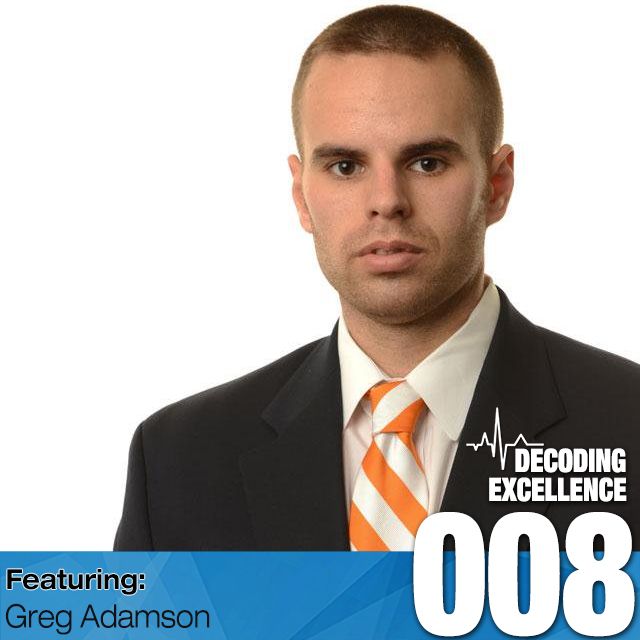
In this episode of the Decoding Excellence show, I am speaking with Assistant Strength & Conditioning Coach for the University of Tennessee, Coach Greg Adamson.
Coach Adamson to Tennessee after serving as the assistant strength and conditioning coach at Winthrop in 2011-12. While at Winthrop, he developed training regimens and programs for women's basketball, baseball, men's & women's Soccer, track and field, men's tennis, and lacrosse. Prior to his time at Winthrop, he served as a graduate assistant for strength and conditioning at Central Michigan for two years, where he worked with four top 25 teams.
Coach Adamson and I discuss:
- His background into S&C
- Coaching progressions & evolutions
- Empowerment & Education
- Battling Entitlement
- The Power of Youth Coaching
- Characteristics of Great Coaches
- Problem Solvers & Enthusiasts
- Favorite Books from 2016
- Utilization of Sports Technology
- Building Sport-Science Buy-in
- His Definition of Excellence
You can catch up with Coach Adamson on Twitter at @UTCoachGreg
This episode of the Decoding Excellence show is brought to you by Vald Performance, the makers of the NordBord, DashBord, and the GroinBar. They can be found at ValdPerformance.com
Stay updated with the podcast by following me on Twitter via @AdamRingler
In addition to those social mediums, you can head over to AdamRingler.com/Newsletter and sign-up for my weekly newsletter. This is a newsletter for the curious. It's chalked full of interesting articles I've read through the week, things I'm exploring and finding fascinating through my week, and a collections of thought experiences and resources I've cultivated.
It's essentially a Birchbox newsletter for performance-related articles, research, and daily musings.
Thanks again for listening to the Decoding Excellence Show! I appreciate all the support growing this Sport Science, Strength & Conditioning, and High-Performance Coaching resource. If you have taken anything away from the show, please login to iTunes and navigate to the Decoding Excellence page and leave us a review.
Key Takeaways
- Adamson shares his path into strength and conditioning and how his coaching progressions have evolved over time.
- The conversation tackles empowerment and education, battling entitlement, and what youth coaching teaches you about the profession.
- Adamson discusses the characteristics of great coaches, the books that shaped him, and how to build buy-in for sport science.
About the Guest
Greg Adamson is an assistant strength and conditioning coach at the University of Tennessee, previously at Winthrop where he developed training programs across multiple sports, and a former graduate assistant at Central Michigan. He and Adam discuss his background, coaching progressions, empowerment, entitlement, and building sport-science buy-in.
Listen and Subscribe
Find this episode of the Decoding Excellence Show on Apple Podcasts and Spotify, or use the player above.
Go Further in This Episode
Enjoyed this conversation? Here is how to get more from it:
- Read the transcript below to revisit key ideas at your own pace.
- Share this episode with a coach or colleague who would benefit.
- Subscribe to the Decoding Excellence Show on Apple Podcasts, Spotify, or your favorite app.
- Join the newsletter at adamringler.com/newsletter for weekly insights on human performance.
Episode Transcript
This transcript was automatically generated. While we strive for accuracy, some words or phrases may be misheard.
[00:00:00] When you think about it, I think about the coaches that make an impact are the ones that actually get to know you, you know. And so, for the longest time I couldn't figure out a way, how do you really describe that, right? And it would have been the ones that I say, love tough. You know, we hear the saying tough love, but I think if you reverse the order of those words, right, love tough. When they truly love you, then they now have built up that trust to be tough on you. Sports Science, Strength and Conditioning, High Performance Coaching.
[00:00:34] Welcome to the Decoding Excellence Show. Today's episode is brought to you by VOD Performance, the makers of the Nordboard. If you haven't checked out their website yet, I highly suggest you head over there, whether it's returned to play, injury prevention, or just plain performance testing. VOD Performance has the tools that you need. Check them out at VODPerformance.com.
[00:01:02] Today on the Decoding Excellence Show, I talk with Coach Greg Adamson from University of Tennessee. Greg has a fascinating story, and we explore his pathway into coaching from a graduate assistant at Central Michigan University to finding a position at Winthrop, to his eventual and current position at University of Tennessee. We discuss everything from education, empowerment of student athletes, and building adaptability. We dive deep into utilization of technologies and wearable devices into current training,
[00:01:38] Both on catapult sports devices and discussing the latest acquisition with Woop, and how they're using that piece of performance technology. We discuss books and some of the favorite books that we both are reading, and some of the best books that we read during 2016. This is a wide-ranging conversation. You do not want to miss this episode.
[00:02:00] I thoroughly enjoyed my time with Coach Greg Adamson, and you will be a better coach from listening to this. Without further ado, here is my conversation with Coach Greg Adamson. Coach, welcome to the show. Appreciate it. Thanks for having me. Hey man, I am certainly excited to have you on your materials.
[00:02:25] I know we've gone back and forth on social media and Twitter for what is damn near feels like a year, kind of just sharing and retweeting, and so it's been finally great to connect with you and get you on the Decoding Excellence Show. How are things with you? Things are going really well. Busy over here on Rocky Top. There's no question about that. We got a lot of projects going on and most importantly, we've got some amazing student athletes. We get to work with every day.
[00:02:50] I've been looking forward to having this interview and just sharing a conversation with you that I know we're going to discuss a lot of great topics throughout the day today. But more importantly, I'd love to explore your journey into coaching and just provide the listening audience with a background about how you currently got your role and maybe the steps along your coaching pathway that led you to where you're at today. Yeah, no doubt. Initially was an in turn and coached high school when I was an undergrad at Winthrop University.
[00:03:24] Coach at Rock Hill High School. That was my first couple different sports I ran. I ran baseball there, worked with football. You know, it was an awesome time. And then went on to get a central Michigan. Had a blast spent two years up there. I got married. My wife moved from South Carolina to central Michigan and said no go.
[00:03:46] Went back to Charlotte. She's a registered dietitian. It was a fitness consultant for a company and I want to get back to college coaching and actually turn out a job at another place so we could be together. Was coaching first grade basketball and in turning again. And then luckily, you know, one of my good friends was the assistant at Winthrop where I'd gone to school. Got the head job at NKU.
[00:04:07] And it was just a quick fit. I think I was in that role within about 48 hours. So no need to have two weeks or anything like that. Spend a couple years there. Enjoyed my time. Love the area. Obviously went school there.
[00:04:21] My wife went there. I got the chance to come to Tennessee initially with football. From my old director from Central Michigan in January of 2013. I started at the University of Tennessee. Since I've been here, my role has been kind of all over the placement. I've been playing six men for a while.
[00:04:36] I guess you could say, fill in utility. Any which way you look at it, work with football. Been fortunate enough to work with soccer, swim and women's growing, overseeing GPS for a season for football, overseeing it for soccer. We've done different things over here. We've been initiative that we do with our student athletes. So different aspects have been really involved with.
[00:04:58] So it's kind of been my journey. I got into it all of it because I had three major knee surgeries in high school. I don't know if I was looking back at it. I look at all this push for high school strength and conditioning. What I wish it was how cool it must be to go to high school now and have a strength coach and have somebody that's got a background and a passion to want to help you on your way. I remember we would all just do.
[00:05:25] So it was going to sign. I remember I think the big one for us was Ole Miss. He's going to Ole Miss. Let's all do the summer program. No such thing though as a movement efficiency. We didn't talk about movement, quality.
[00:05:38] I look back at it now and go the way the body works. I love this side, the performance side and not a good athlete. I would tell you that just a hard worker. It's just a good fit. I think the fact that I've had to work really hard to learn the different things and different movements and techniques is maybe a better coach. I think you got a cool trajectory and pathway from just moving and having that sort of graduate assistant experience at CMU
[00:06:07] And then kind of serendipitously falling into interning and becoming an assistant at Winthrop and then moving on to Tennessee. I'd love to kind of explore a little bit. I know this is going to be kind of a wide-ranging conversation. But I'd love to maybe explore a little bit deeper when you made that first transition from going from CMU and back to Winthrop. What were you thinking from now you're no longer an intern, you're no longer a graduate assistant, you're interning there and accepting that first job, that first responsibilities of actually, the training wheels are coming off.
[00:06:51] You're now an assistant, this isn't just an internship. What were you thinking, what were you feeling, what was that conversation that you're having with yourself during that time? It's funny, at that time, I really wanted to just kind of push kids physically and psychologically. That's all I felt back to. And I was very raw. My gift was being able to teach.
[00:07:20] And so it hit you quick though. I think luckily the assistant, a very good friend of mine, he's the head strength coach in Northern Kentucky University of Bryan Blues. He was a great mentor, shared everything. He did something that you don't always see. Left me everything he had done for a couple of years. And it's something that I then did for who followed me.
[00:07:46] I wanted to repeat that path just because you want to do right by the kids, right? And to do right you need to know what has been done oftentimes. So you want that person to succeed behind you if you truly cared about the well-being of the kids. If you remove that pride. So I think that was huge. But yeah, it was definitely that first year was definitely a lot of learning, a lot of experiences.
[00:08:12] It's full circle. The best way I can explain it, we have a girl that came here as a graduate transfer on women's basketball. I don't work with women's basketball here at Winter, but I did. And I had her as a freshman. You know, five years later, she's here as a graduate transfer. And I, you know, I, she comes here and I love her to death.
[00:08:30] And she's worked with all these strength coaches. And I was with a different coach. And they asked her them to describe me. She goes passionate, crazy, and tough, you know. And I was like, yeah, I guess, you know, and it was just when I trained her five years ago. You know, I started thinking back five, six years.
[00:08:46] I'm like, what was I doing? You know, like, I mean, I was just making them work, you know. And so I think that's where it's really, you really start to progress when you aren't assistant. And you have to answer to the head coaches. I think your progression and your ownership of what you're prescribing for these kids really starts to take a hold. And it's, you know, I think too.
[00:09:15] It's definitely one of those things. For that year in between, I turned out a job to go be with my wife. She moved up to Central Michigan for me. So I guess I can move, you know, move back to Charlotte. I say that's her castically. Charlotte's a lot nicer in my pleasant Michigan.
[00:09:30] But in that, that, that down year, I love the coach. You know, I could get out of coaching tomorrow. I could get fired tomorrow and I'm coaching, right? And so a buddy of mine, a professional runner, I trained, we were coaching a first grade, second grade basketball league. And this is the team that nobody wanted to didn't have a parent step up. You know, so we're coaching this a church league basketball, right?
[00:09:51] And you just never know. One of the dads was good friends with Joe Kent. You know, and that was just another bridge. And so, you know, I think to young coaches, sometimes you think, and so that led to a relationship with Joe, you know, coach Kennedy is one of those things. Sometimes kids don't realize, you know, younger interns and GA's and stuff that when you're coaching,
[00:10:11] Good things are going to happen. You know, it doesn't matter the level. If you love it, you're going to do it. And I still resort back to that basketball team. I mean, I tell people all the time, that's probably my best coaching job date. We went from losing five straight to winning six straight, you know?
[00:10:26] Change the culture of a seven year old. That's a, that's a battle in itself, right? And so, I think that that's one thing that if I can, if I'm passionate about, it's, it doesn't matter where you're at. It matters whether or not you freaking love the coach, teach, and just love on these kids.
[00:10:45] Love tough is what I said. To bridge on top of that, because I think there's a couple, a couple anecdotes in there that really resonate for me. But if you were to kind of explore a little bit deeper, how did you become interested in that empowerment and that teaching? I mean, was it a parent?
[00:11:05] Was it the way that you were raised? Was it a coach, a mentor, someone in your life that got you passionate in sharing that love of teaching and education with other athletes? I'd love for you to explore that for a little bit. Yeah, no doubt. You know, I think my dad was a huge influence on me growing up.
[00:11:24] It's funny. I've got my son's three and a half. I've got two kids, three and a half, and my daughter's one. And my mom was saying, I never had anything but the sports page. You know, so I grew up just loving sports. And, you know, my dad coached me when I was young.
[00:11:37] And I remember, you know, he'd bring candy bars to everybody else while I'm having to run laps for something. You know. And so I think there was that love right there. I think at one point in my growing up, we moved all around the country.
[00:11:51] So at one point, I did five schools in five years. And so good, battering, different. I saw some good youth coaching and some bad youth coaching. You know, and so I knew there was a desire in me to want to kind of change that a little bit. And so when I went to Winthrop, it's a teaching school.
[00:12:08] It's a school based around just education. And so there was a professor there, Dr. Wilson. She did an unbelievable job. And, you know, initially I was doing the Fizz Ed track. And I took her coaching class. It was a grad class.
[00:12:22] It was a good as a sophomore. She let me in it. And it just, it absolutely opened my eyes to, man, like as a coach, you should have a mission statement. As a coach, you should lessen plan. You know, these are things that I necessarily hadn't seen.
[00:12:37] And so I think there's just that innate desire in me to want to believe in kids, you know. Because it wasn't necessarily all there for myself, you know. And I think it's funny. You know, I don't block. I'm working on my first blog ever.
[00:12:54] I've been working on it for eight months. It's in my head. I just got to write it. About, you know, three fifths of the way done. But one of the points I want to talk about is everybody talks about these kids being entitled.
[00:13:05] And it's entitled kids. And I think sometimes you can see entitled coaches, you know. Whether, and I have a hard time sometimes. I'm like, hey, John Wooden, the best coach in my opinion of all time passed away in a little time home, right? The best to ever do it was humble.
[00:13:22] I mean, but he was tough. But it was one of those things. He just loved what he did, you know. And nowadays it's so blown out. You know, it's so big. And it's so different.
[00:13:33] And so, and it took him so long to perfect his craft. But I just think sometimes it's funny. Like you can look at it. Not never being young. You see what some of these directors make. It's only schools.
[00:13:43] You see the salaries. You see the contracts. And if that's what you're in it for, you're going to be really let down at some point, you know. Because, you know, if you start with the end in mind, and that's kind of Dr. Wilson,
[00:13:54] She kind of really drilled that into that class that hit me, you know. You're going to pass away one day. There's going to be athletes at your funeral. And the question is, is, you know, are they happy, you're gone? Or are they saying they're talking about how you've impacted them? You know, and Billy Graham talks about a coach will impact, you know,
[00:14:14] An athlete more than anybody else could ever do it, you know. And so I think there's just kind of that relationship, you know. And I had had some good coaches and I had some coaches, like I said, that maybe could have been a little bit better in some areas, you know, growing up. So I was kind of hit. And so, and then what you, and every coach knows this.
[00:14:33] But when you see a kid get it, you see them become better. And they invite you to their wedding. You're in their wedding. You're in their wedding and you're just taking a step back and you're sitting there. And you see that next process of their life. There's nothing cool, you know.
[00:14:49] There's no better feeling. And so I think that, you know, that's just kind of where it's at, you know. And like I said, I get out of here tomorrow. I'm going to go coach middle school or something. Yeah. Yeah. I think, you know, on top of that, you talked about entitlement.
[00:15:07] And I think you see it. And it's, I think it's pervasive certainly in not only our own strength conditioning industry, but just, you know, societal sort of swings that, you know, people are getting into whatever profession, whatever pursuit that they're doing for the wrong reasons. And I think if you are truly passionate about leaving an impact and being a positive mentor and role model for what is otherwise the youth population that we serve,
[00:15:37] Then, you know, you're approaching it from the right reasons like, you know, Coach Wooden and having that sort of modest and humble and removing that ego aspect of coaching and doing it for the right reasons. I'd love to, when you said that you were, you moved a lot in your youth and you were five schools, you know, and traveling quite a bit. You talked about having different coaches and some that shaped you positively and maybe some,
[00:16:06] Now that you look back upon your coaching sort of legacy and years in it. And you said, well, you know, maybe there were some coaches that did some things poorly or did some things wrong. If you could juxtapose those two against each other, what are the qualities that the good coaches possess that did that was different from maybe what the, you know, the poorer coaches did? I mean, was there specific, you know, memories or anything that resonates? Was it the way, the demeanor, the attitudes, the structure?
[00:16:37] I'd love for you to look at that a little bit and maybe try to come to some conclusions. Yeah, man, great question, yeah. You know, I think when you think about it, I think about the coaches that make an impact are the ones that actually get to know you, you know. And so I, for the longest time, I couldn't figure out a way. How do you really describe that, right?
[00:17:01] And it would have been the ones that I say love tough. You know, we hear the saying tough love, but I think if you reverse the order of those words, right? Love tough. When they truly love you, then they now built up that trust to be tough on you, you know. And so nothing, too, is I'm not big on, you know, I think at a young age, you need to be careful with your belittlement of athletes.
[00:17:24] You know, and that's one of those things that you see it, you know. And I'm just one of those people. I don't like to tolerate that. I don't like to see it. And so I think, you know, how are you trying to, you know, motivate? You know, what's the conversation about?
[00:17:41] And so I think, you know, sometimes it's, it's really easy to fall back on fear. You know, because it's just, you can resort to it. And it works, but it only works for so long. And we know that. And so I think that's one of those things that, that's the challenge of it all. You know, it's how do you, how do you tap into that intrinsic motivation?
[00:18:05] And so those coaches that make you think, okay, man, how can I be better? I didn't know I could do that. You know, you know, and even now, it's funny. There's a guy out there named Frank Oakisi, you know, he's a training partner in mind. And he's from Kenya. He's serving the militia.
[00:18:21] They're played soccer. It went throughout where real close friends. And we're training to run this awesome marathon. You know, and I'm a terrible runner. I got bad knees, right? And I just want to do something.
[00:18:30] You know, you try and do different things. Just push yourself. And even now, like, man, he just, he gets to be believing I can get a run in or I can get this done, you know? And so, but it's because he knows and believes in what I'm capable of, you know? And so I think sometimes that line is something you got to walk, you know? And I think you got to watch your language, your demeanor, all these things that we know.
[00:18:54] But I think you have kids, right? Yeah, yeah. I got a four-year-old daughter who is foregoing on 13 and a one-year-old son. So our kids are about the same age and, you know, our top, you know, our three is in force. You know, they show us so much. And one of the things is is when they're frustrated, they immediately resort to, you know, Kayla, my son, just for a resort to either snapping back or going into a shell, right?
[00:19:25] And so I think that's, you know, attitude reflects leadership, right? So there's that, you know, I remember we all watched Remember Tides back in the day, but that has to reflect leadership. And you know, I think that's the thing. And that's our challenge is, can we change that mindset, right? When we can't do a problem, we can't fix it. Like, how do we go about that?
[00:19:46] And it's funny. I just actually accidentally said the word can. I've tried to outlaw that for myself and my family. And you know, I posted a thing on Facebook the other night of my son, he said he couldn't, you know, he's like, I can't turn the light off. You know, I'm like, buddy, you can. Just problem solved. How do you go about it? You know, let's not use that word.
[00:20:03] And so I think that's the other thing too is just when coaches fall back on just to immediately screaming and yelling, I wonder how much they really invested in their lesson plan of the day, right? Did they draw out what they wanted to? What was the objective? You know, because that's going to tell you a lot about how much they're really invested, you know? And so that's one of those things that you got to account for those type of things and those type of conversations. But what we can't do, I gotta keep saying it, what we shouldn't do, right, is fall back to that. And so I hope that kind of answers that I know went a little bit off on a tangent.
[00:20:43] Look, this whole show isn't it is sort of like a public sort of exploration of our coaching pathways. So there's no wrong path. And I think, you know, when you, when you talked about like attitudes reflect leadership and the ability of learning to navigate, do I go in a show or do I confront the issue? For me, it very much sort of parallels, like Carol Duex work in mindset and learned helplessness. Like what are we teaching? How are we impacting our our student athletes to either embrace a challenge, whether it's a light switch, whether it's a spring or whether it's a defensive stop in whatever sport, whatever vehicle that we're using to drive this sort of behavior change? It's really ultimately comes down to the mindset. And again, you know, the attitudes reflect the leadership. And if as we as mentors, we should be demonstrating and reflecting the characteristics and the behaviors that we want to see in the student athletes that we work with.
[00:21:49] So I love that the piece about not just tough love, but love tough, because I do think that so much of it is is built upon the relationship and the sort of the permission that an athlete gives you to push them to challenge them, to motivate them, to encourage them. And I think that is built on relationships. And I'd love to sort of dive into the positive relationships that you've had. And maybe some of the lessons you've learned and the pitfalls that you have learned to avoid as you've navigated from CMU to Winthrop to now Tennessee. Are there if you were to look back as far as like positive mentors in your life, whether it's a father, a mother, a coach, you know, someone completely outside of sport. The more conversations I've had, the more I've learned that, you know, great mentors can be academics. It can be people completely unrelated to sport. Are there any sort of particular people in your life that really resonate that shaped your pathway into coaching, education, empowerment, adaptability that you continue to spread that message that's led you to where you're at today?
[00:23:04] So many, you know, you know, I think it's one of the things I approach every relationship with. I'm going to learn something, you know, from whoever I'm in a, you know, a friendship with or mentor, etc. You know, it's on my father, but out of professor as well, Dr. Montgomery said CMU now he was a former coach that is in the sport administration program. He was a great mentor for me, definitely challenged my thought process. Some great people up there, some coaches, you know, it's funny. So I'm agonist was the women's soccer coach. We became very close and he's not Mississippi state. Just got hired there, so it'll be fun playing against him because I know what he's about, but he was a good mentor. You know, and then from there on out just so many coaches, Marlene Stallings, women's basketball coach of Minnesota, a dear mentor and friend, and, you know, and it's just funny you look at it and you grow and hear, you know, right now we hired rock, our director, and he's been phenomenal. He's done an unbelievable job, our associate like certian's a great mentor of mine to me, our swim coach Matt credit.
[00:24:13] Matt credit is in my opinion, one of the best minds in coaching hands down the matter of the sport, you know, and Brian Penscare women's soccer coach. I mean, there's just so many people that kind of form you ladies, you grow, you know, you mentioned the book mindset, you know, I love that that gross based mindset. But you're always learning, I think the biggest thing is though, is I love to be around people that don't see obstacles, you know, they don't talk about problems. They talk about solutions and doing things that haven't been done, you know, those are, those are the people that are going to be enthusiastic, right? Because you got to have a little bit of enthusiasm, you know, to be crazy, you know, trying to accomplish things and see things differently and challenge the status quo. And so I love being around those type of people.
[00:25:08] And so, you know, I think that's just kind of where we're at from that, you know, I love being around people that love to read. If I have a conversation with you and you don't reference a book, start to wonder, you know, I got leaders or readers, I know it seems simple to say it like that, but it's the absolutely truth. And so, there's a lot to be said about reading and just enjoying wisdom that's already been laid out. And so, it's kind of what we're at right now, you know, the field. Is that what's in it, Kansas now, close friend and unbelievable mentor mine, really somebody I trust tremendously. The guy's heart is in the right reasons, you know, there was, I was so ecstatic for him when he was in our medias, other myths, just for our profession, because it's funny.
[00:26:00] I had the conversation with some administrators at a different school that I know and they were just talking about what is, you know, what does his strength coach know about running athletic department? You know, and my response was, well, is it any different than somebody has a background in marketing compliance or fundraising? Unlike, he's worked with multiple teams, he's worked with student athlete, he's proven to put, he's going to put them first. He's balanced the budget, you know, he's made thought out deliberate decisions. You know, and so, I think that was huge for our profession is as the athletics, as they see is they don't just see us as, oh, hey, that's just a meathead guy or whatever that might entitle, right? You know, and sometimes it's their own inferiority that they want to throw that down, you know, they don't necessarily want to work on themselves.
[00:26:50] And that's where it could be. So, I mean, I think that as well has been big. You know, there's a high school coaches, Evan Bryant is a coach in Georgia, he's close friends and mentor of mine. And so, man, the list could go on forever. Man, I, you know, there's a couple of things in there that I think is important to recognize. And that's obviously, I love the fact about just the requirement to continue to advance and think outside the box and to challenge mediaocracy and the status quo. And I think that's necessary and not only our field, but every field.
[00:27:28] If you, if you want to be an innovator and you want to leave a legacy and you want to do things greater than they've ever been done before, then it's required to really challenge yourself and stretch yourself and stretch your organization to think big. And not just marginal gains, not just a small percentage of gains, but to 10X your own organization the way that you're doing things. And the fact that we can capture so much wisdom in, you know, two, three hundred pages of a book. It blows my mind when I talk to people that don't read because of the time commitment to sit down. I mean, with the technology of audiobooks and e-readers and physical book. I mean, it's, you know, people will spend their entire life in, you know, economics.
[00:28:17] And then at the end, write their memoir and write down everything they've learned in their 60, 80s, 90-year life in a book that you can then amass their knowledge in a weekend. It blows my mind that, you know, like, that's the best vehicle I think sometimes to learn how interconnected all of our disciplines are. And since you set the scene for that, I'd love, and not necessarily, I don't need to know the one book or whatever. But what are, what are some of the, some books that you have found instrumental in your coaching career or, you know, whether it's communication or actual training X's and O's or business management or leadership development or even, even as far as saying, you know, I've coached on the floor from six to six. I just want to go home. I want to read something that gets my mind out of it, but challenges your thinking in sort of a fiction standpoint.
[00:29:13] I'd love to, I'd love to dive into what you love to read and what's really resonated with you. Yeah, no, I love that. You know, it's funny. I love anything by John Wooden or about, I mean, anything about John Wooden. Any biography I have, I think probably eight books that got wooden somehow on the cover, right. Big fan, you know, ego is the enemy by Ryan Haude. Love that book. Love the concept. You know, I think that's funny. There's two books that he's written off school is the way he goes the enemy and, you know, I'm hooked on both just the thought processes and the way he lays it out and studies people throughout time. I'm a big fan. I read a while at heart by John Elder to big fan of that. Just what it means to be a man and what it means to be a father husband.
[00:30:07] You know, and it's from a training perspective, you know, I'm always reading something, you know, and I think it's, you know, it's funny. I look at it out, you know, right now I just finished sport analytics, but, you know, I enjoy just different people putting stuff out there. You know, like Caldice, which I basically training so many of us fall back to it. I love, you know, Berngame better. I didn't mention him before, but he's a huge mentor of mine. Someone that I've become very close with and anything he puts out, love to read, love to think about it, love his love is want to challenge the status quo. I think he does a great job of that. Love his common sense. You know, and so I read a book that might seem simple recently read soccer anatomy. Pretty fun. You know, just kind of thought like, I don't know if it's out there, but for each sport, there should be a book just anatomy, right.
[00:31:07] Recently read books when fast. And so I mean, I'm always read, you know, and I guess what I'm reading at that time is probably what I'm going to resort to to talk about. And I think that's the importance of consistently evolving our mind, but the books that I come back to, you know, and then I love the Bible, of course. Whether or not you're Christian, I mean, it's still a lot of a lot you could take from diving into that and just leadership and from a standpoint of things and society, you know, and how things haven't really changed over, you know, ever so many years. You know, John Gordon, easy reads great stuff to recommend to kids. You know, that's one thing, too, is I, you know, I really challenged my kids to read. You know, I mean, my personal kids, but the kids I'm blessed to coach, you know, and really trying to get them to think, you know, because if they read a book that you recommend and they start reading it, I know you got them right. And today's world is going to take the time to read. Now they're really thinking, you know, and so it's pretty cool, you know, and so that's kind of where we're at.
[00:32:12] You know, I would recommend every coach out there, ego is the enemy. You know, I love all the books, you know, from good to great, you know, and those are all awesome as well, tipping point. I mean, just we could all go on and on, right? You know, getting ready to dig into extreme ownership, I've listened to it. Now I'm going to try and read it, you know, and I think, you know, I'll listen to a lot of books on Audible, big Audible fan. And then if we want to go the other route, right, if you just want to read for fun. Vince Flynn, Miss Rat, best series, I think out there. Miss Rat is just the CIA spy. You know, Vince Flynn and the author actually passed away. They have a new author doing the series, but it's the best selling series and the audio books are amazing.
[00:32:59] You know, so if I'm just trying to just kind of listen, and what I love about it is, yeah, you know, although it's, you know, not necessarily 100% true. Even though the author got in trouble at one point for being too close to what goes on. What I love is just the outside of the box thinking, right? On the spot, how do we think through this? How do we do it a little differently? So there's something to take from everything, you know? And so I hope that answers that question. No, yeah, it does.
[00:33:29] You know, and to go along with that, I think you mentioned obviously and let off with wooden and it reminded me of practice perfect. By Doug Lemov, who's an educator, he had a teach like a champion was another book, both excellent materials, especially when so much of our professions about pedagogy and structure of design of what we do. And you know, borrowing from the educational system and to be educators essentially of strengthen conditioning and how to move and how to how to learn these behaviors are tremendous. I completely agree with you with Ryan Holliday. I think those, both those books are sorely needed in our profession, which seems rampant with ego, egocentric sort of philosophies and principles. So I think that's great. You know, you talked about, you know, early in this, in this show about crafting your own personal coaching philosophy.
[00:34:30] And a book that was so instrumental and I try to reread is Pete Carroll's win forever. That's next one. Yeah. I mean, that for me, that sort of changed my narrative that I had as far as coaching for the right reasons. I remember reading that in grad school long ago and really sitting down and saying, why do I coach? And what do I want out of coaching? And I think is super necessary for us in our craft.
[00:35:02] And then, you know, like I've been trying to read a little bit more fiction, but I would say my best read perhaps of 2017 if it isn't Ryan's daily stoic, which is sort of like a replacement for the Bible as it's crafting from different stoics. And meditation and as far as like meditations from Marcus Aurelius and just some lifelong lessons that applies in a lot of different situations. The best sort of nonfiction, the gene so much because of our involvement in trying to optimize and help shape athletes to their genetic potential. Having a, it's the gene intimate history. I'm going to butcher the author's name. I think it's like Siddhartha not even going to try Amazon dot com. Check it out. But he also, he also wrote a, yeah, it is, it is thick.
[00:36:06] Man, it is thick. 592 pages. It's also available and audible. But it dives deep into the exploration of how we discovered the gene and Darwinism and evolution and the whole process, the scientific experiments with the pea pods. It's, it's a tremendous read if you are interested in the historical sort of evolution of our understanding of science and the genetic code. Really fascinating read and one that I recommend. Probably my best book of actually of 2016. Now that I've nerded out a little bit about books and reading. Adam Smotherman, he's assistant coach at Clemson, he's a rock star of a coach, right?
[00:36:54] And he's the one that told me to win the, to read win forever by Pete Carroll. And one of my life philosophies is if two people I respect say the same book, I got to read it. I just always go with that. If two people say you're the second person. So now it's like I'm kicking myself that I haven't read it yet, right? And that's hard. I mean, like there's so many, there's people that we respect and everybody has their own flair of what resonates to them and, you know, books that call out to them. Some books resonate more, you know, there's been books. I'm trying to think of some popular books that people love and that I read it. And I'm like, oh man, you know, it's, it didn't really call to me. But then you pick it up three, four, five years later and it hits you, right?
[00:37:37] It's the idea of like being at the right place at the right time. And there's books. I mean, like you referenced the Bible. I mean, you can read things over and over and different passages, different chapters, different books will hit you at a different place in life. You know, like you talked about being so training heavy earlier in your career and now being on the edge or other side of it and the importance of empowerment and education and student athletes. Not to say that training isn't important, but just there's differences and progressions that we go through within our professional career that I think is important, just like a good book or just like a good passage. I'd like to, I'd like to maybe change kind of where the conversation's going. So we know that you can sell out rockstar arenas and you can play the hits. And that's the, the show is obviously, you know, it's not technically driven. It's not, you know, as far as what we do, the X's and the O's.
[00:38:39] And let's talk about velocity based training and XXX and of different sort of things. But so we spent the first perhaps half of the show, sort of understanding who you are and getting a glimpse behind the curtain that is you. I'd like to, I'd like to talk about present day, modern day coaching and what you're currently up to at Tennessee, as far as what you're teaching and how perhaps you're teaching your athletes about education and empowerment, this adaptability in your student athletes. I browse, I use you as a resource so much on social media and Twitter and I see the pictures of your athletes training and not only is the methodology rock solid and I know you have a scientific approach and we can talk about technology here down the road. I just would like for you to talk maybe a little bit about the intangibles of the relationships, the the empowerment and maybe like the how of what you do with your student athletes that's that's led you to this position and this kind of thought process of this larger scope, this larger importance of the vehicle of strength conditioning and what we're teaching our athletes. Yeah, no doubt, you know, it's fun, man, it's one of those things. I got a couple different philosophies, you could say that have kind of evolved over time, you know, when you talk about Twitter, I'm only on Twitter, I'm not on Instagram and Facebook is more for, you know, family, right. And so I figured I got to do one for my social media and do it correctly, do it right, really reach the kids. Snapchat scares me, right, I'm not about to involve in that and then I've only got so much time.
[00:40:21] And so I sold out on Twitter, and I tell people all the time the second my kids quit commenting and favorating and retweeting, I'm out, right. The second they stop paying attention, I'm out. But I have a five to one. I don't put anything on Twitter unless I have hit five personal texts to an athlete. And so it's funny, like some days you'll see me just not put anything out and stuff and partially it's because I'm busy, but I want to make sure I'm building that individual relationship before I worry about, you know, what the outside world seats, right. You know, and so I think that's a big part. You know, I think one of the best things I ever started was 90 seconds away. I realized I was watching TV one night on my wife and sitting there and I'm just like, these kids have grown up their whole life, only known commercials, right. They don't know VHS, they don't know rewind, they know Hulu. And most of them only know maybe a commercial to start a Hulu, right. And so their attention span and we all know this and we read about it. So once a week, I like to take a topic and it could be anything, right. Like why do we squat, why do we hand clean to conditioning to something physically to an agility drill could be specific.
[00:41:39] You know, one time we did Batman versus Superman, you know, but 90 seconds, so why we do what we do and why we believe it, right. And that's the best thing I've ever done because I think this generation, they have education everywhere. And you know, at one point I want to go back and do my PhD and so I took a class here and what two kids, it's not happening right now, right. It's going to happen. But I'm sitting in class and it's different when you, when you go back to class and you're in your 30s as opposed to when you're 22, 23, 24. And I'm sitting there and I'm having a hard time with the professor because she's just regurgitating PowerPoints, PowerPoints that have probably been supplied her by the book, you know, and business inside her own article, PowerPoints should be outlawed at universities. And then we had this guest speaker coming. He did everything on the whiteboard. And I'm like, that's it. I got to get out for 90 seconds in front of my kids and put it on the whiteboard. And then if I don't know what they ask, I got to say, I don't know and own it, right. And so that's kind of where I think a lot of the relationship and trust come from is they know I'm going to be honest with them and they know I'm going to care about them. And so when you care about somebody you're honest with them. And so that's, that's the biggest thing, man. I think it's fun. I love to see them get excited about it. I love to see them getting favorite and retweet. You know, it's funny our swim group. We have a group going to NCA's women go next week, men will go the week after.
[00:43:03] Kids that don't go. We called them our 2018 group, right. You know, they're going to go next year rather than the kids that didn't go. You know, that's kind of disrespectful. And so, you know, we've been getting out at 6 a.m. I'm going to do some different things fish out of water so to speak, right. Doing some different type of training because it's the time of the year where we can have a little bit of fun. And so, I mean, it's been pretty tough on last Friday. We actually ran out at a football stadium. We ran a big gate. You know, it's gate 10. It's a huge hill. And it's pretty cool. But so it's on this Friday. You know, be ready. You don't know where we're going. Make sure you got running shoes. Make sure you dress warm. It's 5.30. I'm like, hey, meet me at the law class. You know, the only question I got is. Staying eggs your waffles. What are you, you know, you know, and it was awesome to watch them come out and just get excited about it.
[00:43:51] And so I think that's kind of the other part about it is, you know, we need to have a pulse on our teams. And so, you know, and so that's kind of my role here. You know, I work directly with women soccer, rowing and then men and women swimming. And I kind of over time, you know, and we have a new AD. I think some things could maybe. We'll see what it looks like, you know, within our fed condition department. Right now, we're in a great place. Though, you know, we have Rockio, because he's leading the department doing a great job and. But I've kind of overseen over time. The applied performance aspects of certain sports and certain things. And. You know, what's funny to me is I'd be reminiscing. I want to talk a little bit about technology because I think.
[00:44:37] I have become a little bit of passionate about trying to challenge the stats, quote, when it is, that's where I made the most mistakes. 2013, I'm working with footballers using 50 Polar Heart Rate monitors. And we had zero buying from our kids, right? Which is the buying for them with selfish, you know. And so we progress, you know, over time and to that, you know, and it was just a lot of work and, you know, I spoke for Polar at the National Congress. Two years back and, you know, I didn't do the job of speaking I wanted to, but at the time I wasn't allowed to present any outside data, right? And that's okay. And that's, that's a rule I was under.
[00:45:11] And so it was kind of tough to present on that and just talk about. And I remember walking away from that thinking, man, like we've got to do a better job. Most importantly, I do a better job of getting these kids to understand why. And so I think that's kind of, you know, talking about books. You know, we've all talked about, you know, the power of why and what's your why? You know, I actually ask when we have these coaching system positions, my first question is always what's your why?
[00:45:36] You know, give me a why statement. And so I started, that's kind of why I started asking myself, why are we doing it? Like why? And I think that's when you really started to see that growth. You start challenging your own thought, your own process. And so we went from that to GPS and, you know, we no longer at this time are using Polar Heart Rate monitors.
[00:45:55] We could go back to it, right? They have a shirt now. But it's funny I can talk about, you know, some of the different things I've seen with that. We actually utilize Woot Now with a lot of our athletes. And so long story short, you know, I'll be curious to see where our profession looks like in five to ten years. Because I think anybody has the model figured out, you know. You know, I've talked to a couple of our administrators and we talked about what's he going to look like, right?
[00:46:25] Like, what do we, you know, how do we move forward? You know, I told you it's been really busy. We're building a brand new weight room. And we're going to put a sports science lab in it, right? I don't know. And we don't know 100% of what that's going to look like.
[00:46:38] And we're trying to be very deliberate. We have a donor of the Carmichael family, so it'll be the Carmichael sports science lab. And we're a static. They're behind it, right? But it's just curious. You know, it's just interesting. And so one of the best things that's happened for me here is there's got a Brad roll.
[00:46:54] Then then I felt 20 years had got four different teams. He worked with Wayne Johnson. He was at the U back in the late 80s. You know, and so he's our intern. Makes 12 bucks an hour, right? 57, 58 years old, you know.
[00:47:08] Comes out to our soccer games sometimes and he runs GPS for football, which I used to do. And I just got to the big point where there's just too much, right? There's only so many hours in the day. But he's been really good for me as well. Just kind of how do we build this out? And how do we go about doing it the right way?
[00:47:24] Because I think it's like anything you want to challenge the stats quo, but you also want to be very deliberate. And so if you want to ask any questions about that, I'd love to dive into it. Yeah, man. Yeah, I think there's enough. And you spoke about it already when you said, you know, like it's harder predict what the future of strength conditioning and performance training looks like with the advent, or at least the popularization of sport science, infecting and coming into the field.
[00:47:55] And I look at it as such a positive discipline to allow us to objectively audit the program design and what we do. You said it. You said it audit, man. It's fun. That's the word. I think we need to, I mean, so much of our profession has been kind of built on, you know, subjective opinions of what modalities are better than others.
[00:48:22] And we've had sports science, but now the capabilities of equipping athletes with biometric measurement devices and IMUs and accelerometry and GPS devices, they're getting cheaper and cheaper and smaller and smaller. And it's becoming a accessible way of measuring the bio demands of each sport. And you alluded to it. You said it, probably drawing reference from Simon Sinek's start with why? Like as a sports scientist or applied sports scientist and a performance coach, we need to have the questions formulated of understanding what sort of information do we start to collect? That can lead us to a hypothesis about whatever we're trying to answer.
[00:49:11] And I think a lot of times right now in the profession is that where you are keeping up with the Joneses, per se, to collect, collect, collect and assess, assess, assess, that we've never taken the time to understand the why? What questions are we trying to solve within our own organization? What is it we're trying to optimize? What is it we're trying to improve? And that leads us down to a slippery slope of collecting so much information that we have this paralysis by analysis of too many data points. I'd be curious. And you said it.
[00:49:47] I mean, look, collecting GPS and sitting out there and getting IMAs and distances and velocities. It's a challenge to gather information, A, just the collection of it, but then the interpretation, the assessment of it. How are you balancing that? I know it's a give and take, a relationship of gathering enough information, but also making sense of the information to make actionable decisions. What's your relationship with that? The biggest thing I've learned is do not go down that road when you're working with a team unless there's somebody on the sports staff willing to go down it with you.
[00:50:29] If they're not willing to get in the passenger seat or drive at times, it's not going to work, right? And I say that because it has to have actionable data. The data has to be actionable on whether it's the practice plan, whether it's the individual athlete, et cetera. You're not going to be able to anywhere with multiple sports being every single staffing, right? Be up there when they're just kicking in and having conversation, right? And that's one of a lot of things get talked about.
[00:50:53] And so I learned that from football moving into it with soccer, we went to it, our goalies coach, you know, him and myself. We've just been driven conditioning something that's not talked about in our profession. And I think it gets lost, you know, that it's important. And so we've tried to, we have this whole system on how we try to individualize our conditioning. And it's been a road, you know, we've used the mass and certain things out there. But he's been there with me every step of the way.
[00:51:20] You know, so we're two years in the catapult with our soccer program. And, you know, we're starting to look at, we're starting to look at the chronic. But I mean, when you talk about certain metrics, player load, our top three velocity bands, in our meters per minute. Our head coach to all the way down understands entire athletic trainer, right? And so we can have some conversations about certain kids and positionally certain things. And then we have their game averages built in.
[00:51:46] And then we have those same conversations with the kids. And I think it's one of those things that's funny. Like, you go into it initially and you want to talk like max velocity or overall distance. And those aren't bad things to talk about, right? But you also got to go into it and ask your kids, what do they want to know? And so what I learned from football, when I got a chance to do it again.
[00:52:10] And football now, we actually utilize zebra as well as catapult. And so with zebra, it's in their jersey. So we have every guy right wrong there and different. We've got everybody in our indoor and our indoors wired out. So that's pretty cool that we're blessed to have that ability. But with soccer, it was just, we put the units by the cleats and made it part of their uniform.
[00:52:31] You know, it made it a mindset like that. And made them feel, okay, you guys are blessed to have this. You know, and so it's all about how you approach it. It definitely does change how we do things in season. There's no question. And this is what I don't think there's enough conversation on.
[00:52:49] You know, and I'm not a sports scientist. And you'll never hear me describe myself as that. I like the applied performance mindset. I really love technology. I love the concept of audit, right? You said that I get so excited because it's like the thing that we need here next.
[00:53:05] And my opinion is we need someone that's going to audit every day. And I say that in the sense of that's what I think I think the model is going to go to. It's someone that has an analytical drive. Because when it comes to finances, right? You know, we need somebody to audit those. You know, whether it's your taxes, whether you're company, right?
[00:53:24] They look at that. They don't necessarily tell you how to spend the money or where the money is going to go. It's your decision. You know, say you're CEO, whether it needs to be a marketing or person up. But you need to know where everything's at. And what hasn't hasn't worked when you look at return on investment.
[00:53:37] Right? That's what we need to know because we only get so much time. And what the new rules coming into effect in August, our time constraints are going to be even less. You know, the NCAA passing that down and schedules are going to be more strict. And I'm all about it, right? I'm not against the student athletes.
[00:53:52] I'm all for it. I love them taking ownership of their bodies, etc. But that means when you, to me, time is your most expensive commodity. And so now if we have to take that time and put a price on it, time just went up, right? If time is a stock, it just went up. We're going to have to now make sure we do more with it because it's more expensive for us to get.
[00:54:13] And I think that's all we need to keep in mind. And that's where a lot of this technology can come in. You know, if we can get them, you know, we use whooping. We do opt-in, opt-out, right? It's the athletes' decision to use whooping. And we have it on certain kids.
[00:54:24] You know, when we talk about the heart rate variability and the sleep, etc. But we leave it up to them. And so I think that's one of those things as well. You got to kind of look at. And so. I think, and you mentioned a couple of different things.
[00:54:37] I mean, like, granted with Major League Baseball, now sort of player association and the acceptance of wearable devices. Now we're starting to see that as far as whoop specifically with MLB. And using wearable technology as it starts to infiltrate its way into sport. And I love the opt-in, opt-out. And especially, you know, like with something whoop sort of continuous HIV and sleep.
[00:55:06] You know, like it's, it's, I think that's important to balance that invasiveness, non-invasiveness aspects of it. But I look at something like catapult, like workload monitoring and being able to gather player loads as just as important as a football helmet or a shoulder pads when it comes to prevention of injuries and the sort of auditing or the balance of management of those workloads conducted during training sessions, practice, and competitions. You know, it's, and you said it. And I think it's, it's important to reiterate is that we are, we're at the point where we have so much different biometric information that we can collect.
[00:55:50] It's important to understand what each athlete wants to hear because it might be player load for your starting point guards. It might be IMAs for another athlete. It might be your velocities or distances covered for whatever. And I, I think it's, you nailed it on the top of the head of shaping what's important to them to continue to build buy-in. But to already have that buy-in from the coaching staff because ultimately, you know, it's great to collect information on the back end to help influence and to understand what the demands of the sport is so you can better prepare for it. But if you can't impact practice schedules and structures of what we're doing and the other 20 hours of the week perhaps, you know, of skill training and their actual football practice or basketball practice.
[00:56:43] Then, you know, a large majority of this technology can go unutilized or go for a nail. So look, you and me, we share the same love affair of technology. And I think we're going to keep, I got to keep that for part two because I know that you and I both can, we can nerd out about, you know, accelerometry data and information. And I'd love to explore how you're using Woop and some of these sort of more wearable, personal wearable devices, whether it's, I'm trying to think off the top of my head. I mean, there's a number of different beddits and Woop and misfits has some different wearables. And now that, that the pro sumer, kind of that pro and consumer market devices are getting cheaper and cheaper.
[00:57:37] I mean, we're going to start to see this and, you know, I know the NCAA right now has sort of a one foot in, one foot out as when it comes to the usage of wearable devices. But when utilized correctly by intelligence, smart training staff, professionals, they are one of our most powerful weapons in understanding and the prevention of injuries. And if we truly care about athlete well-being, it's necessary. I mean, everything you just said, athlete well-being. It's funny, I did an interview for Wall Street Journal while back and I don't know if it's other published or not. But they wanted to talk about, is it wrong to look at athlete when they're away from here, et cetera, right?
[00:58:24] And it's just funny that that was the thing that I kept going back to is no. They're going to be a better mother, father, CEO, teacher, educator, whatever they go on to do, if they have a better understanding, the importance of sleep, right? They're body and they're way to recover. It's funny, let's definitely, we've got to definitely set up part two. I think so and I'd love to kind of get invite you back on and have a roundtable technology discussion because there's been similar conversations with people that utilize different wearable devices and workload monitoring devices and companies and to talk analytics to talk about how we use that on an applied standpoint. It's a good standpoint to affect the day-to-day microdomic, mezzo sort of cycles of training would be fascinating to circle back around to kind of put a bow tie on this.
[00:59:19] And because obviously it's decoding excellence show and we're getting at the heart of what, what it is, the intangibles, the tactics, the tools, the techniques that go into what helps shape an excellent practice, an excellent performance. I think there are more commonalities than differences between the top of their class, whether it's chefs, artists, musicians, creatives, experience Silicon Valley coders, whatever it is, and us coaches. When you think of excellence or mastery or the best at their craft, what words, what things, what pictures does that sort of manifest in you? What do you think of when you think of excellence? When I hear excellence, I think it's two things. One, Steve Jobs once said, we don't get a chance to do many things and everyone should really be excellent because this is our life, life is brief and then you die. So this is what I've chosen to do with my life.
[01:00:20] I piggyback that on to, okay, so we don't get chances, we don't get many opportunities, so every single project matters. So now let's define what excellence is within the task. In the book Bounce, the author, Michael said, excellence is about stepping outside the comfort zone, training with a spirit of endeavor, accepting the inevitability of trials and tribulations, progress is built and affect upon the foundations of necessary failure. This is the essential paradox of expert performance. When these conditions are in place, learning takes off, knowledge escalates, and performance source. You're on the path to excellence. So when I hear those two things and kind of mirror them together, excellence to me is about persisting and resisting.
[01:01:02] Certain things you're going to have to resist and then you're going to have to consistently persist. And that's all it is. Get outside that comfort zone and look for that spirit of endeavor. And see what type of trials you can go after and tribulations you can kind of combat and see where it takes you. Perfect. Coach, if someone was heading through Knoxville or there are hundreds, thousands of miles away listening to the show and had a question about something that really resonated with them, what's the best way that they can reach you? Two ways. One, Twitter, UT, Coach Greg, Greg, GRE, and then the second way, I'm just going to give you my cell phone. It's 803-389-0060. You know, I would say email, but I get so many emails on a day-to-day basis that I usually don't give back to that till two to three days later sometimes.
[01:01:57] And so I think the best way to directly get me is text message or direct message. I'm not on Instagram. You know, I picked one social media and just said, you know what, I'm going to kind of do well in this and be involved with that. And I was kind of Twitter, right, wrong or indifferent. So those would be the two best ways. To reward the people that listen to the end of the show, they'll get the contact information. Coach, I just want to thank you for coming on the Decoding Excellence Show. I took a lot away from this show and I know our talk on technology and your coaching background and for us to nerd out and talk books.
[01:02:31] There's just a lot of great quality and nuggets in this show. So thanks so much for spending an afternoon with me. I can't appreciate or I can't thank you enough for coming on. I really appreciate it, brother. I mean, I think what you're doing is awesome for the field, awesome for the profession. I think we need to reverse it at some point and put you in the spotlight and ask you some questions, man. I think you have unbelievable insight of love following you know on Twitter, love seeing the different things research-wise you put out. You're definitely thinking at a really fast and next level pace, which is exciting to watch, man. And like I said, I mean, anytime we get to talk shop and just have fun and talk about how we can make our athletes better, which is what we're all in this for.
[01:03:14] It's just a blessing. Thanks again. Yeah, I appreciate it. Thanks so much, Coach. Appreciate it.
[01:03:23] I want to thank Coach Greg Adamson for coming on the Decoding Excellence Show. This has been a fantastic interview and I thoroughly enjoyed the time that Coach Adamson could spend with me. We discussed everything from education, empowerment, adaptability, entitlement, shaping positive attitudes and how that reflects the leadership. We discussed books, performance technologies, the advent of sports science and what they're doing at University of Tennessee to better equipped, prepare and position the athletes that he works with at a greater chance of not only capturing victories but also player wellness and player health. Again, I want to thank Coach Adamson for coming on the Decoding Excellence Podcast. And like always, if you've taken anything away from this show, if there's something that really resonated with you, please reach back out to me on social media.
[01:04:20] I'd love to hear about it. And like always, please go on to iTunes, subscribe, leave us a review, good bag, ugly, doesn't matter. I want to use this information to help impact the lives, the other people and the future coaches to make our industry an even better industry. So that young male or female graduating with an exercise science degree or a kinesiology degree entering into this profession, the profession that we're shaping right now can enter into one that's better equipped, better suited and can hopefully continue to help pass the baton to these young coaches so they can continue with shaping the lives of our student athletes. And like always, thank you for tuning in to the Decoding Excellence Show where we attempt to understand the techniques, tactics and tools of world-class performers and truly what it takes to decode excellence.