#007 Dr. John Sullivan

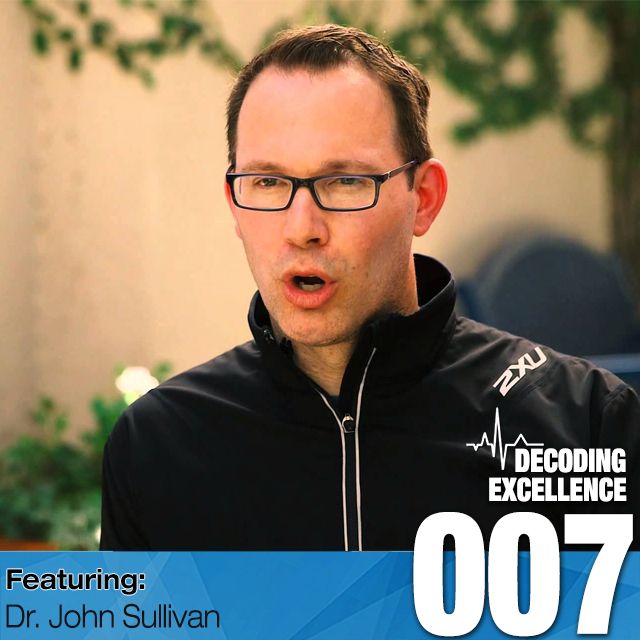
In this episode of the Decoding Excellence show, I am speaking with Dr. John Sullivan.
Dr. Sullivan is a Sport Scientist and Clinical Sport Psychologist. He has over twenty years of clinical and scholarly experience, and for the past 16 years he has worked with the same team in the National Football League (NFL) coordinating clinical care and sport science. Dr. Sullivan’s experience also includes such work within the National Basketball Association, Major League Soccer, English Premier League, The English Football Association, Premier Rugby League, Australian Football League and Olympic national teams.
Dr. Sullivan and I discuss:
- The importance of brain health
- Importance of Nutrition, Hydration & Sleep
- His book: "The Brain Always Wins"
- What "Mental Toughness" really is
- Performance Technologies
You can find Dr. Sullivan on Twitter at @BrainAlwaysWins or at his website TheBrainAlwaysWins.com In addition, you can read more from Dr. Sullivan by purchasing his latest book, "The Brain Always Wins" via. Amazon.com
This episode of the Decoding Excellence show is brought to you by Vald Performance, the makers of the NordBord. They can be found at ValdPerformance.com
Stay updated with the podcast by following me on Twitter via @AdamRingler or visiting AdamRingler.com or DecodingExcellence.com
In addition to those social mediums, you can head over to AdamRingler.com/Newsletter and sign-up for my weekly newsletter. This is a newsletter for the curious. It's chalked full of interesting articles I've read through the week, things I'm exploring and finding fascinating through my week, and a collections of thought experiences and resources I've cultivated.
It's essentially a Birchbox newsletter for performance-related articles, research, and daily musings.
Thanks again for listening to the Decoding Excellence Show! I appreciate all the support growing this Sport Science, Strength & Conditioning, and High-Performance Coaching resource. If you have taken anything away from the show, please login to iTunes and navigate to the Decoding Excellence page and leave us a review.
Key Takeaways
- Dr. Sullivan makes the case that brain health sits underneath everything else in performance, and he unpacks what mental toughness really means.
- The conversation covers the fundamentals that support the brain: nutrition, hydration, and sleep.
- Dr. Sullivan discusses his book, The Brain Always Wins, and where performance technology fits into the bigger picture.
About the Guest
Dr. John Sullivan is a sport scientist and clinical sport psychologist with over twenty years of experience. For sixteen years he has worked with the same NFL team coordinating clinical care and sport science, and his experience also spans the NBA, MLS, English Premier League, and Olympic national teams. He and Adam discuss brain health, nutrition, hydration, sleep, mental toughness, and his book The Brain Always Wins.
Listen and Subscribe
Find this episode of the Decoding Excellence Show on Apple Podcasts and Spotify, or use the player above.
Go Further in This Episode
Enjoyed this conversation? Here is how to get more from it:
- Read the transcript below to revisit key ideas at your own pace.
- Share this episode with a coach or colleague who would benefit.
- Subscribe to the Decoding Excellence Show on Apple Podcasts, Spotify, or your favorite app.
- Join the newsletter at adamringler.com/newsletter for weekly insights on human performance.
Episode Transcript
This transcript was automatically generated. While we strive for accuracy, some words or phrases may be misheard.
[00:00:00] And let's bring it back though, Adam, to the collegium world or even the elite world are coaches' health, which is often poor. They haven't slept. They're not managing their brain health. They're not sleeping, hydrating, you know, eating to fulfill neurotransmitter need and proper synergy there. And yet they're trying to educate and their frustrated, their reading or on facial reactions. They're not coaching at a point of excellence or even at a point of getting a information of learning and bridging the diversity of a team.
[00:00:34] Sports science, strength and conditioning, high performance coaching. Welcome to the Dakota Excellence Show. Today's episode is brought to you by VOD Performance, the makers of the Nordboard. If you haven't checked out their website yet, I highly suggest you head over there, whether it's return-to-play, injury prevention, or just plain performance testing. VOD Performance has the tools that you need. Check them out at VODPerformance.com. Today on the show, I'm joined with Dr. John Sullivan of sports scientists and clinical
[00:01:12] Sports psychologists that has an emphasis on integrated sports science, human performance technologies and CNS measurement and assessments. In addition, he is the co-author of a book called The Brain Always Winds, which is a practical guide to improving your life through better brain management. This conversation is a wide-ranging one and it was a really fun one. I really took a lot away from the time that Dr. Sullivan and I spent together. We discussed everything from his thoughts on mental toughness and really what that really means from a resiliency standpoint.
[00:01:49] Then we go into talking about some performance technologies and ultimately the show centers around the most important topic, i.e. Brain health and what we can do to impact the brain's health from a nutritional hydration, a sleep standpoint, and some of his thoughts on creating an integrated performance team of transdisciplinary members. This is a wide-ranging and fun conversation and I know you're going to take a lot away from this interview, so without further ado, here's my conversation with Dr. John Sullivan.
[00:02:31] Dr. Sullivan, welcome to the show. Great to be here. Thanks for having me on them. Hey, it's my pleasure and it's, you know, like obviously I'm just excited to have you on and talk shop and I think this is going to be a fascinating interview. How are things on your end, man? Busy, as you know, it's a busy time of year, but busy is good for our world in sport. That's for sure. I don't hands. I'm not rather busy working with developing talent and necessarily watching paint drive, but by the sounds of what you've been up to, you're busy as well.
[00:03:04] Yeah, you know, like within the collegiate world, I mean, obviously March Madness is still going on in sweet 16 starts today when we're recording the show, but basketball just finished up and, you know, now it's the layover for a couple of weeks and then we'll start right back into training for what is otherwise the 2018 March Madness tournament in next year. So it's busy. Yeah, certainly. Dr. I wanted to invite you on and learn from you. And again, as I've said on most of these shows, this is sort of a medium to scratch my own itch and to get people like yourself that serve
[00:03:45] The athletic population in a wide variety of disciplines, whether it's, you know, sports performance, whether it's nutrition, whether it's biomechanics and then potentially in your case, from a sports psychology standpoint, the influence of the cognition and the brain on sport performance. And I'd love to explore a little bit and have you provide the audience if they're living under a rock and haven't been exposed to your materials. Number one, shame on them. But two, I'd love for you to give a bio about what you're currently up to in your background.
[00:04:23] Sure, I appreciate that. I think it's, they've gotten to know you and I love the, you know, I've listened to other podcasts and I love the way you do a conversational narrative. I think it's, that's, we learn a lot from that, you know, if we think about our education that we all had, we learn in the classrooms, but it's often the interactions outside. And the way you kind of set up your podcasts is that exciting opportunities that we had as we're going through our academics. But I'm a clinical sports psychologist and sports scientist. So let's see how I spend my days. So
[00:04:54] I've worked in the NFL for 16 years with the league office on certain initiatives, but I've been with the same team for that amount of time. I've worked in the NCAA and currently doing sports medicine and sports science at Providence College, University of Rhode Island and Brown University. And then I also found my time as an outside civilian consultant to the elite military. And then I'm visiting scholar at the Queensland University of Technology and the Queensland Academy of Sport, which is an arm of the Australian Institute of Sport. And then in my spare time, I work
[00:05:29] With concussion. So I find myself in a couple of different exciting venues that allow me to engage in different types of research and different type of practitioner care. And it's certainly as unique kind of pace, but I really enjoy it because each thing adds to the next. Understanding how to get someone well from concussion bleeds into how do I keep them well, you know, because the brain drives everything. And so how do I keep them well as they're training as athletes, because athlete stress is trauma. And then how do I optimize that? And there's other or maintain skill level
[00:06:05] Throughout a season or like you were talking about the NCAA season, which is there's no offseason anymore. There's a low and high season. And so the maintenance of that skill or maintenance of health is critical. So it's kind of how I spend my days. And then I probably say in my spare time, I write quite a bit. And you caught me right after writing periods. So my head is full of stuff. And you know, and we're going to explore this is a wide ranging conversation. And there's so much that I think we know about people sort of on the superficial level of, you know, what they're
[00:06:38] Nine to five is or their day jobs. But I'd love to explore a little bit of the writing and sort of your routines throughout your day. But I think we'll start at square one, which is I'd love for you to maybe share the genesis or the start like how how did you get interested in in the aspects of whether it's clinical or applied sports psychology? What drew you to that field initially when you were going through your undergrad or through adolescence or your life? Yeah, it's a great question, you know, because I think there was a genesis for for everyone in any field. I was actually just talking
[00:07:16] About that the other day with some coaches, you know, there's influences. There's there's really opportunities that kind of direct us to have motivation and excitement. And in for me, I was a division one athlete. And I was always interested in the fact of where's that next one percent? And I did think of it that way back then. And the fact was there had to be more to this. Then so I was a division one athlete. I grew up playing a lot of different sports, you know, when we see that an athlete say it's kind of exciting, but probably for me and you it was pretty much
[00:07:51] A norm. But I ended up specializing if you will in track and field and cross country. And then some other endurance sports cycling, but at the division one level track and field and cross country. And I just kind of looking at it good, there's got to be more to this. There's got to be more to, you know, long-study distance intervals, you know, VO2 max, cardiac capacity. There has to be more. And so it really kind of spurred me on to start really examining this stuff. So as an undergrad, I was lucky enough to have a mentor. And I think that's a theme that all your listeners can relate to.
[00:08:28] And if you've got younger listeners who are in the academic system now, that is something to find. It's somewhere in your academic journeys to connect and really have a mentor. And he actually was training clinical psychology, but he was one of the very, very few that was really specialized in both clinical psychology and sport. Which to be a sports psychologist, you have to be a clinical psychologist that you got mental trainers and mental coaches, but they are not sports psychologists. Their training is very, very, very different and it's less rigorous and there's
[00:08:58] A lot of gaps in knowledge base. But I was lucky to have him as a mentor. And so he was able to kind of give me readings. And so it kind of fit along with my psychological studies, if you will, academically. And then I was also a journalism major as well. So they kind of fit into each other that piece of communication and understanding how to get a message across. But it was really from being a competitive athlete. That's where it really started. Yeah. Do you feel in your adolescence as you're going through sort of what is otherwise our prep career of high school and maybe prior to that?
[00:09:36] But you know, with this understanding of what you know now on the other end of it, being a professional that you are, did you find yourself looking back and saying, yeah, I felt like I had the mental skill sets, the tools, the tactics to navigate what it was otherwise your prep career through cross country and through a wide variety of different sports. Were you, you know, I used this sort of nebulous term, but were you, did you have the tool set of what you now possess or was that that the inability or the lack of tools drove you to a better understanding or to seek the answers
[00:10:20] Of finding that 1%, which is, you know, that this mental skill set or this, this, what we now know as, you know, sports psychology or clinical set. Yeah, that's a great question because you can see obviously people's kind of motivation is sometimes driven by, you know, feeling, you know, a capacity, there's an incapacity there and then how do I improve it. And then there's also human motivation that drives just that thirst of intrinsic knowledge. Like how does this stuff work? What's the why in this? Why does this happen? And I can't say it's either or I think it's a bit of
[00:10:56] Both to be honest with you. I think from the standpoint of as a competitive athlete, you know, I think this generally happens. And this goes to some of the myths out there that predominate in sport and there are many, but I tend to find with my bias or my focus is there's plenty about the brain that we just don't, we don't talk about the brain in sport. We don't learn much as a culture. You know, people can lay blame on that. I just kind of take it, it is what it is. And that's really kind of worldwide. So when you take any athlete, even me as an athlete, there are gaps in
[00:11:32] Abilities physiologically because there are gaps in tools emotionally and emotions run the show in sport and life. They really do. We feel first then think not what everyone learns in our societies that we think and feel that is not accurate. So when you have an athlete who can't regulate before an event or is somewhat disregulated, it affects VO2 max, it affects power output, it affects movement efficiency, it affects information input at critical times. If I go back to my sport in running, do I make a move? Do I not make a move? Technically. So yes, of course there was gaps.
[00:12:10] I think there's gaps with anyone that's just developmental. It's not a weakness sort of thing. It's just developmental. And then I think there's another piece to your question that's really, really good is that in a very fact that often we train things in sport that we forget, transfer to other environments like their skills, their tools, their strengths. And I think we forget sometimes to point that out to athletes that being in a training cycle is difficult. It takes a discipline, it takes a scheduling and awareness, but those types of things also are helpful in the
[00:12:45] Academic journey because it's not a sprint, it's a marathon. So you have to have that resilience, you have to have that discipline, you have to have routines. And so yeah, I think sport did help me develop some of that to be disciplined with my studies and then also pursue them in a similar way intrinsically. Wow, this is really cool. This is exciting and seeing progress. Yeah, no, I think both both were certainly a part of my process. Yeah, because you know, I just when you were sharing some of that, I sometimes think with other practitioners like,
[00:13:19] Is it the chicken or the egg, right? Is it, do you, did you have these strengths innately, or was it sort of cultivated, sort of by family or mentors or young, you know, youth coaches that sort of set the pathway for you, the genesis, or did you find that, you know, the inability or the lack of having a coach that talked about these mental tools, whether it's routines or visualization or self-talk, or just what some of the classical, you know, on the superficial level of what we might be aware of. And I know there's much more,
[00:13:54] And there's so much more that I'm completely oblivious and unaware of, but I was wondering if if you didn't have that person, which is then what drove you to maybe potentially scratching your own itch of understanding there has to be more, there has to be more, you know, I mean, yeah, you know, then I just think that I'm glad you shared that because that's so important. And you touch on another thing right there, those mentors, even having, like when I don't look, I look back at it, I'm not upset that the group of coaches I had were unaware of these things,
[00:14:27] I think even today we ask our sport coaches to do too much with too few resources, meaning if you look at more mature formalized structures of sports science around the world, to be a coach, a sport coach, you have to have a degree, and then you have to have a high, you typically a high-read degree, a master's degree, and then go for certifications, and it doesn't make you an expert on all the points of compass of sports science, does make your nutrition as a physiologist, drink the conditioning coach, a sports psychologist,
[00:14:57] But it lets you understand how to utilize those resources and communicate, and then how to put it into a program, where they're not leading necessarily, but the collaborating. And I feel, so I don't hold any negative feeling about sport coaching in the United States in that way, we're just not as formalized, but I still have those questions of what else goes on. And I would say, I can think of one particular sport coach, I had that he was probably that same way, he was inquisitive, there's got to be more to this. I mean,
[00:15:29] I get this other stuff, it's important, you've got to train physiology, but there's central physiology and neurophysiology that's important as well. But yeah, it is, it's sometimes having the questions yourself, or people posing them, or the gaps in them, but without mentors, I wouldn't be where I'm at. It's just, you're never an island to ourselves. Yeah, for sure. Yeah, and you know, I owe so much my own success and inquisitiveness, and I think the way that I think, and even when you look retrospectively and you go back,
[00:16:07] I mean, the strengths of your mentors allow you to catapult you into a particular field, or share an interest, but also just maybe as importantly, the weaknesses that they share. If you look back on them, I mean, like anything can be a lesson, if you look at it and say, okay, what could I do differently from what did I learn out of this particular person's, this mentor's inability to communicate, or day, you know, whatever, maybe what is perceived as a as a weakness could allow with the little retrospection and an introspection in it,
[00:16:41] To really analyze, you know, like, what, how could I've done things differently? I think Adam, that's a really strong point, and it's one that's missed often in sport, or in the process of having supervisees or interns that we mentor, because in sport, we often are emphasizing an untruth about the neuroscience of learning, that as mentors or, or, you know, supervisors that we should be not showing mistakes, and this is kind of a myth in sport. You work to perfection. Well, in fact, the brain hates
[00:17:19] Perfection. It responds with anxiety and disruption to processes that have even been practiced well to mastery. And so to your point, we should be showing our supervises and even asking them, okay, did you notice I made a mistake in there? Or was it? But yet we have the shame about it. We have this attitude that we shouldn't be, but actually the brain needs to make mistakes to solidify pathways that are more formal, that are more appropriate, or a higher level learning. And so I agree with you that mentors who are open about, I'm not perfect, I make mistakes,
[00:17:57] Or even have their students go, okay, what would you have done differently there? Would you see, I did make a mistake and are open with that and can let their ego down. It's a much stronger learning environment. You said two words in that that really resonate with me. And you spoke of mastery and you spoke of ego, which I think sort of, you know, when ego is present, it's really hard to find or at least seek or be on the journey of mastery. And I love that because, you know, and similarly, and with here, with the people that work with me and
[00:18:29] Around me, I mean, one of the biggest things I want to do is share what my weaknesses are. And I think that's that is kind of a transparency from a coach to say, like, this is what I'm working on. This is what I'm not great at. And this is a weakness of mine, perhaps, but just note like you who are interning, volunteering, or mentoring, or whatever, you are working on your own path towards mastery, but that nobody's ever going to arrive as a master, you know, like, and for me, it's the transparency of showing that I have weaknesses. And these are the things I'm working on.
[00:19:06] And catch me when I'm doing something poorly and identify that. And we can be accountable to each other. And I think that takes an ego-less approach. And I think ego often, as Ryan Holiday would say, ego sort of gets in the way. Me go as the enemy in that aspect. And that's a great point right there. And I often think how it's talked about, and it's get into the psychology of it, it's often talked about this amorphous thing. And then that's why these points about ego are kind of left to the side. What do they mean? How do I conceptualize it, contextualize it,
[00:19:46] And make it actionable? An easy way to do that is we all have an ego. It's how we use it in situationally. And it goes back to the heart of kind of our brain structure. We feel first then think, this ego is managed by managing emotion. If you cannot manage emotion in situations, then we are unable to execute at our highest level. So typically when we talk about learning, when ego gets involved, it really has to do with emotion that's disrupting the process. So if I'm the supervisor, and I'm getting defensive about a situation, I've now lost either the
[00:20:25] Ability to interact or the ability to listen to the signal that I'm getting defensive and why is that? And then interact appropriately. Because ego is not this amorphous thing. It relates to emotion regulation. And that's the piece people often miss. They just think of extreme examples. They think of people that are just very authoritarian or very rough or very macho. No, there's subtleties to this. When you can't manage emotion or be aware of it yourself and how to use it, you've now suddenly become ineffective educator. And I think this is a good transition. Obviously,
[00:21:01] You know, you spoke about writing. And I'd be remiss if I didn't mention your book, The Brain Always Wins, and your Twitter handle. Brain Always Wins, if, you know, if the audience were to haven't followed you as a resource. Yeah. Again, I highly suggest doing so. But The Brain Always Wins.com, in this book, you talk a lot about, hopefully, you know, obviously some of the topics that we talk about. But the transition I'm going to make here from sort of a nebulous term as ego, grit, toughness, mental toughness, character, all these sort of ambiguous sort of terms that I
[00:21:43] Think we throw around sometimes or coaches, especially in my industry, from a strengthening perspective, sometimes throws out and may, you know, wrongly or, you know, however your opinion is, right, create workouts that develop mental toughness. And then we go down this pathway of well, these workouts don't develop mental toughness. They reveal mental toughness. But we're still defining mental toughness as this sort of ambiguous set of maybe tools. I doubt that, but resiliency or character or personality or grit. I'd love for you to maybe expand on some of your opinions or
[00:22:26] Maybe the myths of sort of these classifications of of what we call what we think of as the sort of sport psychology tool sets as these words. I'd love for you to explore that a little bit. Yeah, you've set that up quite well. I really love how you went back and forth with it because it really kind of is the heart of where we're at where mental toughness means everything and nothing. And in science, that's not a fit. It has to bring knowledge, it has to bring clarity. And when you get to a subjective definition of mental toughness or grit and they mean everything and nothing,
[00:23:08] It's the perfect example that where we should take a pause in sport science and go, is that accurate or is that just pseudo science? Now remember, I'm criticizing my own field and I'm happy to do it because this term has been used to mean everything and nothing. And that means to your point, it's been used to hurt people. It's been used to not develop talent. It's been used to not protect talent. And so we should all take a pause with these things and very much what you said is, you know, are these programs really developing mental toughness? I have to say if you just
[00:23:47] Look at a history of mental toughness that I can get in the history of grit, the terms have been around since the late 1980s. It really was a rebranded term from hardiness. And that look in personality research. And it wasn't until 2005 that it even became relatively strong with some scientific rigor. And so if you think about that gap, but how long it been being used, and yet it still wasn't establishing a rigor, most of the experiments were, you know, in the studies which were using self report measures and subjective measures, really we're getting to the heart of the
[00:24:23] Matter. And they still don't. They hold very little validity. Not that mental skills, like the traditional, what I like to call sports psychology 1.0, like you mentioned before, visualization, routine building, goal setting, these types of things, they don't show merit. They do. And in fact, we know even more they have merit by looking at the neuroscience of them now. But that mental toughness is a reasonable concept is not true. And then you brought up a really valuable point that I've witnessed coaches do. They'll use the term mental toughness. And I just saw this probably about a
[00:24:57] Week ago. A coach was saying to the athletes, I really need you to be mentally tough right now. And what he meant was focus. I got no problem with that. You're queuing them to get into your individual routine to kind of get focused. But again, the term meaning everything in it being on specific is a bit of a problem. And you want to be telling your athletes not to be their best, but how. So when you use that term, that can be very confusing. And it's not specific. And I'm very into specifics as I'm a scientist. But then when you get into grit. So let's get into grit.
[00:25:32] Grit is a rebranded term as well. And when I say that, that's a negative. Scientifically, when we've evaluated a term already with your objective and objective measures, that means we've probably taken it to its nth degree. There's nothing more to be found out. And grit was rebranded from conscientiousness. And, you know, Duckworth, Dr. Duckworth, did her research on grit. Yet I've posted on Twitter and elsewhere. You can look at Dr. Credo's work from Indiana University meta-analysis of over 300 studies looking at she made some simple
[00:26:09] Statistical errors. So it accounted for less than 1% of any variance. So it accounted for 1% of any change. That the term is does not mean anything. And she's been able to prove nothing in the environment which she studied, which is academics. Yet she has been proliferating it that it's a concept in sport when you can't do that. She's done no research in sport. And it's not even a concept. So when we look at these, they're very based on belief bias and illusions of validity. They sound good. I mean, to the common person, they really do sound good. And even its
[00:26:47] Port scientists, they sound good. But they have no evidence. The evidence were evidence lies is that we are born with the most sophisticated survival system in the known universe, the human brain. So we start from day one, resilient. And it's how you train it, how do you develop adaption or evolution. So it really goes down to the multi-disciplinary or the transdisciplinary where you train an individual because we start with someone that's already tough.
[00:27:20] And so these concepts have gotten entrenched in our culture and in our language. And we just have to shift them. We have to go to a much better understanding of a term that fits more neurophysiology as resilience. Really looking at, you know, resilience is a looking at a readiness factor of what you mentioned earlier, rests, bloating, relative adaption from the CNS out to the periphery. So we get to a much more scientific, measurable and individual neurodiversity terminology because we don't train teams. We train individuals and they all don't develop at the same rate. Yeah,
[00:27:59] Or recover at the same rate for that matter either. I'd love to go down this route. So we talked and certainly there's some maybe sports psychology version 1.0. And if we're shifting and we're looking ahead to what the horizons looking and if we were to visualize perhaps what sports psychology 2.0 would be or the next generation of it. And we were to go down the route of resiliency in athletes. And I know that's that's also sort of I think kind of parallels the route within strengthening and performance training with building robustness and injury reduction and
[00:28:38] Prevention in athletes or student athletes or whatever. But if we were to explore this resiliency, if you could, how would you define that? And then perhaps to go one step further, how do you develop that or how do you begin to lay the foundation to develop and discuss what these strategies are with athletes or with coaching staffs? Sure. I mean, it resilience from the literature and it comes from two places. It goes back to kind of a bit of our conversation earlier. It's like asking the question why. And in the cycle,
[00:29:15] Logical literature, when we were looking at people who were put in really traumatic situations, whether it be abuse, whether it be war torn environments, whereas soldiers returning from combat missions, we were seeing that obviously for some it's an overload on the emotional system. And again, we feel first then think an overload on the emotional system. And so people would develop acute stress or PTSD. Now, granite, we have methods and we're still getting better with that technology. But we also discovered this group who don't get traumatized. And so that became
[00:29:52] Really interesting. And the literature is why? And let's get to the heart of this. What was it about the neurophysiology and their internal psychology or their internal resources or skills or tactics or routines that really kind of allowed that trauma not to stick neurologically. And so that was one area where it started to get established. Another area was looking at health care status in the sense of people going through long-term health issues or acute issues like cancer. And why were some more resilient through the process of having to go through chemo or go through
[00:30:31] Radiation or just go through the treatment process? Why were these groups of individuals standing out of being able to recover faster? So it really came from a clinical standpoint, but it very much fit sport. And really what we're looking at is since the brain is the central organ for adaption to all experiences, what is changing in the brain architecture to alter systematic functioning like autonomic, immune, metabolic neuroendocrine. So it's really much more specific of looking at signaling. It's all about signaling and looking at the systems of the CNS
[00:31:08] Responding to peripheral stresses where they go for a run or they're going to study for a test. You know, I got to do that public speaking. These are all stressors or I would say it's much more micro trauma. And then what are the windows of plasticity for growth and redirection function for better health? So that is really what resilience is doing. We're looking at a really a systematic approach that's including objective data along with subjective data. Now maybe to go a little bit further. So right now with the current literature and the state of
[00:31:47] Technology, what are some of those objective measures that we can begin to explore both from a very sort of clinical standpoint, maybe very sort of laboratory standpoint, and to maybe the field tests that a youth coach could equip the scalability of sort of these objective measures when working with either an athlete or a student or someone else. Yeah, I love the way you roll that out. It really is kind of we got to think about how we use technology and how we assess and what resources do we have available and they really do break down
[00:32:26] Like that, right? Infield testing with limited resources. What could we get at this relatively valid and reliable and could help us give us some information about because health is a foundation of performance. So how do I keep my athlete healthy? And then if my resources are below, how can I gather some information that's relatively reliable? Then obviously look at if you have a larger sports science team, what can we do? Interacting transdisciplinary to get information to the coach and the athletes to make the environment more culturally sound to produce performance
[00:32:57] And then laboratory, which again could be a byproduct of getting sampling and then sending it out and bringing it back to the system or more laboratory research. I think when we look at from a low resource environment, unfortunately, we're working with tools that are going to have some error. They just are. The problem is is because in sport, if you ask an athlete if they're ready, we all grew up in this. You look at the coach and you say you are. Even though in your head, you might be going, hell no. So there's that social, there's that ability factor. However,
[00:33:34] Like any assessment, it should be embedded in an education program to try to reduce that over time or you use some measures to assess that desire ability. Not necessarily if they're lying. Typically, it's not about lying. It's about almost an unconscious or conscious faking good. Because I may have to do with who's starting today. So it's using platforms that can reach them where they're at, like on their on their smartphones. And it could be done immediately, like MetroFid, CoachMePlus, Conduct, SMG, you can pull your athletes and do it at proper times a day where you're
[00:34:12] Going to get high compliance. That can be helpful, but it's got to be embedded in an education program. Otherwise, they don't get any otherwise answered. They're going to be questions. And you don't get to shape them about this is so we can take care of you as opposed to this is so we can police you. Yeah. So just measuring emotions. Emotions has the highest correlation to brain health. Because evolutionary wise, it is what has allowed us to adapt because it's an intricate part of our warning system. We're taught in sport and partly culturally in life not to
[00:34:51] Listen, but in fact, it's derived from the CNS. It's gut brain interaction. And when you don't listen, you miss opportunities to have choices or have knowledge. So just looking at emotion is one of the key factors from a low resource, just asking them. And there's certainly when I've looked at those platforms and do it electronically, it's pretty standardized to some of the stuff we will see in written kind of pencil and paper measures. So those kind of things have been pretty standardized. I think what's important, and I know there's a whole avenue and route that you
[00:35:30] Could go down from a laboratory and from a high resource standpoint, but the times that we've done subjective wellness questionnaires and you alluded to it, you said it. And I think you said it brilliantly when we're looking at emotion and we're monitoring or at least assessing or asking the question. How is your mood? What is your fatigue? What is your sleep? What is your soreness like? If you do two things, if you fail to embed that information in an education setting and start to talk about maybe some of the low hanging fruit that affects your mood, your fatigue,
[00:36:11] Your central nervous system, your sleep, you're ultimately failing with equipping the student athlete with the tools and the tactics to take ownership of how to better affect their long-term health and IE their readiness. But secondly, if you use that information or rather, if you don't use it, then it almost becomes neglect on the other end. The emotion drives, I've reported that my mood is low, my fatigue is at an all time high, I didn't sleep and you're not listening to me coach and that can negatively affect the perception of a student athlete that you, here you are, you have
[00:36:53] This intervention that you've developed out of care, but the inability to follow through on the information communicates otherwise that you don't care, which I found also intriguing. You better, if you are going to go down this road, then you better have the scalability and the flexibility to actually be receptive to the information that you're receiving. Very, very true. That's that systematic program that has to be put into place and I think that we in the United States can be leaders in content areas but formally the sport science structure is very, very limited. In the
[00:37:35] Sense that because coaches don't have a formal educational pathway in the United States, they're not given the resources to understand this information. So do your strength at point there and then if you don't have a sports science team that's systematic or the resource, just human resources, meaning time availability and then disciplines represented, it's so easy to neglect this information and then you can't build a high performance environment or gets much more difficult because there's more noise. If you don't have trust, you don't have much to work with.
[00:38:06] That is just to the heart of psychology and the sense of attending skills. We learn that as psychologists that if you cannot create rapport, connection, good luck with anything else. So when a coach sits up there and talks about it as a family or as a team and he's negating these factors of communication, then emotionally they're not going to feel that connection. And so it's hard at your point. We talk about it in the book, the brain always went to my co-author Chris Parker who is at University of Nottingham Trenton Sports Science. We talk about these factors you're talking
[00:38:36] About. If human performance in the United States often is put into this two bucket system that health and performance don't touch, when you cannot perform unless you're healthy and that's brain-derived and if you don't sleep, you don't hydrate, you don't feed the gut brain access through nutrition. And then that all affects emotion. You have a very weak foundation to work from. And we talked earlier and you mentioned the NCA system. The NCA system is a perfect example of unsustainable performance because they're asked to do 70 hours a week of work, six bosses,
[00:39:17] Some of them called professors, some of them called coaches. And they have fewer internal resources and fewer human resources to help protect them. It's an unsustainable thing. So what do we see? Some of the highest rates of what most people call mental health, I'll call brain health, I think mental health is not an accurate term, nor is it served as very well. It's filled with quite a bit of bias, but reduction in brain health. And so then a reduction in physical health and then a reduction in performance in the classroom and on the fields of play. Yeah, I know the NCA
[00:39:52] Gives us examples of the outliers, but we got to think of Belkirk, the majority of people are managing an unsustainable environment that attacks brain health. And I'm so glad that you mentioned the importance of fueling, the importance of hydration, the importance of sleep, and what you actually consume from a nutrition standpoint. Because I do think that is some low hanging fruit that we should be addressing and educating and talking about not only the importance, but setting up an educational structure to make sure that our actions as coaches actually
[00:40:30] Elicit that training response that we want. And I'm curious, you know, both in your book and your experience, are there other low hanging fruit that we as sort of clinicians as practitioners should be exploring and sharing with our student athletes? And if are, if there are, I mean, what are some of the baby steps, the progressions that coaches that aren't implementing these systems can begin making today? I love the way you frame that. I mean, low hanging fruit and easy winds works with your innate motivational structures within a brain. And we should be going at
[00:41:10] Things that corrupt great leverage for health and their everyday factors. And I teach this to my NFL athletes all the time. They're obviously concerned about CTE as I have been. I don't know why I get invited to league office meetings and talk about concussion because I tell the truth. Maybe it's so they can just hear it and they say they heard it. But you know, it teaches them your biggest leverage your lifestyle. And so to your point, that's low hanging fruit. So you can stimulate an athlete with a proper workout. But we all know, and I've heard plenty of coaches
[00:41:44] Complain about it. It's the hours away from the facility that undo any of the signaling. It's absolutely accurate because we've overdosed to overemphasize the workout is the only part of the process that matters. No, no, that's a stimulus where it all comes together as a low hanging fruit and a lifestyle. So let's go back to nutrition. I think you're touching one. And I posted something on Twitter absolutely to the heart of this today. If you look at, and there's research to show this, most nutrition textbooks for a graduate level and undergraduate level and medical,
[00:42:15] Whether it be biological or absolutely medical textbooks for medical school will have to be rewritten. What we were learning about the gut biome is changing the face of what we understand that everything we do is about signaling. In some neurotransmitters cannot be produced except for certain foods or diet. They act as precursors like serotonin, triptophan is its precursor. We can't make it internally. So we have to take in certain types of foods that allow that to be transformed, if you will. And if you look at serotonin's impact on training, it down regulates.
[00:42:54] Training makes it go up. But when you can't recover, it goes down. So what does serotonin affect? Mood, focus, memory. None of those things are validly important. But yet we don't teach your athletes that and the nutrition information they're getting is all about fueling muscle. So there's other tissues that are far more important. Brain tissue, cardiac tissue. Again, the center of our body, brain, heart, stomach, connected by one nerve, the vagus nerve. So we're not feeding for signaling,
[00:43:27] Not just for muscle. That's low hanging fruit. And most of the educational athletes are getting has nothing to do with the NS signaling. Nothing. It may be a byproduct helping. But again, those wise matter. If you bring it to the brain, it's not just more information. It's more specific information about why it's important. Connecting the systems. So I think that's low hanging fruit, absolutely. And if you look at the statistics and depression among NCAA athletes, I just use that model. The statistics are the same across the board for
[00:44:04] A leads board. But it's very, very high. Why? Training is not stress. It's trauma. Trauma has an impact on the brain and the stomach and the heart. If it does, and we're not fueling for signaling and neurotransmitters, which we talk about in the book of the brain always wins, then you're not centering on providing fueling because fueling is for the brain primary. Everything's brain first. But we emphasize other things. I love the fact both in your book and the resources that you've shared and other mediums as well, that as you go through and you're talking
[00:44:40] About the importance of nutrition, not just to fuel muscles, but to fuel the brain. And then from a nutritional aspect as well, or from a hydration aspect as well. And then this sort of also something that I think is certainly within our world of performance. I think it's gravitated. Certainly has moved into the NCAA and you're seeing professional organizations with sleep rooms and nap rooms and Premier League and elsewhere, starting to emphasize the importance of sleep, as if it wasn't ever important at one point in time. But starting to look at this as a sort of
[00:45:21] Wada approved performance enhancing discipline, if you will, PED, if you will. And I love to hear you riffed a little bit about the importance of sleep and from an immunocompromised sort of position of that negative aspects of poor sleep from a decision-making, from a cognitive sort of standpoint. And what some of the effects are of negative sleep or poor sleep and how that can ultimately affect performance. I love the way you frame that in the sense that it's suddenly become important. I totally agree with that. Looking at the research and how it's been out there,
[00:46:07] There has certainly been a push more for looking at it. But there's been decades of good research out there. And one of the leaders on that is the military. And then also other shift work type environments where critical decision-making is pretty important. You go to a ER, you want that doctor to be relatively fresh to be able to make those decisions. So in medicine, we've seen that across even disciplines in medicine looking at surgery and looking at outcomes of surgery when they're fatigued at a certain level or decision-making in the ER. But we also see it with pilots,
[00:46:40] Truck drivers been involved with some of that research as well. So you're right, it's coming out of the woods like, oh my god, we just discovered this. No. What we have discovered in the last five years, which is monumental, is that we did not know the brain had a lymphatic system. That at sleep, deepest levels of sleep, we are brain is actually detoxifying. And it detoxifies first before any other system. So the importance of sleep is actually the repetitive factor of neuroplacicity that all systems are growing. But they're also important that it gets rid of things that either are
[00:47:23] A danger to the body in higher amounts like tile proteins, or we're getting rid of neurotransmitters that we do not need. So there is that process that's ongoing. And that's been a discovery in last five years. And that came from research at the University of Rochester. And that's hugely add to it. But sleep is your number one performance enhancer. There are still things to be quite blunt. We don't know about it. And people shouldn't be alarmed by that, but I think people are, I just like, people are kind of surprised that there's a difference between the brain and the mind.
[00:47:54] And we actually don't know what the mind is. I think in another time, there is a big difference. We know more about the brain. But regardless, sleep is your number one performance enhancer. And to the heart of your question is what do we lose? And then what are we getting? So we lose quite a bit. So the average NCAA athlete, just using that as an example, because it is your largest elite athlete organization in the world. So if we're looking at athletes, gotta be taken care of this quite a few. The average is five hours a night.
[00:48:26] So that is not enough for if you think about their primary roles. So you're not getting enough time for neurogenesis, a brain tissue, and then any other tissue after that. And then when we look at their other primary role of memory, learning, taking in information, and then being able to interact with it in some way and show a discipline of, I know, that it's not enough time to consolidate information. And if we take both of those and then start going down the chain of things that are negatively impacted. So let's go on the sports side. Obviously, sports should be developing some
[00:49:02] Cardio respiratory ability, the OTMAX, energy output, energy efficiency. By lack of sleep, we're scarring the internal organs of the cardio respiratory system. So we're reducing their capacity, even though we're trying to stimulate growth there and increase its strength and vitality. If we go on the side of attention, which bridges both parts, and attention is not event, it's a tripart process. So if we go attention in the classroom, it's ability to be alert that information, track it, and then make an executive decision about, do I take a note about that?
[00:49:43] How do I take that note? How do I take that information? Or how do I encapsulate it so I can remember it later? In sport, it's the same thing. Am I alerted to the sequence? Do I get the pattern? Then am I, can I have the capacity to track it? And then can I make a decision? Both the lack of sleep affects both the decision making arenas. If you don't have attention, it doesn't, you don't unlock anything else. That's just how the brain works. I think to your point too, I mean, it's just experience working with a wide variety of different
[00:50:15] Athletes. It's, you know, anybody that's been in both an educational role or a coaching role, and I think that are acutely aware of it. I mean, there's a, there's a skill to learning and sort of this meta-learning of how to improve the actual intake of information, both a sensory or from an educational standpoint, and applying that in a way that changes both behaviors or movement patterns. And I think to your point, some of the things that you've just discussed certainly supports their ability to better retain, use, decode, and assess that information
[00:50:51] And make it actionable for them. Yeah, I mean, did you, the example you're given there, I can give you some examples from science? So they did research in the NHL and they're looking at differences within the healthy range of sleep. So the healthy range of sleep is seven to ten. And so we both know ice hockey is a very fast sport. I mean, that your puck range of speed is, you know, anywhere from 60 to, to over 100 miles an hour. And then your range of speed on ice for players can range anywhere from 25 miles an hour up to 40 or 50. So it's a fast-paced sport. And
[00:51:21] They started to look at, is there a difference between someone who sleeps seven hours still in the healthy range in 10 hours? And their ability to, you know, have good, read reactabilities and leading to good abilities to decide there is. And you're still in the healthy range. Like, right, there's human diversity there where, you know, sleep is not a one-size-fits-all, but within that study, they were able to show and control for some of those individual differences that it's individual and we should be tailoring it to such. And sleep is an enhancer on that
[00:51:54] Pattern recognition attention sequencing. But then it leads into that other sequence that really connects to it, which we talked about earlier, emotions. We've all been around colleagues, friends, family, who we know didn't sleep well. They are irritable. And that's an evolutionary signal to us that we're not a hundred percent. It makes us a little anxious. We got to stay in our toes. And that's adaptive. But if your emotions are off and you're putting no high performance environment, it affects decision-making. It affects how you move. It affects how you execute.
[00:52:26] It affects your fatigue level and your recovery level post. So, again, there isn't anywhere sleep doesn't touch because evolutionary ones, we've needed it because as our brain has grown, we've needed that ability for neuroplacicity. And so if we pull away from that, there's a whole host of undercurrents that can happen. We do see movement issues. And then we do see, unfortunately, issues related to connective tissue, ACLs, hip and pinchments, things like that. Due to lack of sleep, we don't move the same.
[00:53:01] To parallel some of the touch points that you just discussed, I mean, I share a similar story from to mere Dr. Kelly Starrad or Dr. Kirst Parsley. And the example is a surgeon that might be going into repair your ACL and them putting on their rubber gloves and then taking a shot at tequila and then to follow that up with another shot at tequila and then to grab the scalpel. Like nobody would ever sort of allow for that to happen at the workplace. But yet, we still ask pilots to go in and fly the 747 jets or the doctor, the surgeon,
[00:53:48] Waking up with only five to six hours of sleep and then ask them to perform their professional duties. Yeah, it's okay for our athletes to only get five, six hours of sleep. And sometimes, if you're traveling East Coast to West Coast for a competition, how it affects sleep in that aspect and that recovery and the reaction time and the cognitive abilities that a person may have. I look at that and I think it's ludicrous. Well, you're right. And you bring it to a really great example I've written to journal articles about it. If we take occupational health standards
[00:54:27] And then we mirror it against what we ask our college athletes to do, it wouldn't be acceptable. It's not at all acceptable. And in fact, when we look at high stress jobs that relate to working against chronobiology and our sleep patterns, these occupations have rules in place. Now again, sometimes I'm not followed and we hear about those cases. And we hear about those cases because to your point, this isn't followed. This is dangerous. You want a surgeon standing over and you go, I haven't slept in 32 hours. I think before you get any, you know,
[00:55:05] More unconscious, you're like, I'm out. Give me someone. We got to, we got a replacement team here, surgical team. And then the same if, you know, a pilot got on, you know, the intercom and goes, you know, I haven't slept in three days, see on the ground. And then the steward or stewarder says, you know, we're flying to so and so if you'd like to get off the flight now, I think you'd see a mass exodus. Yet these occupational health standards, if you compare to college athletes, we're asking them to do something we don't ask for on adults to do, who have more internal resources.
[00:55:36] We're more actually fundamental resources in our occupation. And then it spins into this other piece that I might work with law enforcement in the military. We know that a lack of sleep affects visual pathways, but it affects our interpretation across those pathways to the brain. So if someone is under-rested by sleep, they will interpret pre-fight indicators that are not there. They will interpret aggressive, nonverbal behavior because we communicate much faster and much more content, nonverbaling. So when you think about law enforcement and military engagement and you have disrupted visual
[00:56:15] Patterns where there is seeing aggression where it isn't there, that's dangerous. That's dangerous. Especially nowadays when we demand even more of our soldiers and military service members to go on longer tours or longer recon missions, ranging in 48 to 72 hours at a time. And what that sleep deprivation can ultimately affect as there aren't a mission from a cognitive standpoint, visual standpoint, or things like that. And let's bring it back, though, Adam, to the collegium world or even the elite world, our coach's health, which is often poor. They haven't slept. They're not
[00:56:52] Managing their brain health. They're not sleeping, hydrating, eating to fulfill neurotransmitter need and proper synergy there, and yet they're trying to educate. And they're frustrated. They're reading wrong facial reactions. They're not coaching at a point of excellence or even at a point of getting a information of learning and bridging the diversity of a team. Or you've put your athletes through that. And they're misinterpreting a coach. There's an interrelation here that's happening where you now just don't, you're not working in a high performance environment because
[00:57:28] The learning environment is not rich. It's actually quite poor. Yeah. I'm so glad that you brought it around to coach's health because I think you certainly in United States that this is sort of the thing that's missed. I mean, we share about the importance of hydration and sleep and nutrition and lifestyle balance, this work-life balance yet as practitioners, as coaches, we're often the last people to take our own medicine because we have an early morning coaching group at 6am and we're staying up. And it's the keeping up that Jones is to read research and articles and this that
[00:58:03] Ultimately we're hurting both our end goal, which is educating athletes through the vehicle of ourselves by predispositioning ourselves in a negative state where, you know, ultimately, we drive our own performance down, the performance of effective coaching, effective education. And I see that so prevalent in our industry and to parallel that with, and I might have said this on a previous show, but I just thought it's so important, you know, an exposé article from, you know, Coach Urban Myra, Ohio State, the lone wolf. I think it was in sports illustrated
[00:58:42] Or ESPN talking about how we as coaches don't talk about mental health issues and that, you know, there's more people in the coaching industry that struggle in that battle have these invisible battles of mental health, but because of the egotism, because of the machoism of elite sport, we neglect our own mental health sometimes. Yeah, I would agree with you. You know, brain health to me, again, wherever it is on the continuum and all it has to do with quality of life and our quality to engage in whatever is
[00:59:15] Important to us in front of us. Then what fascinates me about the your point that you're making, and I think it's very true, this resistance in sport is the military has engaged more in the concept of brain health and in fact, they're probably the leaders if we look at it from a systematic level. Now, granted, we do hear about failures in the system. It's a big system. Expect you're going to see that. There is no utopia. I hate to burst anyone's bullet. But the elite military was a leader and it's distilled down. They're the leader in performance. Now, granted,
[00:59:48] Not everything in due applies to sport. We've got to keep that very clear. But they are leaders in concussion care and much of what they do is not what we do in sport. And that's only a piece of brain health, but when they talk about what people traditionally call mental health, they're much more tuned to this because what sport is is what the military is. They're both maybe similar and dissimilar depending upon this situation. It's trauma. And the grind of being a coach if you make it unsustainable, it's very predictable, neurologically, the downgrade of brain health.
[01:00:21] It's very predictable. The statistics and the way we're wired is very predictable. What will come? You know, there may be some neurodiversity and intensity and the direction, but there's very few choices. You're going to downgrade in gray matter mass. You are then going to start to feel depressed and anxious. You are going to then go into some of the centers we talked about that lack of sleep. And I've been working, you know, it took me 10 years of working on that with my NFL team. Because every coach has the opportunity to interact the opportunity for excellence. But if you
[01:01:02] Look at particularly football, you know, that the start and stop nature, a coach really is from the military stand and that sport came from the military really was a way to teach tactics and teamwork, that they have the chance to change the events. But if they are not healthy, aware, and capable and ready, not going to make the call. In fact, you know, as a consultant, I worked with one of the top teams in the NCAA and I got asked to come in because they were at the championship game and the call went to the offensive coordinator and he couldn't make the call. It's not they
[01:01:36] Couldn't make the call from a content knowledge standpoint. He absolutely could. He had been slept in three days. So the call had to go to the top. And it was in that moment to your point that that coach was like, huh, we, we need to do a better job for our athletes, but we're not taking care of ourselves. So how can we be performers? And so it's a missed, it's a missed, missed opportunity and missed point that we all should be taking care of ourselves. We are the vehicle, as you said, for dissemination of information and caring and excellence. I want to kind of follow up maybe as
[01:02:14] We, we come to the end of this thing with something that you said that really resonated with me. And obviously a coach that works within the NCAA. And you talk about this model of the NCAA being unsustainable. And I would love to imagine, but maybe not even imagine, but challenge, you know, us as practitioners, as coaches within this organization. If you were to see fit and you were responsible for the change, that is the NCAA and the structure that we know it, the balance of social and academic and what we call sort of amateur sport at this level laughable. But
[01:02:54] As we call it that, how would you change the model to allow it to be more sustainable and maybe at the same point draw out a better emphasis of brain health and how it impacts performance. But ultimately, what would that structure look like differently in your mind's eye if you were to be responsible for this? Yeah, I think there's many ways to kind of break this down. And I'm probably not going to hit them all in this moment. So I'm going to fail you in some ways. And I'm going to fail myself. So because I think it's a great question. And I think you could do a, we could do a whole
[01:03:29] Conversation on that and hit them all. Yeah. I think this is, and to think about a conversation among a number of disciplines within sport having this conversation, what a powerful import than any of us could get from that. But I'll go with the first side is looking at the college athlete. And you might notice, I don't say student athlete because it's a misnomer. They're never allowed to fully engage in either capacity because it's unsustainable. And it's also language that was derived from the NCA so they would not have to pay them when they got injured
[01:04:05] Called workers comp. So I refuse their propaganda. But but I understand what you use it. It's what everyone knows. Absolutely. Absolutely. What everyone knows. But the first place I would go is is time demands. So if we look at even if we're dosing properly and there's an if there because there's a lot of moving parts to a multi-factual process of really training and athlete. But let's say it was dosed properly. There is not enough time to recover from that stimulation because everything loads the brain. That's why when I see all this literature out there of a
[01:04:45] Cute chronic ratio and RPE, you are missing the central nervous system. Neither of those in concert can account for the full functional system. Not at all. You're not accounting for all that other load that student has or that athlete has from the academic side. You can't. Only the central nervous system can. And the cute chronic ratio to just go down that road and RPE, I have plenty of data that shows both of those looking great. They still got injured. They still got burned out because unless you're looking at the CNS, you don't know. And so the load, the time demands have to be
[01:05:26] More respectful of what you're asking them to do. And you can go many different ways on that. You could look at the athletic side. You could look at the academic side. You could make adjustments there in both environments. But the time demands have to allow for adaption in the evolution of those abilities, whatever you're training. And that clearly isn't there. It just isn't. And that's why you do, I think, to some account. There's many reason why you do see this. But I think that's why you do see to some account violations in rules within the NCA where they will
[01:05:59] Fudge factor some of the time demands, you know, paper classes or recovery. So there has to be looked at that. And I think there's some other issues within the student athlete standpoint. I just used it and help you out there. But it definitely, I think there are other issues. The time is the big one because it's not about time. It's about energy. And if you don't have the recovery of the energy for the CNS, you just don't have anything to work with or you just don't have quality to work with. So I think that's one standpoint. I think that in a standpoint of when we look at the athletic
[01:06:34] Departments in and of themselves, they are not set up for really that health is the most important factor. And until they are, you're not going to be truly protecting talent and developing it. There's plenty of statistics that show the NCA if we want to develop talent and say, I'll go back to my sport and the sense of one of the sports I grew up with, long distance running. It is it is a detriment to the development because they raised too much.
[01:07:09] And so if we look at really developing talent and long-term athlete development, we have to look at health. And so let's go with personnel. All right. How many how many universities have a full-time nutritionist? And then does that full-time nutritionist census fit the number of athletes? Or do you have them trying to do everything and there's no way they can because they don't have enough staff? I mean, most. Let's let's just look in your world. How many strength conditioning coaches are actually engaging with the student athlete population, but they don't have enough resources
[01:07:46] To really focus on the programming or to really feel good and uncomfortable with it? Because it's human resources. All these beautiful buildings don't run an athletic department. It's human intelligence. So it's it's numbers. Then let's go to biomechanics, which you mentioned earlier. How many people actually will use biomechanical analysis and have access to that resource? Very few. But we know it's important. Then we'll go to sports psychology. I was for when I started I was 20 years ago. I was one of eights in the United States. Now we're at 80 with 1100 schools
[01:08:23] And over 450,000 athletes. And it's 2017. Yeah. If you don't have a transdisciplinary team, we're not working together. And it's what I would call we're trying to boil the ocean. Yeah. Yeah. So it's a human resource standpoint. It really is a human intelligence. I think with the exciting part of Adam, I would say is I think the first university that does this and I don't think it has to be a big name university. It's got a ton of money. It's got to be people that are thoughtful that puts a full sports science team together. You're going to see a difference.
[01:08:57] You're going to see a difference in health. You're going to see a difference in performance. I still think I got to deal with the time demands, but that will make a difference. I love the fact that you didn't cite a particular technology. You didn't say that it needed to be X, Y, or Z that ultimately the best performance tool is your human resources and a truly transdisciplinary team of professionals that that equipped and have the right athlete to practitioner ratios that allows for us as sports scientists, as physical preparation coaches,
[01:09:33] As sports psychologists, as technical coaches, as biomechanists, as performance, whether it's physiologists, that we all work in a multi-disciplinary team with a similar direction and directive of sharing information and intelligence that allows all of us to be transparent and to work in conjunction with each other to push to provide the support that an athlete really needs. Because people should battle for matter first, and if they don't, then you've started down the wrong road, and all of us should be in the focus of I'm working with this individual,
[01:10:18] And I've contracted with them, and they have contracted with this institution, and we are going to focus on long-term athlete development. And that means a connection by people. Technology, as you said earlier, is a passion. It is a minus well. I spoke at CS about this, about the very fact the point you're making. They are just tools, and do know if you've not done your validation of safety, signal, and error variants, as a scientist, you're just marketing, and I'm helping to listen, because it could do harm, and then it doesn't fit the tool of that long-term
[01:10:52] Athlete development. And then I think it touches on this other piece that I think has been in the news, and you brought it up, too, that scope of practice is so important. I'm writing an article about that right now related to sports science, and this is one of the structural problems in the growth of sports science in the US, which I'm excited about. But there are some real negative factors that are coming to light, everyone trying to be everything to everybody, and not even having licensure or certification. That professionalization has got to happen.
[01:11:31] And I think what you're seeing, and I know it's sort of a multi-factoral reason perhaps, but as you alluded to with the sort of under-resources of what is otherwise our labor force, you're having institutions and organizations asking so much of one person that, we're asking where it's almost a systemic problem of an organization or an institution wide of saying, hey, we don't have the availability of having a sports nutritionist. So who is a upon to then educate and provide that education for an athlete? We don't have a biomechanist.
[01:12:11] So who's going to be doing the sort of clinical evaluations? We don't have the tools for whatever sort of transdisciplinary team and role that a position might fill. So it's, you know, it's again, it's how do you do the best for your student athlete within sort of the construct that you have, but then greatly exceeding what is otherwise your professional scope? Yeah, and it gets dangerous because again, in the end, if you're beyond your scope, we're now breaking the contract with that athlete. You're breaking the contract with that athlete
[01:12:44] That we are going to keep them healthy and allow long-term athlete development as a part of a systematic process. But then we're also increasing liability for our profession, our department, and lastly ourselves. But I think it, Tom Nichols said it best in his book, the death to expertise, that this Google filled latent blog reading I can look it up on Wikipedia environment has allowed marketing to supplant true competence. And until we reframe that again, and even in younger professions who don't have a scope of practice or an ethics code or a licensure,
[01:13:27] That's what they should be pursuing. Because that's the way we will work well together, and we will ensure a proper transformation of more formal sports science in the US, and we really do. And we should be supporting each other on that and policing the field, calling people out and doing it respectfully, but we need to. We need to. Yeah, I think it's in everyone's professional best interests to know where the lines are, where the gray zones are, and continue to operate within their own discipline and within their
[01:13:58] Own domains without stepping, stepping outside of that. And then maybe to a secondary point, to, you know, to also challenge the institutions when you're being asked to exceed what is otherwise your professional scope, to have the, both the professionalism and the discipline of saying no, and saying that exceeds your skill set, and to live with either A, the repercussions, but more often to live with the circumstances that, you know, like we have to, as an organization, as a professionalism, as a profession, to say no to what is otherwise asked. Yeah, I think it's a powerful statement,
[01:14:41] Because when we say no, then they have to look for an alternative solution, which may be guiding them and handholding them to a proper solution. And you're also touching on it, which done a bit of a, a bit of a field research on. So when you look at who athletic leaders are in front, if you look at their conference, and you look at the topics, and then the expertise who's teaching about it, they're teaching themselves of this. So I don't know about you, but I don't know many athletic directors who know anything about mental health or brain health,
[01:15:15] Who know anything about caution, who know anything about long-term athletic, you know, development, who know about systematic planning for a performance environment, a high performance environment, based upon health. And so when you look at their development, we're talking to people that who don't speak this language. And so by saying no, we get the opportunity to teach them, because I don't think they're requiring this knowledge. And then we do have to collaborate with them. It just is what it is, but we have to get them up to speed. But I think you're right,
[01:15:47] You have to say no, because you're garnered respect with that. You've garnered an ear to listen. And then to that other point on respect is, I think when you're working a transdisciplinary environment, we start to get to see the huge strengths among all the disciplines, but we get to respect that too. And we get to see that it's the solutions integrated. In this way, I, you know, in the elite military, they do case conferences on every one of their operatives about their development. You find me an NCAA environment that does that regularly.
[01:16:22] Yeah, but yeah, that's what we do in the elite military. It's amazing when things become life and death. We get a lot more specific. Yeah, you know, when it's a win loss, it's not nearly as impactful as a human life. So the details matter certainly when it's really life and limb, although yeah, it's sort of we still use really like battlefield analogies about being on the battlefield or in the trenches with athletics and how far could we really be from the grave sort of in results that it could potentially be. I want to put it in this way. I know that obviously
[01:17:04] People and the audience can follow you on social media and it's the brain always wins. You also have the website, the brain always wins. I think your Twitter handle is actually brain always wins. Yes. Not the, but the website is the brain always wins. And you're the co-author of otherwise the brain always wins book, which is all of this information and much more. And it's laid out probably much better than long form narrative and and jetting all over various topics, but that's kind of how my sort of caffeinated brain sort of works in the morning here. But my brain works in
[01:17:43] The morning with caffeine too. So no worries. But I want to give, I want to give you sort of the end of this and just, you know, an elevator pitch, you know, if, if you were to have 30 seconds to say why someone that's that has listened to the show, these topics have resonated with them. And they're like, this is great. You've, you've got the hook, you know, set. I'm thinking about going on Amazon.com. What would be that message that you share to the audience member to say, okay, now I got to go and buy it now? Well, there's two things I'd say and I'm going to put,
[01:18:19] You know, the first thing I'm going to say may, may, may surprise people because I'm really not going to talk about the book. I'm going to talk about the mission of the book. So having had the honor to work with military and the elite military, one of the lasting injuries of war is brain health. You know, we're asking young men and young women to be an environment that really challenges the brain and the brain's emotional centers. And so the proceeds of the book, parts of the proceeds of the book go to veterans groups worldwide. In the United States, it's the lone survivor
[01:18:56] Organization. I come from a military family. And so, but, but it's not just from that. We've learned a lot from the brain from ultimate sacrifices. And then we learned a lot, we've learned a lot from the brain from also battlefield injuries. And then also how we train our military, you know, especially our elite military. It's a brain-first approach, which is kind of not as common in sport in North America and elsewhere in the world. So, you know, when you're investing in the book, you're investing in helping someone else invest in their health. And we, you know, Chris Parker,
[01:19:34] My co-author and I could not write the book and not do this. And in fact, our next book, which will be very specific to sport, the brain always wins in sport. It will be connected to, you know, pretendries, or excuse me, pretendries, you know, fine, you know, and victims of games, of really an Olympic-style games for wounded warriors. And so we've learned so much from them. I think the second thing is is that the human performance, whether you're an athlete in business, a parent is derived from the brain. And everything else is complementary. It doesn't mean it's less
[01:20:14] Important. It's complementary. And we wanted to fill that gap, you know, because we just don't learn much about the brain. We just don't. If I didn't study it, Adam, honestly, I don't think I'd know very much. And it's just how our culture is. So this is an opportunity to bridge that gap. And we've written it so people can understand a process of how it works. And it's not one-size-fits-all because that doesn't account for neurodiversity. We've really set it up for people who can individually engage. No, excellent. Dr. Sullivan, I want to just thank you for coming on, the decoding excellence. And
[01:20:46] For me, you know, I got a whole notebook full of notes that, like I said, this is about sort of scratching what is otherwise my own itch and learning more about the great work that you're doing and your experiences. But also to learn a little bit more about you and your background of what makes you tick because there are some things that both that you share on Twitter and elsewhere in your book that really resonate with me and thus the reason why I wanted to get to know you more. So I would encourage this audience to continue to go to your website, to follow you on social media.
[01:21:23] And do you have an ETA for the brain always wins and sports? More than likely, it will be late quarter of next year. If it comes out early off, certainly put it on Twitter. As you know, probably some of that stuff that relates to editing. Yeah, the manuscript is getting close to being done. The writing process, as you were talking about earlier on, the writing is easy. I think it's the editing. The editing, that is hard. Well said, well said.
[01:21:56] Well, Dr. Sullivan, thank you so much for coming on the Decoding Excellence Show. And until next time, man, let's let's touch base. And when this second one comes out, we'll have to we'll have to jump online and do it again. Fantastic. Thank you so much Adam. It was a great pleasure. Appreciate it. Thank you.
[01:22:18] I want to thank Dr. John Sullivan for coming on the Decoding Excellence Show. I took a lot away from this conversation and a whole notebook really of notes and topics and things to think about as we continue to develop our transdisciplinary performance team here. The ideas between mental toughness and what that really means if it means anything versus a resiliency-based training. Looking at different wellness questionnaires from a mood of fatigue, a sleep assortment standpoint and trying to get a better understanding of how the
[01:22:54] Athlete is feeling and how that might affect their central nervous system and their ability to be ready for training or for competition. And then obviously the importance of nutrition and hydration and sleep as we relate it to brain health, not just mental health, but brain health. When we're looking at our student athletes, but like I said, this is a wide-ranging conversation this whole show is about bringing great people on like Dr. Sullivan and really understanding the tools, the tactics, the techniques that go into creating a high-performance team and an
[01:23:32] Excellent or masterful coach or program. Until next time, thank you for tuning in to the Decoding Excellence Show.