#010 Hamish Munro

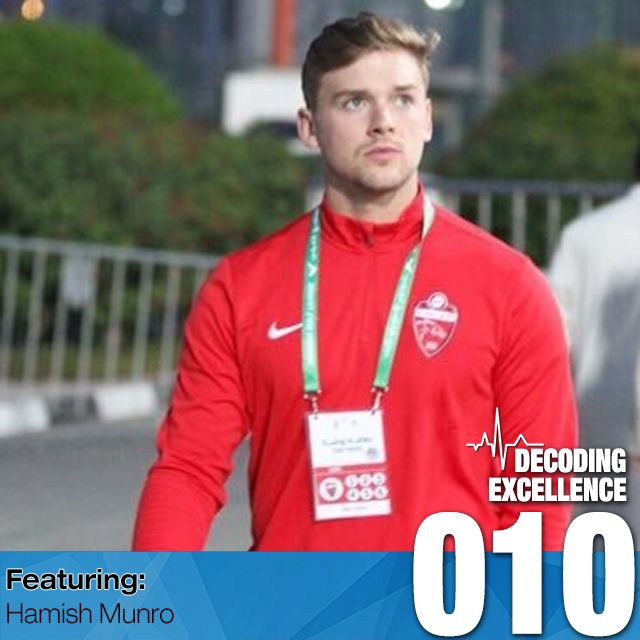
In this episode of the Decoding Excellence Show, I am speaking with Hamish Munro, the U21 Sport Scientist/Strength and Conditioning Coach at Al Ahli Football Club Dubai.
Hamish is a Sport Scientist, Fitness Coach and Strength and Conditioning Coach who specializes in the physical preparation of footballers. Hamish has worked in professional football within three countries across Europe and Asia leading the support of sport science. Hamish holds a BSc in Strength and Conditioning, a PGCert in Sport Performance and accreditation including CSCS, XPS, Eleiko, and FA.
Hamish and I discuss:
- Overview of Tactical Periodization
- Lessons Learned in his Journey
- Progression through Football Clubs
- The Place of Technology in Training
You can catch up with Hamish on Twitter at @HamishMunro90 or his Linkedin Page where he outlined a great post about Tactical Periodization.
This episode of the Decoding Excellence show is brought to you by Vald Performance, the makers of the NordBord, DashBord, and the GroinBar.
They can be found at ValdPerformance.com
Stay updated with the podcast by following me on Twitter via @AdamRingler
In addition to those social mediums, you can head over to AdamRingler.com/Newsletter and sign-up for my weekly newsletter. This is a newsletter for the curious. It's chalked full of interesting articles I've read through the week, things I'm exploring and finding fascinating through my week, and a collections of thought experiences and resources I've cultivated.
It's essentially a Birchbox newsletter for performance-related articles, research, and daily musings.
Thanks again for listening to the Decoding Excellence Show! I appreciate all the support growing this Sport Science, Strength & Conditioning, and High-Performance Coaching resource. If you have taken anything away from the show, please login to iTunes and navigate to the Decoding Excellence page and leave us a review.
Key Takeaways
- Munro gives an overview of tactical periodization and how it shapes the physical preparation of footballers.
- He shares lessons learned from his journey progressing through professional football clubs across Europe and Asia.
- The conversation covers the place of technology in training and where it actually earns its keep.
About the Guest
Hamish Munro is the U21 sport scientist and strength and conditioning coach at Al Ahli Football Club Dubai, specializing in the physical preparation of footballers. He holds a BSc in Strength and Conditioning, a PGCert in Sport Performance, and accreditations including CSCS, XPS, and FA. He and Adam discuss tactical periodization, his career progression, and technology in training.
Listen and Subscribe
Find this episode of the Decoding Excellence Show on Apple Podcasts and Spotify, or use the player above.
Go Further in This Episode
Enjoyed this conversation? Here is how to get more from it:
- Read the transcript below to revisit key ideas at your own pace.
- Share this episode with a coach or colleague who would benefit.
- Subscribe to the Decoding Excellence Show on Apple Podcasts, Spotify, or your favorite app.
- Join the newsletter at adamringler.com/newsletter for weekly insights on human performance.
Episode Transcript
This transcript was automatically generated. While we strive for accuracy, some words or phrases may be misheard.
[00:00:00] What that sort of opened my eyes to and taught me about was the whole process and the end product in terms of what the ultimate aim is. And then I quickly sort of began to realize that I'd completely overestimated my sort of role in in a team. And sports science, strength and conditioning, high performance coaching, welcome to the Decoding Excellence Show.
[00:00:31] Today's show is brought to you by VOD Performance. If you haven't checked out the website yet, stop this show immediately. Head over to the website VODPerformance.com and begin immediately looking through the resources. They're the makers of the Nordboard, the dashboard, the growing bar, and there are some incredibly smart minds in the world of performance technology, tools, rehabilitation, and performance evaluations. Whether it is performance training, testing, evaluation, screening, or just simply return to play protocols from a pre-bench marking,
[00:01:09] Pre- and post-injury, check them out. They are incredibly smart guys and they will equip your facility with the tools that you need to be successful. Thank you again for the support. And please check out their website VODPerformance.com.
[00:01:26] Today in the show we have Amish Monroe, a U-21 sports scientist, strength and conditioning coach at Aalee Football Club in Dubai. This is a monster of an episode today and I took a lot away from Amish and his conversation regarding tactical puritization and some of the lessons that he's learned along his coaching journey. Like so many of us, the successes that he had very early on and some of the things he's had to navigate through his career that lent to the lessons and the wisdom and the experiences that he now currently holds. If you have any interest in technology
[00:02:03] Or soccer or football puritization, this is an episode that you do not want to miss because this is an incredibly smart coach and you will take a lot away from this show similarly like I have. So, without further ado with enough waffling from me, let's jump right into the conversation with Amish Monroe. Amish, welcome to the show, man. How are you? I'm very well at him. How are you, mate? I'm doing really well. Just finished up a training session with some of one of our teams here and empty gym. The lights are half shut off. It's called outside, rainy, sort of miserably depressing
[00:02:44] For what is otherwise spring out here in the middle of America, which star can says, how about yourself? I'm good, mate. I'm a bit of a polar opposite at the moment. I'm sporting some sunburn. So, fresh off the beach, train a session this evening. Sunday was pretty good for me. Yeah, if you can include beach and Sunday, you're pretty much winning over a large percentage of other fitness and sport coaches like myself that is hundreds if not thousands of miles away from a coastal barrier body of water. So, you're not going to get much sympathy from me hosting a sunburn,
[00:03:29] Man. That sounds great. No, mate. I'll accept the sunburn if it includes beach. It's not a problem at all. Yeah. So, hey, I wanted to have you come on the Decoding Excellence Show because I obviously being active on social media and Twitter. I constantly come across the great things that you post and you post everything from what you're currently doing with your guys and we'll get into training certainly in your background here, but research. What's the best practices, whether it's injury prevention or performance enhancement and more so than just looking
[00:04:08] And sharing the research. It appears to be through the videos and the pictures and the things that you share that you're crossing the barrier or crossing the gap and you're applying the research, which I absolutely freaking love. And I'd love to explore a little bit that on the show, but before we jump into it, I'd love because obviously the demographic that listens to this show, collegiate strength and conditioning coaches, collegiate and professional sports scientists in America right now. And we're trying to grow it internationally here. So, for people that
[00:04:44] Might not be familiar with your role as a fitness coach, U21s out in Dubai as an emphasis on sports science, can you provide a little bit of a background for this audience as far as what you're currently up to and how you got into that role through education and sport athletics and what led you to where you're currently at? Yeah. So, if I attacked the education portion of that, so I did my first degree was at St Mary's University in London and it was a BSC and Strynford edition in science. So, that was the path I chose to go down almost immediately. From there,
[00:05:25] I went and did a postgraduate degree at the University of Bedfordshire in sports performance. Along the way, I've had a variety of internships at Norwich City, Peterbury United. I was lucky enough to work in China for a year at a football club or a soccer club. I don't know how we're going to proceed with that, but yeah, football club out in China for a year and then since 2015, I've been in Dubai with a luckily football club working with their under-21 team looking after their sort of sports science and the strength and the addition in program. Excellent.
[00:06:06] And, you know, with, if you could sort of fill in the gaps a little bit as far as that, you know, maybe less from a from an educational standpoint, but just some of the things as you've proceeded up through sport, from internship to internship to opportunities to work in China to what your current role is. What are some of the things, you know, like the various roles and steps that you've taken to gain those internships? And, you know, like, I know this is a wide-ranging question, but what are some of the things that really resonate with you as far as
[00:06:49] What you've learned at those various stops along the way? Well, I guess the first thing that came into my head when you were introducing that was initially, as an undergrad, it was putting myself out there. So putting myself out there to as many people as I could trying to sort of touch base with them and see what they had to offer potentially in terms of internships or advice. And then from that came about the Norwich City internship where I had a host of great mentors there, so I immediately sort of was in a group of people that were able to really help me out.
[00:07:24] And off the back of that came a lot of great things. So from there, from my academy internship, I managed to go to Peter Burrana first team internship, so there was sort of a natural progression there from a academy to first team. And then the Chinese opportunity came off the back of my work at Norwich where the head of sports science had previously worked in China and had asked if I wanted to go out there. And as I was an unpaid intern, it was a paid role, it sort of made sense. And that was sort of a great, I was really thankful for the guys at Norwich and it really
[00:08:06] Liberated my sort of, I guess you'd say, the putting myself out there paid off, is what I'm trying to say. And putting the work in at Norwich as an unpaid intern, it sort of paid off. And those guys my mentors really helped me out. And a lot of people speak about sort of trying to pay it forward. And when you're a young guy breaking through, that's real difficult because you don't have a lot to offer those around you initially. Now, you do in terms of the work you're able to offer, but in terms of opportunities and things like that, you can't really offer people too much,
[00:08:39] It's more just your labour. So getting that from those guys was awesome and I'll sort of be forever indebted to them for that. And then again, I got helped out in Dubai by a friend, an English performance analysis who was here at Allali and he put me forward for a role. So again, it's you sort of, you have to call in favours in this industry when you're a young guy and then be very prepared to pay it back when you can to the guys that do help you out. To bridge on that, I mean, it's very similar to what we see in the collegiate sector here
[00:09:18] In America as you go from one sort of collegiate internship to another and then eventually you have your first potential paid role as a graduate assistant. And you know, I remember just reflecting back my own internship experience is like yourself. I mean, you don't have much else that you can pay forward outside of just the hard work that you do and then eventually you become a graduate assistant or you get an academy role that's paid and then you work your way and it's still paying your dues and then eventually you're in a position where you can hire others and hopefully that
[00:09:57] Experiences of, you know, humbling of recognizing that you don't have much much to offer as a young guy, it allows you to then pay it forward to them. But you spoke about your mentors and how it was these individuals that sort of struck their neck out, maybe showed you the ropes as we all have various mentors in our life. But do you remember, can you remember, can you reflect on any particular moments where, you know, there was wisdom that they shared or something that they did that really resonated with you professionally, that you still sort of emulate today in your own
[00:10:35] Various roles or carry forward, whether it's teaching other, you know, whether it's the athletes that you work with or other sort of support staff that you come in contact with. Is there anything that still resonates with you from those mentors? Yeah, so my sort of direct boss at Norwich City within the academy was a guy called Chris Lorkin. He's since moved on to Aston Villa football club and then he's since moved on to Norfant's County Cricket Club and he was awesome to me. He basically gave me a completely holistic grounding and introduction into strengthening the conditioning in football
[00:11:16] In an applied setting. So he gave me an inordinate amount of information and applied skills to then go and present in my own sort of philosophy and applied work and also his boss Mike Watts, who was the head of sports science at the whole football club, he was the guy that took me to China. So again, it was Chris's sort of investment in me in recommendation off the back of what I'd sort of helped him out with the club that got up to the top man that was Mike and then got me across the China. So from a skills point of view, like I can't even begin to explain what Lorks gave me really
[00:11:57] Because it was awesome. Like the amount of information he was able to give me and his openness with that was with the way he sort of steered me through was awesome. And then obviously off the back of that he lied to Mike and gave a glowing report. And so I was lucky enough to get paid opportunity off the back of that. So those two guys, Chris Lorkin and Mike Watts were awesome at sort of helping me progress out of my undergraduate degree. It's cliche to say that we all stand on the shoulders of giants. But I think specifically within this sort of young profession that we're in, I mean,
[00:12:35] We really have to pay it, understand that there's these mentors, these pivotal people that sort of pave the path for younger strength conditioning, fitness coaches, sports scientists to come in. I mean, I think we owe a real debt of gratitude to these people that that's helped us carry forward, carry forward the profession. You said a couple of things and they're that really resonated with me and that that your mentors provided you sort of this framework of this holistic, integrated model or approach to training. And I see it common in strength conditioning at the
[00:13:12] Collegiate world where you kind of go into a mentorship B, you write a you become a apprentice, if you will. And you learn the craft of whatever mentor it is, whether that's here in the States, Olympic lifting oriented, a high intensity training approach, a quote-unquote functional approach, whatever approach is disciplines, modalities you might prescribe to. But what really resonated with me when you said holistic integrated is that I think right now this is sort of where the profession I think best practices is is understanding that we need to work together and we
[00:13:51] Need to work in these multi-disciplinary teams. Was that always the case when you like when you first arrived? Have they been sort of this holistic integrated approach or was was this something that your mentor was changing organizationally and then sort of by proxy you've learned and have you carried that approach to all the various different football clubs and organizations that you've worked with through your journey? So it's an interesting one. Lorks at Norwich Chris, he was really sort of, he would let me mold my own philosophy because he
[00:14:33] Realized I was still a young coach and he didn't try to sort of hammer his philosophy onto me or onto anybody else for that man. So I would sort of spend a lot of time observing him and asking him and looking at what he was doing. So as an automatic by-product I sort of inherited a lot of what he did. But it wasn't really until I was out in China where I went to my first club in China and then I was there in a matter of weeks because I made a real real mess of things with a manager. The manager the first club I went to was a really, he was a local coach. He wasn't a particular fan of
[00:15:15] Sort of outside influence. It was a president that took me to the club and it was almost a recipe of a disaster before it started but the way I went about that as a recent graduate wasn't sort of in line with what I'd been taught or sort of within my best interest in terms of I was a bit of a bull in the China shop and the practice that I was seeing in front of me wasn't what I had sort of come to know was gold standard. So I immediately sort of put my opinions across which was completely the wrong thing to do. I should have absolutely took on this sort of
[00:15:53] Softly, softly, slowly, slowly approach and tried to get the manager on side. I should have listened to Dale Carnegie and his book earlier than I did but the second club I was very lucky in that the assistant coach was a Portuguese coach who had some 30 years of experience in the top league in Portugal. A guy called Flores Schap who's now a really, really good friend of mine and we were the only two foreigners working in this football club in this small middle of nowhere city in China. So we were basically in each other's pockets for 10 months and he introduced me to
[00:16:34] Tactical periodization which is obviously one of many models but that was sort of the model that he championed and being from Portugal and he was Portuguese it sort of made sense and what that sort of opened my eyes to and taught me about was the whole process and the end product in terms of what the ultimate aim is. And then I quickly sort of began to realise that I'd completely overestimated my sort of role in a team and I think a lot of us can be guilty of that in terms of the importance we put on strengthening addition in sports science especially in a sport that's as intricate as football.
[00:17:13] So that was a really good eye opener for me in terms of learning about that integration and appreciation of what others have to do and what the end goal is for the adaptation of performance announcement in football really. And you gave me so many different things to chew on but I'm going to go back towards the beginning of your response a little bit to maybe put the audience sort of in a frame of mind. What age were you when you were out in China just to get a better idea of? I was 22 so I was a young guy. Yeah so like and then how was it years later when you read
[00:17:54] Like Dale Carnegie's whether it's like how to win friends and influence people or like was it pretty soon or? No it was it was it was pretty it was pretty soon after and it was a recommendation from a well-known strengthening coach in the UK called Nick Grant for my follow a lot of his stuff and that's sort of one of the books that he puts out there is sort of pivot alter sort of developing your your soft skills if you like as a coach. What resonated with that as I was kind of following your own coaching journey is that this is a similar journey and story that
[00:18:30] So many other coaches can replicate and make and we all have shared right in our own sort of journey of getting somewhere and and maybe the environment is not the particular way that we learned it or the system isn't it you know up to what we might particularly hope or imagine or think it should be and you know like all of us you know we take this sort of hammer and nail approach to it very early on in our career and then you start to learn sort of the soft skills. The you know the nudging the massaging of a philosophy a best practice a way of doing something
[00:19:08] So I love your analogy of a born a china shop because like you know it draws so many comparisons to some of my own mistakes I've made in my young coaching career as well. Yeah it's I think it's a it's a pretty apt one for a lot of recent graduates I guess it's interesting as well there's that graph that sort of doing the rounds on social media now as well I know Tom Williams up that Toronto put it up there not long ago and it's that sort of U-shaped curve on a graph which the y-axis is the perceived competence and then along the bottom you've got
[00:19:43] Years of experience and then you know when you're at sort of zero one and two years you're at the height of the left side of the U and then you swoop down to when you realize you don't know a lot of tool before you're 20 years into it and you realize you've got a bit more sort of knowledge under your belt and I think that sort of rings true for a lot of guys as well. You mentioned in that response as well kind of the scope of where we're going to explore a little bit throughout this show and that was this tactical periodization and the preparation and the work that you do
[00:20:16] Being sort of multi-faceted in that especially within football and again you'll have so much more experience discussing this than I do just because of your nature of the sports that you work with but you know I think it's certainly in America it's very easy for us in strength and conditioning to sort of think that collegiate strength and conditioning is the only scope of things that will help perform its enhancing enhancements and I think as you start to work in very complex systems i.e. Football clubs and organizations that there's so many different facets that go
[00:20:58] Into enhancement of athletic performance and that strength and conditioning at least from the strength sides sometimes when you when you look overseas takes a little bit more of a backseat role to some of the other things and I'd love for you to kind of riff our sort of where you see what you might think of in gym strength conditioning and obviously having experience as a fitness coach and the planning of the various sort of energy system development sort of plans that you need to do what is sort of if you were to lay the groundwork what is you know tactical
[00:21:35] Periodization and then how does it fit within the system of what you're currently doing at at your current organization? Yeah so tactical periodization I should say like tactical periodization is obviously one model of many I think the reason I've sort of taken to it is sort of one of the one of the best available at the moment especially with football is it's the fact that it's not a blanketed approach it's not this sort of one size fits all where it is a model but it's driven by the head coach's philosophy and the way he wants his
[00:22:12] His team to play basically so you immediately have this differentiation between coaches and you don't have to necessarily have this sort of carpet bomb approach to which to which a lot of models can contend to be and it basically tactical periodization within football it basically breaks down the game into its four key moments it isolates team sort of unit entry unit and individual situations and and then you'll you'll display that in training and how you want that to look in games and particular games and particular opponents. Now how that works with sort of integration
[00:22:51] In terms of our sort of energy system development and gym work is it's basically trying to be complementary so rather than trying to become almost departmentalised and sort of close off from one another I think it serves to to increase the amount of integration that we have in terms of our application so we can we can look to for example for our energy system development we can try and be as specific as possible with a situational situation or drills in training so you know if we if we wanted to do a certain amount of aerobic work running over longer distances
[00:23:37] Less changes direction more velocity type work you know you could do that on a specified field using higher numbers you could manipulate the amount of time you're going to play that game for you can manipulate the amount of touches you can manipulate the goal sizes you can manipulate overload of players on one team the other team you you can do an unknown amount of things but what it all comes back to is that game model and is it a transferable drill to what you're trying to do in the upcoming game or upcoming fixtures and now on the flip side of that I think our gym work
[00:24:15] We do take it away from what what's going to happen on the field because sort of true sort of strength work in a football setting is one of the only is one of the only things that you can't really get through football you need you need to take yourself away from the field from that and you need to get under load and lift load and push and pull and squat and lunge and do everything that we we'll do with instructor conditioning so while it lends itself to be as integral as possible there's still components of that sort of performance model that you need to take away
[00:24:47] From take away from the game in the sport so no doubt and you know I think some of the things with and sort of the narrative that we use here within our my own organization it's just really trying to consolidate our training stressors so if we know that you know out on the basketball quarter or elsewhere that it was going to be a pretty physical day and we're going to get a little bit more transition sort of offense and it's going to be a lot more running up and down the basketball court then that gives the various support staff a better understanding of
[00:25:20] Sort of how we can compliment what is going to happen are there competitive or training environment i.e. The basketball court or the baseball or the softball field and then try to mold our training to be complimentary of it verse like you said a carpet bomb approach where maybe they're working on high velocity running and we're working on speed and you know the PT or their you know their athletic trainers is working on regeneration and we're all confused and you know mismatched if you will I think this centers to my next question is that and it's almost like a chicken or an egg
[00:25:59] Sort of question but so much of that decisions I think is dependent on the sort of the acceptance of the information that you present to the head coach or the manager and especially in collegiate sport where you know a lot of times the technical tactical decisions are implemented and made at the head coach level how influential are you or you know like when you sit down at that table and you're discussing the sort of logistics of a training schedule I mean is it derived solely from you is it a collaborative team effort I think a lot of the audience is unfamiliar to
[00:26:42] That sort of collaborative approach but I would love to hear sort of the the process of deciding or when you brought that to your organization how receptive they were or for coming to the information that you were presenting yeah this is why I am such a fan of tactical periodization sort of as I sit here in March of 2017 because it ultimately is devised upon the coach's philosophy so when you go and put that in front of your head coach and say right I would suggest this way of working the whole thing is based around your philosophy and the way you want your team to play
[00:27:22] You're going to struggle to meet a head coach and turns around and goes and not sure about that they're immediately they're immediately going to buy into that or a variation of that and we're quite lucky here and that our our coach is really really open and there's no sort of closed doors the discussions we have a really open ended we discuss different you know possibilities permutations of things that we're going to do and what we think might happen and then afterwards what actually happened how we can change
[00:27:54] Up next time so a lot of what happens on the training field will come from him in terms of the narrative in terms of right this last game are you know no lot wasn't good enough we got over ran we this happened that happened we need to do this isn't this now from a methodological point of view I'm not going to argue that because he's the head coach he's the technical tactical driver of this team so I need to support that I might then just go to him and say right well these are our numbers or these are the noises that the boys are making in the change in room or this is happening
[00:28:32] I would suggest possibly you know for this drill rather than doing two lots of 15 minutes of two touches can we do can we split that up further into three lots of eight minutes with three touches so we slow the game down and we have more breaks depending on what the data previously is saying and prospectively what we might be doing so from that perspective we're we're really open and collaborative and it's just being respectful that he's on the head coach and I'm there to support him and it's not the other way around you know and you were discussing towards the end of that
[00:29:07] Response obviously changing biomotor outputs force speeds power distance running through a number of different soccer and specific sort of drills and I think you know certainly that is prevalent within sort of American sport perhaps to football but what you might not see necessarily is that same integrative approach to the development of basketball drills hey coach I think we should do a small side of games only a half core we should go you know like so how important would you say is studying from materials of strength and conditioning versus studying materials of sort of sport
[00:29:56] Drills within that sport specific model if you will it's that makes sense I know that's seemed like even on my own sort of like rambling of it I'm like I don't know of that makes sense but yeah it's interesting the first part of that question so what you were saying about that integrative approach in in American sports I was watching the documentary I forget the name American documentary on the Arizona Cardinals is that word buddy Martin yes correct yes and it's sort of there was a scene where he's walked out to the head coach and training
[00:30:31] And he's sort of you know like a situation where we've all been and he's sort of gone up to the head coach and gone look you know the loads have been quite high last few days is there any opportunity that we can sort of slow this down or lower the intensity and the coach has just point blank turn around and gone no it was end of conversation and it was you know that happens that happens all the time but yeah it's I think that integrative approach is is also going to win out in the end you know and the the sort of sports drill versus strength and conditioning
[00:31:07] Book argument it's I think it's just learning the sport like anybody who knows that sport like if I was to come and work in basketball tomorrow I'd be terrible you'd fire me you blood what is this guy doing because I wouldn't I would not know where to start with a basketball team from a sports perspective obviously I could go in there as a completely raw rest and see coach and we could do everything that we do as strengthening coaches which is squat lunge hinge push pull power clean snatch we do mass runs we do intervals and everything else and that that would be fine but would it be
[00:31:42] As specific as it could be or as integral as it could be or as efficient as it could be probably not so I think obviously as a grounding you need that strengthening conditioning knowledge and you know that's integral that's your foundation but as soon as you can start to sort of learn the sport and then look to manipulate the variables within it to bring about your physical adaptations to make your training process more efficient then I think the more you can do that if it's applicable what you said first that really resonated during that response to me was you know if you can learn
[00:32:21] And then manipulate and one of the ways that you can learn with drills you know if you were to come in and start immediately working with the basketball team or or a foreign sport that you haven't had much experience is just through observation right and not just observation with your own sort of coaching eye but with devices like IMU devices GPS accelerometry data that you can start to and this is starting to happen more and more at universities and across America but certainly in professional sport is sort of the categorization of sport drills with various biomotor outputs so
[00:33:02] If it is a particular basketball drill what's the player load on that drill average what's the the the changes of directions what's the excels or decels on that drill and even if you don't really know the sport right away you can start to build a database based on the norms of the teams that you work with and then start to fit that sort of structure to you know that is essentially a tactical periodization model so that you can perform the best when you need to go and perform the best which sort of lends yeah I know which I think lends me to my next question which is the sort of
[00:33:47] Collection of information via technologies and how you use that objective information to audit your training program so you know without getting too sciencey although I'm kind of a nerd myself I mean what are you guys using different sort of technologies if we were to go down this rabbit hole a little bit to help objectify what you guys are doing on the pitch yeah so we use we use stud sports GPS systems and polar heart rates every day in training so each one of the boys will be wearing one of them so that can sort of help us to build
[00:34:27] This catalog of tactical drills and and what the what the variables that we put into these drills like you like what you've already alluded to and what that's going to do to that situation I think the biggest the biggest thing with the with technology now is the physical domain of it I think we know so from a from a soccer perspective sorry I keep bringing it back to soccer but this is sort of my sport I want it to be in that sport so please I mean speak from your experience by all means no so yeah I mean the crossovers massive I'm sure similar things would happen in
[00:35:06] Basketball hockey or whatever sort of sport you as a go into but in soccer if we if we close the pitch up for example and we put a touch limit so a one two touch limit and we put multiple goals in that sort of pitch we know that we're going to get a lot more change of direction we're going to get a lot more sort of what we traditionally use sort of anaerobic bounce and we're going to get much more of a sort of loading effect whereas if we were to do the opposite of that and turn it onto a big pitch we would use big goals two single goals and we were to use an open touch limit
[00:35:46] We know that we're going to get a lot more high velocity running and less change of direction that's our sort of physical outcomes from those drills but in terms of what we do with these physical variables how that manipulates tactical outcomes I think that's like that's personally for me speaking that's what I'm trying to develop now so is what I'm doing to these drills physically still complementing what the coach is doing is it overloading that tactical principle is it underloading that tactical principle and I think when you sort of start to crack that and you get
[00:36:20] The physical and tactical outcomes and you have quantifiable ways of understanding what it is you're doing on all fronts I think that's like that's like a really truly efficient training system I think when you can start to match those objective quantification of the drills through a variety of different KPIs or outputs to the plan that the head coach or manager is trying to implement on a weekly basis it only supports their vision through data but also sort of you get at the general idea that you are at where you need to be from you know whether we want to kind of go down
[00:36:59] The routes of acute orcronic ratios or if we're trying to raise training load or decrease training load you have the numbers you have the data to be able to otherwise intervene when we need to as you know prep coaches but at the same time allow the coach to do what they're very you know what what they excel at which is coaching soccer or whatever other sport that they're trying to do we just sort of sit in the background just background computer processes monitoring the work and and jumping in or intervening when we can when it's appropriate to make sure that the athletes
[00:37:36] From a biological standpoint are getting the adaptive stimulus that they need so well I mean certainly well said I I'd love to sort of explore it because I know we we've we discussed a little bit of this off air um and then I think you also share down a similar other podcast but with this information coming in and you know the various different data points that that you can get if you wanted to really sort of uh deliver yourself a headache uh with all the various uh points I mean data collection analyzation of this information stamp near a full-time job
[00:38:18] Let alone being on the pitch going through fitness drills going in the gym training various different uh qualities I mean how do you balance the data and the collection the interpretation of it the delivering of that to a coach or to a training program with the other various sort of job demands that you have that we all share that's that's a good question me and that's something that I've sort of doubled within the last couple of years while I've been here um purely because like you say you do generate a hell of a lot of numbers over a single session and then when you look
[00:38:54] At multiple sessions and multiple weeks the numbers get ridiculous and try and to sort of stay on top of that is is very difficult so I think it's just outlining like what you alluded to as well sort of key metrics that you're going to continually look at in terms of where you're at um obviously delve into a lot of what Tim Gabbett's done in terms of the acute chronic stuff and the 10% ratios and everything in terms of that sort of readiness and also get to know the coach very well in terms of what he wants to know so like for as an example at the moment we we all the
[00:39:35] Numbers we collect all the numbers we collect we'll go to the first team sports scientist so he has all that information so he can generate whatever he wants to generate with that information because he's much smarter than me and he's able to do that in terms of our coach our coach just gets averages he'll only get training averages um thus to make sure not to overload him because if I give him every number from every player that's going to completely blows brains up and so I think just identifying what they what certain parties need to know um so the coach will get training averages
[00:40:12] He'll get you know what's our average high intensity running on a match day minus four okay where were we today where were we up or down and where were we in relative terms to the last few days and weeks um and what does that mean going forward on whatever training day you might be on then to the players the players will get a kickback of the information they'll get a simplified version as well um just to make sure that they're brought in um I'm sure a lot of people maybe not in North America you guys have some real professional athletes there but here the buy-in to start
[00:40:48] With the GPS was suspect and it was almost a battle every day to get the boys wearing it but then when you consistently get it on him get it on him get it on him kick the data back to him kick the data back to him so they get used to it and they're actually interested in what they've done in training that day or that game then I think you're you're beginning to win and then like I said to the first team sport scientist he gets all the numbers um because he's he's awesome um he sort of winged players are going between squads he's able to work out where they're at what they can handle
[00:41:19] And um what they can handle basically yeah and I think you said something that sort of paralleled my own sort of journey in that when I first began collecting information reporting information um I think the air for me was a um not having a very central question that I was trying to answer so it lends itself to a lot of collection in the beginning and then as you started collecting and piecing the dots together with practice and training and and various sort of uh interventions and naturally you want to share that information and it lends itself to overwhelming a head coach
[00:42:00] That is otherwise very busy with their own sort of work and recruiting and talent identification that you know in the the last I'd say five six years it's been you know really trying to have a better funnel where like you said that first team sport scientist sits on top of the funnel and gets every little bit of that information and then you channel down the funnel and it's you know maybe it's your ATCs your physios your strength conditioning coaches and then further down might be the players and then lastly as it exits the tunnel uh through the funnel it might be your head coach that
[00:42:38] Receives just maybe one to two performance indicators that they care about and that funnel might be different for every organization for every coach and I think it's important to know um the the coaching staff that you work with um what you know like did do you find what what sort of I without getting too nerdy um although I I love it so this is primarily the show is to scratch my own itch uh per se but what uh what sort of things aren't important for you as far as indicators of performance things you might collect whether it's session RPE if it's RPE in general if it's
[00:43:18] Heart rates if it's various metrics uh through your uh monitoring system some mean what what it interests and captures your eye as a uh practitioner um I think this is again it's a good question mate and it's an ever evolving question you know yeah like whatever I say now I could listen to that in two years time and what an earth is he talking about yeah especially with a rapid rate of development in technology at the moment totally um so for me at the minute and our coach um we only look at a certain we we look at five metrics uh selected few metrics um I suppose the most
[00:44:00] Debatable of them uh would be we use a coach's rating of perceived exertion which is mine um now I know a lot of people are probably like what is this guy talking about but I'm obviously working in an arabic country where the guys probably half the guys have good English the other half have a very scratchy English um and also we're in a country where there isn't a sports science degree yet I'm not even sure if there's like a sports science sort of high school college entry certificate I don't know what it would be but there's there's not a lot of that
[00:44:37] Here you know so the boys haven't necessarily had a lot of exposure to it so they're not as well educated as other guys that would be in North America Europe and other places um and it's a funny story I remember a couple of three seasons ago when I was here and we just finished an eight-minute block of uh maximum aerobic speed runs 30 seconds on 30 seconds off uh guys were running in groups I went with a middle group and I remember finishing that eight-minute block of running with them getting to the end and feeling like my heart was about to explode I was rolling around on the floor
[00:45:12] Like struggling in a big way and uh one of the other lads in the group was in a similar state to me and as I was on the floor I was like oh you know oh my how much was that one really easy 10 really hard you know struggling to get my words out and he's there go three and I was like all right we're not either I'm not putting this across properly or you're not listening to me well enough you know no matter what it was it that wasn't working well so now I try and sort of perceive the drills um from my experience when I was playing football and I was younger and then obviously the sort
[00:45:50] Of sports science insight I guess in terms of what's happening to the guys within those drills and then I formulate a rating of perceived exertion at the end of the session um alongside that we use simple session time and then the GPS metrics we use are total distance high intensity distance and total number of accelerations and decelerations relative to the session time but that is something that I'm starting to go away from and starting to edge towards another metric explosive distance from statsports which has been really useful but and yeah like I said mate it's ever
[00:46:29] Evolving uh subject and like I said I'll probably listen back to this in a couple of years to sign and scratch my head I just think with basketball as a scope here uh or a frame of reference I mean you know in the last several years we've seen more emergence of professional and collegiate sport teams acceptance and usage of technology to quantify the external workloads of their athletes and that's you know three four five years ago um so I can't imagine now as things technology gets cheaper and more advanced and more's law that you know we're going to start to see greater algorithms
[00:47:08] Greater technology smaller accelerometry units that uh the the state of wearable measure measurables um and wearables if you will um is is only going to continue to rise and become commonplace um I'm curious when you were saying you were doing your 30 30 what at what percentage of MAS were you guys going for for that lad to to say that it was a three out of 10 or so oh we were we were pushing like 120 we were we were up there and this is this is Dubai heat in September anybody who's been in that month will know what that's like and it was pretty excruciated
[00:47:46] Yeah I'd have a heart it's either have a hard time believing that's a three or in very humbling how quickly uh we as practitioners can get out of shape if uh uh humbling when you're standing next to a lead athletes in some respects yeah mate I the only thing that I sort of um took comfort in was that he was rolling around on the floor next to me uh if it had been sort of stood up giving me quite a calm three I'd have been a bit more worried but he was sort of slapping around on the floor as well so I knew something wasn't right with that three so yeah for real I uh I heard on another
[00:48:21] Podcast um you share how not only with technology and the emergence and more things coming in um how you know how challenging that can be and I am no different I think with more wearables and more technology um and vendors coming in to really start to quantify and audit what we do as practitioners that it lends itself to um sort of being difficult to stay up with it and to follow things like this so I guess my question would be what what resources what websites what mediums do you look to to continue your own education and stay abreast to sort of wear technology and
[00:49:06] Integrate of sports science and performance is going I think the biggest thing mate is interacting with other guys and interacting with guys that are doing things that you're not necessarily doing in terms of exploring your options so I remember a few years ago like I'd be on social media or I'd be speaking with someone or I'd be reading something I'd be like oh shit they're using GPS look what does that mean and then you know when I was young guys it's like guard up it was like oh no you know scary don't want to know about it whereas now I'll just dive in and be like oh can
[00:49:40] You tell me about this can you tell me how you're using it I'll be you know it'll be great to hear about what you're doing or whatever and then you can sort of take that and then you can look at the various research and blogs and everything else that go alongside it and try to sort of formulate your own opinion on it and then obviously you've got to go from there to then your own environment and how you might plug that in and I think there's a there's a process for for the sort of integration of technology and it starts from that sort of solid base of research in terms of is it reliable
[00:50:14] And valid and and then you look at other practitioners in the field you know in terms of a technology perspective you look at someone like Carl Val who's like you know incredible when you read a lot of his stuff and and then somebody who's a bit more specific to me you'd look at someone like Dave Tenney Aussie implemented that in a football environment and then you can start to strip it back and see if it's if it's suitable for your environment I guess yeah and I think the gem in that of what you said is at least what resonates with me is just to look a little bit on the fringe
[00:50:46] Of other practitioners and which is sort of the reason of this show is to to have people like yourself come on and and to to spend an afternoon and talk about football preparation which is otherwise not a sport that we have here at Wichita State but to share similar conversations with other practitioners and that's partially was one of my reasons of going out to to Dave's Seattle sports side weekend you know very sort of oriented around football and the preparation for but the more you you start to integrate yourself with professionals I think the more you find that
[00:51:23] There's similarities and then you have people like yourself that yourself in what you said with Carl who will check and balance you know technologies and and various practitioners that might use it in their own domains and then you start to kind of connect the pieces I think what you said was brilliant and and certainly applicable to to all coaches regardless of what sport that you might work within what just as I sort of kind of come towards you know what is otherwise the the tail end of this this show just describing and going through and I know this is sort of a wide
[00:52:05] Ranging sort of question if you will but you know we've talked technology we've talked tactical preparation and periodization and we've talked a little bit about your background but ultimately the show is about getting to the root of it which is you as a practitioner you as a coach you as a sports scientist what you know whatever title we might align ourselves to but with your purpose you know like and I feel like everybody has a purpose but when you go in or you're on a training pitch or you're on a training session I mean can you describe what your purpose is I know that's
[00:52:48] Wide-ranging but that's so deep that's so deep I think everybody that's involved in that tight team environment is after the same thing in terms of they want to be able to sort of positively affect others and they want others to positively affect them in this sort of sport and environment and I guess if we use the word purpose it would I just want to go in and positively influence that team in terms of going be nice and bouncy energy get everybody working together make sure you're sort of going towards where you want to be going what would what would you describe
[00:53:29] As a sort of purpose for a recognition coach I think very initially it was to come in and you know be instrumental in winning championships right that was that was my young sort of naive you know right out of grad school sort of approach and I think as I've hopefully I knock on wood here matured a little bit that it is much more about the supporting of the athlete in the attainment of what their goals are and to support and sustain what their dreams and their their their purpose so it's I know that seems maybe potentially
[00:54:10] Waffling on my end but it's it's to support them ultimately and help them achieve what their own purpose is and I think it comes back to communication with an athlete and the rapport building and the relationship that you build with them because to think that especially from 19 to 22 which is the age demographic that you know I work with here in collegiate sports is that you know that purpose for each one of the athletes that I work with would differ from year to year would differ from team to team and it's almost impossible for me to understand and know what that athlete's
[00:54:55] Purpose or their reason to go into sport why they're actually here without sitting down and having those intimate conversations and exploring their backgrounds I think you know like if I were to allude to another book I think that's why you know Brett Bartholomew's book has resonated so much in our industry right now we've been shared so much on social media because while there is technology and while there is approaches to training from a technical tactical X's and O's and technology we still need to sit down and have conversations like you said and showing up in the locker room
[00:55:33] In the washrooms and and talking to the athletes primarily yeah I think that's a that's a phenomenal answer and it's spot on it's it is a support and role isn't it in terms of trying to give these guys the best opportunity to go and do what they do so and it's that what you've alluded to towards the end there is something that we've come full circle on and it's something that's particularly interesting in terms of our sort of wellness monitoring if you want to call it that wellness or performance monitoring or whatever sort of terminology people want to use with it
[00:56:08] In terms of that sort of readiness to train and we went to sort of a jump protocol we tried the simple questionnaires and everything just came back to the same conversation so just being in the locker room I can't believe I just use the word locker room being in the change in room being in the change in room when the boys are coming in they're not all going to come in together so make sure you get them individually have a chat with them even if the boys aren't speaking English it thumbs up thumbs down you learn a little bit of Arabic or whatever language you need to learn
[00:56:45] And then you just slowly build the rapport you get to know them you get to know what they need and it's sort of goes from there but like you say I think that that's supporting role to to where they're trying to go is the pivotal part of the whole process you know to bridge on top of that you know like and I'd a different maybe for different ages and levels of professional sport and I see it parallel a little bit here in the collegiate is that what you might get from an older aging athlete right the difference for them there why might be I just want to play one
[00:57:22] More year so I can provide a paycheck to my family and send my daughters off to college you know like a little bit more money in the bank and hang on that's that's the reason why I'm playing I just need to stay healthy and bank a little bit more money where you know you might have an academy player coming up and I speak with no experience with the academies by any means but drunk parallels to our freshmen and sophomore athletes right they're vying for a starting position they're vying to make a difference on the team so they're training reasons they are very different from ages you
[00:57:57] Know freshmen sophomore 19 to 20 to 21 to 22 year olds and knowing what their why is and why they're coming in and being flexible enough with that and having that sort of athlete centric model in trying to support their why through the various knowledge bases that we have so that all lines with what the coaches interest is i.e. Winning I think can be a very sort of powerful funnel that allows for everybody to perform at their best for the various reasons they want to perform at their best yeah that's that's an interesting one and something that you had sort of alluded to
[00:58:34] There in terms of that coach athlete relationship and that head coach athlete relationship athletes can make very different noises to different people and you know I can go into the changing room one day and I can be like you know how are you I was school I couldn't ask them what they've got going on if I know they've got an exam going on or you know the sisters get married or whatever like bring up a conversation ask them how they are they can be like you know my hamstrings really tight I tried running this morning didn't didn't go well or you know
[00:59:07] Something to that effect but then if we have a conversation involved in the head coach then that's their that's their boss that's the guy who's going to put them in the game or take them out of the game so then you know that tight hamstring suddenly disappears and then you've got to be like well hang on you know like I understand your point of view but you know I'm supporting his point of view in terms of the head coach so you've got to I think it's a it's a fine fine balancing role yeah and you named it you know a balancing role and I've certainly seen that here with what sort
[00:59:41] Of information gets shared right and what then we do like you said you know we've experimented with wellness questionnaires that that go into you know mood and and attitude and readiness to train and sleep sleep quality and you know it's you know that information be it's maybe potentially a little invasive in some respects with it goes to sleep but you know if if you go out as a practitioner and say hey you know like you know readiness looks down we did questionnaires whatever jump sleep is poor and that information wrongly gets interpreted by a head coach that they're staying
[01:00:23] Up late or not prioritizing their performance and rips an athlete because of it you're never going to have valid data ever again from that athlete if it was wrongly communicated so it's it's a balancing act of winder report what to report winded just say someone looks off verse supporting it with information it's a challenge it's you've made some good points there and especially I can think of some scenarios this year where guys have come in tired or guys have come in real a phagic and some of our guys are going through national service and
[01:01:02] The rb in the changer room before the before the training and everything else all here what they will have done they might have done you know 10 mile hike or a three kilometers you know all out spring or whatever and then the coach can be like are we you know he's been lazy this is a bit of an extreme example but you know forgot to train for are he's been lazy been and then that's when you've got to be you've got to step up and you've got to support the other angle you've got to support a player and not be that yes man and sort of tuck yourself under the wing you've got
[01:01:35] All actually he did this isn't this it's not his fault and you I think that's where like what you said before we've alluded to that balancing role you've got to play both ends I don't think you can sort of obviously you're aligned to the head coach you're part of his support staff but being that yes man is not gonna is not gonna sort of do him any favors in the long run so I think again that balancing act and feed in appropriate information that appropriate times is critical and I think having the receptiveness and the ego of the other end of the equation is certainly
[01:02:07] Important to the receptiveness of that information from a head coach as well as just as critical as the delivering of that information from a otherwise a support staff too so absolutely look I I want to share a couple different things you can so I first came across some of your information via your Twitter and I wanted to share that at Amish Monroe 90 yeah are there any other ways you know if someone was listening to this show and it had a little bit more football specific questions or wanted to reach out and contact you what's the what's the best ways
[01:02:44] That people can get in touch with you Twitter be the best one I mean Twitter for me I just use Twitter as this big platform to share and ask questions and listen to what people are saying and you know transfer information so that's probably the best one I'm also on LinkedIn just my name Hey Mish Monroe feel free to to get me on there so Twitter and LinkedIn would probably be the the best places to go to to find me so I know via your Twitter bio that it links to your LinkedIn but I'll include that in the show notes as well as well as your Twitter handle but Amish I just
[01:03:25] Wanted to thank you for coming on man it's it's been a great hour of getting to to know you a little bit and listen to the materials that you've happened to share and I'll try to include as much of the information and maybe link to some of the materials that is on complimentary training at least the slides of the tactical periodization model that you presented but thanks so much for coming on the Decoding Excellence Show I really appreciate your time and and the experiences and wisdom that you happen to share. No thanks thanks for having me on Adam it's been great mate it's
[01:04:03] Been great chatting and you know just a collective thanks to you from everybody else sort of listening to these as well you know guys like you putting themselves out to to put out training resources helps a lot of people out and touches a lot of people so it's it's great what you're doing so yeah keep it up and thanks again mate. Appreciate it until next time man let's let's touch base again. Awesome thanks Paul. I want to thank Strength and Conditioning Coach and sports scientists Amish Monroe for coming on the Decoding Excellence Show I took a lot away from this
[01:04:37] Episode and just really appreciate the insights that Amish could share to the listening audience today. I think if you have any interest within technology or tactical periodization or just some of the simple lessons that you can learn as a sports scientist or strengthening coach to develop the relationships with your athletes that you work with or the coaching staff that you work under or for like always the Decoding Excellence Show started as an exploration in the untangibles the tools the techniques the tactics that world class performers strengthen conditioning professionals
[01:05:14] And sports scientists utilize on a daily basis if you've taken anything away from the show today please share this episode on your favorite social media of choice and go into iTunes and leave us a five star review your reviews on iTunes helps spread the show it helps gain a little bit more exposure so that other younger sports scientists and strengthen conditioning professionals can find the show and begin immediately learning from some of the great guests that we've had on like Amish today and some of the other great guests that we've had on the show in the past
[01:05:48] Like always thank you so much for listening to the show and let's keep evolving together