#015 Katie Mark (Part 2)

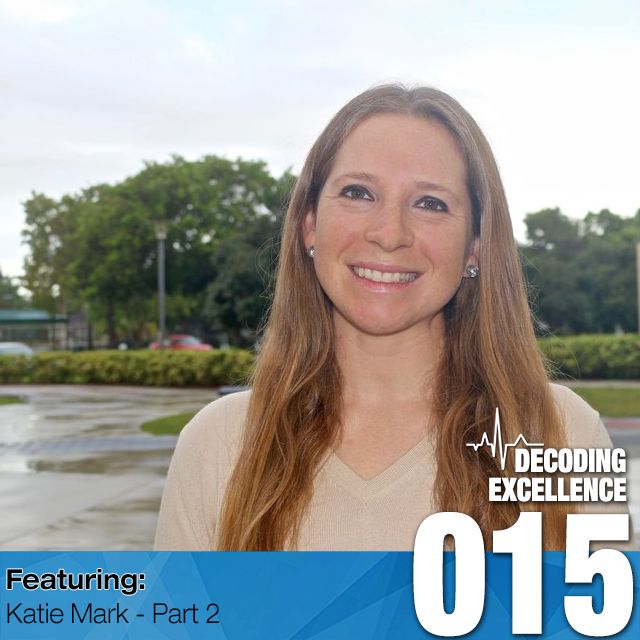
In this episode of the Decoding Excellence Show, I am again speaking with Sports Nutritionist and Owner of On Your Mark Nutrition, Katie Mark for Part 2 of our conversation.
If you missed Part 1, stop right now and download episode #014. It was an amazing conversation with Katie discussing everything from the gut microbiome; and how preventative nutrition goes beyond “Fueling”. We then discussed hydration and sport drinks; and whether athletes really "need" them. Lastly, in Part 1, Katie shares information about exercise-associated muscle cramps. It was an incredible episode and you cannot miss it!
Katie Mark, MS, MPH, (On Your Mark Nutrition) lives in Miami, Florida, where she trains as a competitive cyclist and works as a sports nutritionist, an R&D consultant and a writer. Katie's written works are nutrition-centered, evidence-based and intended for those who are sport performance or fitness-driven. She has a strong understanding of investigating nutrition science research and applying the science in the real world.
Her nutritional philosophy for optimal performance focuses on helping athletes achieve being fit and healthy by using nutritional strategies that target long-term training adaptations and long-term health. She holds a Master of Science in Nutrition Communication from Tufts University Friedman School of Nutrition and a Master of Public Health from Tufts School of Medicine.
This summer, Katie will start her dietetic internship (focusing on Sports Nutrition & Entrepreneurship) so she can become a Registered Dietitian-Nutritionist by early 2018.
Katie and I discuss:
- Being Healthy AND Fit
- Periodized Nutritional Strategies
- What is a High Protein Diet
You can catch up with Katie on Twitter at @OnYourMark_NUTR. You can also navigate to Katie's website, KatieMarkNutrition.com, and browse the many great resources she's posted. Check it out!
This episode of the Decoding Excellence show is brought to you by Vald Performance, the makers of the NordBord, DashBord, and the GroinBar.
They can be found at ValdPerformance.com
Stay updated with the podcast by following me on Twitter via @AdamRinglerIn addition to those social mediums, you can head over to AdamRingler.com/Newsletter and sign-up for my weekly newsletter. This is a newsletter for the curious. It's chalked full of interesting articles I've read through the week, things I'm exploring and finding fascinating through my week, and a collections of thought experiences and resources I've cultivated.
It's essentially a Birchbox newsletter for performance-related articles, research, and daily musings.
Thanks again for listening to the Decoding Excellence Show! I appreciate all the support growing this Sport Science, Strength & Conditioning, and High-Performance Coaching resource. If you have taken anything away from the show, please login to iTunes and navigate to the Decoding Excellence page and leave us a review.
Key Takeaways
- Being healthy and being fit are two different targets, and nutrition strategies should serve both, not just fueling the next session.
- Periodize your nutrition the way you periodize training: what an athlete needs shifts with the training block and the season.
- A high protein diet is worth understanding properly, including what "high" actually means for a training athlete versus the general population.
- Preventative nutrition goes beyond fueling, covering gut health, hydration choices, and cramp management as part of long-term adaptation.
About the Guest
Katie Mark, MS, MPH, is a sports nutritionist and owner of On Your Mark Nutrition in Miami, Florida, where she also trains as a competitive cyclist. She holds a Master of Science in Nutrition Communication from Tufts University and a Master of Public Health from Tufts School of Medicine, and her work focuses on evidence-based nutritional strategies for long-term training adaptations and health.
Listen and Subscribe
Find this episode of the Decoding Excellence Show on Apple Podcasts and Spotify, or use the player above.
Go Further in This Episode
Enjoyed this conversation? Here is how to get more from it:
- Read the transcript below to revisit key ideas at your own pace.
- Share this episode with a coach or colleague who would benefit.
- Subscribe to the Decoding Excellence Show on Apple Podcasts, Spotify, or your favorite app.
- Join the newsletter at adamringler.com/newsletter for weekly insights on human performance.
Episode Transcript
This transcript was automatically generated. While we strive for accuracy, some words or phrases may be misheard.
[00:00:00] I started to see that looking at us aesthetically, you know, we might look fit and ripped and have six pack abs, but underneath, like you mentioned, under the hood, you pop that up, like you can see, there's, your blood tells you a different story sometimes. Sport science, strength and conditioning,
[00:00:18] High performance coaching. Welcome to the Decoding Excellence Show. Today's episode of the Decoding Excellence Show is brought to you by VOD Performance, the makers of, the Nordboard, the Dashboard, and the Growing Bar.
[00:00:34] Whether it's return to play, rehabilitation, or performance testing and training, VOD Performance has the tools you need. So who's actually using VOD Performance Technology? I don't know something like 14 NFL, 19 NCAA, 15 English Premier League, seven English championship,
[00:00:53] Five NBA teams and six MLB teams. They have the tools you need to get the best out of your athletes. Check them out at VODPerformance.com. Welcome back to the Decoding Excellence Show. This is part two with Katie Mark.
[00:01:11] If you haven't listened to part one of this episode, please go back, listen to the show. It was an incredible show. Katie talked about everything from the gut microbiome, hydration and sport drinks to exercise and do muscle cramps. It was chocked full from start to finish
[00:01:29] With high quality materials, that not a lot of other podcasts and other nutritionists are talking about. But part two in Katie Mark's show today, we start to get into the weeds about a lot of other things as well. We start talking about the differences between fit and unhealthy
[00:01:47] And sometimes how athletes can be incredibly fit for competition. But underlying when you're looking at blood markers can be entirely unhealthy. Katie then goes into discussing periodized nutrition, how different macro and micronutrients are important at different seasons
[00:02:05] And different phases of high rigorous training schedules. And then she gets into the discussion of high protein diets, the myths, the facts, the realities of it, and starts really debunking some of the research out there and really goes into it. It was a fascinating conversation
[00:02:26] And I really took a lot away from what Katie Mark shared on the second half of this show. Towards the end of this thing, we start talking a little bit about some of the lessons that she's learned from mentors and her experiences working within Rio for the Rio Olympics 2016.
[00:02:45] And again, I cannot thank Katie Mark enough for coming on the show and really setting a high bar for the other nutritionists and people coming onto this show. She was prepared and it was incredible from start to finish.
[00:03:00] So a little bit of a different show I sit back, I take notes, I don't ask so many probing questions because Katie really just stole the spotlight on this thing and she was on a roll and I just wanted her to keep going. So please enjoy the next hour and 15 minutes of the Decoding Excellence Show.
[00:03:23] Grab a pen, grab a paper, get prepared to take some notes because this thing was incredible. So without further ado, here is my conversation. Part two with Katie Mark.
[00:03:42] And welcome back the Decoding Excellence Show. I'm joined with Katie Mark and we are on what is otherwise the second half of the show and for the listening audience, if this is the first half of what you're listening to then I would suggest that you go back, listen to part one
[00:04:02] Because you're gonna be missing out on a number of different great topics that Katie discussed, which is in way more in detail than what I'm gonna summarize here but certainly just the importance of the gut microbiome and how that impacts athletic performance
[00:04:17] And how you can get a better understanding of that as far as fueling and real food strategies to promote a healthy gut environment. Certainly Katie shared a tremendous amount of information as far as sport drinks and hydration and I use the word sport drinks with air quotations around it
[00:04:36] But really should athletes actually have sport drinks are their better rehydration strategies and Katie discusses a lot of that in the first half of the show and then we started to talk about sort of muscle cramps and exercise associated muscle cramps and the science or lack thereof of actual science to it
[00:04:58] And some of the research and some of the products out there that is actually sort of combating this thing. So if you haven't listened to first, the first half of the show go back, download it via iTunes or elsewhere, your podcast, listening of choice and listen to it because it's an amazing first half
[00:05:17] Of the show but for all those that are now joining us in part two, again, Katie, welcome back to the Decoding Excellence Show. Thanks Adam, I appreciate it. Yeah, part one I know is a lot of information but it's all great information
[00:05:33] And thanks for the intro, I really appreciate it. So for those who haven't listened to part one just briefly a little bit about me, I graduated from Tufts last December with two master's degrees, master's in nutrition communication and master's in public health, then moved back to Miami
[00:05:50] Where I was born and raised and so I've been working part time as a research and development consultant for nutrition. So various nutritional companies also work as a sports nutritionist and a writer in sports nutrition. So my work's even ghost written.
[00:06:08] So doing a lot of that and also training a lot as a competitive cyclist. I train about 10 to 15 hours a week which kind of cuts into my work but it's all, my training also helps being a sports nutritionist
[00:06:25] And being able to apply the science. And before, a lot of this that I'm doing right now it's also before I'm starting a diatetic internship this summer because I'd like to become a registered dietitian nutritionist so I could start working in pro sports. And I'm really excited.
[00:06:46] My diatetic internship is through a program called Wellness Workdays based in Boston and I'm actually focusing on sports nutrition and entrepreneurship and I've got some really cool rotation lined up for six to seven months of 1200 hours of work. So I'm really excited.
[00:07:06] I'm gonna be working with the registered diatician for University of Miami athletics and I'm also got a great opportunity to go out to Colorado and work with one of my favorite sports diaticians, Bob C.O. Harre and he was the former director of sports nutrition at the University of Florida.
[00:07:23] He was also a sports diatician for the U.S. Olympic Committee. He's a phenomenal sports diatician and I'm really excited to go out there and maybe hopefully tour the U.S. Olympic training center that would be really cool. Also, I'm really excited.
[00:07:39] I have a rotation early 2018 working with the Miami Marlins and a registered diatician under her supervision with the Marlins so that I'm really, really excited and I'm hoping by a early 2018 I'll be a registered diatician. I can start jumping straight into doing sports nutrition
[00:08:00] At the pro sport low. Hopefully, 2018, as well as once you're completed and you've tested that you're starting to answer interview interviews for professional and collegiate sport programs because they'd be crazy after the first half of the show
[00:08:18] And obviously the materials you've shared are in both Twitter and Instagram and elsewhere in the papers you've wrote they'd be crazy not to hire you. I hope so. Right, that's the plan.
[00:08:29] That's the plan. For the listening audience that missed it in episode and the first half, it's again, I referenced your Twitter and your Instagram but it's on your mark underscore in UTR for nutrition and on your mark nutrition for your Instagram accounts
[00:08:45] And I would imagine that if you type that in that you'd be able to find your resources and appropriate links to your pages and backgrounds and probably linked in and everywhere else. So thank you again for the update for those of those the audience
[00:09:03] That didn't get to listen to it and I'm excited for part two of this show because you're gonna discuss a couple of different things that I think when we look at the world of collegiate athletics that we see time and time again, athletes that and which will be sort of the first
[00:09:21] Hopefully topic that we can go into athletes by all count if we were to say that I test if you will that appear every little bit of fit whether it's aesthetically or else but might underneath the skin when we start to assess the blood and we start to look at different biomarkers
[00:09:41] Might be anything but fit. So I'd love for you to jump in on that and kind of know from your educational experience and professional pursuits here what you think when it comes to athletes are they fit but are they unhealthy where does that stand for you?
[00:10:00] So yeah, this is a really, really important topic and I really I was interested in this a long time ago or a few years ago when I started doing blood analysis and blood testing not just on myself but for different athletes and testing for certain biomarkers
[00:10:18] Because I started to see that you know looking at us aesthetically you know we might look fit and ripped and have six pack abs but underneath like you mentioned underneath the hood you pop that up like you can see there's your blood tells you
[00:10:33] A different story sometimes and so there was a great paper that was published recently titled athletes fit but unhealthy and I'm gonna you know give the correct contribution to Paul Larson he's an applied sports scientist
[00:10:51] And physiologist and he specializes in endurance performance he was one of the authors in the paper and this paper really resonated with me in terms of not only further solidifying my nutritional philosophy but just really seeing it published out there
[00:11:09] How there's such a need to address this and pretty much the observation is that you know we see athletes were fit but unhealthy and we see that on healthiness you know through biomarkers through blood testing through bone mineral density
[00:11:27] And this is not just athletes at the pro level or the elite level I mean this includes collegiate this includes recreational you know avid weekend warriors who train like athletes you know a lot of times you may look fit
[00:11:43] But you can be unhealthy and I think this is really important to educate people you know what are the definitions of fit and healthy and they have very different meanings you know specifically in taking it from the paper fitness is the ability to perform a given exercise task
[00:12:03] And health explains a person's state of well-being and in that well-being you want your physiology and all your systems in your body to work together and in harmony so as you can see there's big differences between the two and I think that a lot of times we have this superficial
[00:12:22] Interpretation of what it means to be fit and what it means to be healthy and a lot of people will see athletes as fit and healthy but many aren't you'll see that a lot of athletes will have high triglyceride levels or high fasting blood sugar insulin
[00:12:37] And all of that's going to predispose you to certain diseases and athletes aren't immune to chronic disease they just like the general population there's certain risk factors that still apply to them and you know Adam I think you know Ryan Horn out of Wake Forest
[00:12:56] Strength and conditioning coach but I think we had a tweet exchange one time because he you know he had the same observation that a lot of his athletes you know even though they have six pack abs they don't realize that you know when it comes to diet
[00:13:13] You know what they eat you know obviously impacts you know their health status inside the body that they don't see and really it's this idea that you know you can be fit but from unhealthy training and or an unhealthful eating combination
[00:13:30] That's gonna make you unhealthy on the inside and so really it's you know this excess high training intensity or training volume and you know or excess of intake of like process and refined dietary carbohydrate
[00:13:46] You know they can really contribute to poor health and athletes and in the long run you know impair their longevity and just as a side note in relation to this you know when talking about process and refined dietary carbohydrates
[00:14:00] Don't get me wrong carbs are important for an athlete especially obviously at higher intensities but I'm seeing a lot of times and this is really through social media I've seen how some of these you know
[00:14:13] Wherever it is either sports nutrition departments or you know maybe it's students that are doing it or I don't know dietetic students or you know strength and conditioning coaches
[00:14:24] Whoever it is working with your feeling athletes sometimes I see the foods that they're using to fuel athletes and it's like this process stuff you know it's just I feel like
[00:14:36] Maybe I'm wrong but their take on it is that oh we just need to get them energy and sugar so that they can you know train but it's really not considering the context of you know they're they're fueling
[00:14:51] You know sometimes you don't need like if an athlete's eating before they go train you know they just have lunch two hours before their training like why do they need to eat more especially you know junk food or some of these process foods
[00:15:04] Right before training is it really necessary and this kind of goes back into a deeper topic where which I'll kind of touch upon later on is this whole you know improving metabolic efficiency
[00:15:19] And so you know this is where this high volume and or high intensity training as well as the modern diet which a lot of athletes you know focus on this highly processed
[00:15:31] And refined carbohydrate and you know sometimes it's promoted among certain nutritionists or coaches whoever and it's really in a way contributing to an unhealthy athlete because in so many ways
[00:15:47] This you know highly processed and refined foods it's poor nutrition and this can cause increased inflammation in the body it can also you know impair your ability to burn fat for fuel which is really important
[00:16:02] And you know all this these forms of sugar which athletes you know may believe is necessary for better for performance and of course depending on the context it is but that's not always the case you know 100% of the time that you're exercising
[00:16:19] And so this really this you know this modern diet really can lead to poor health and like I said in the short term it's going to you know produce inflammation it's going to impair your ability to burn fat
[00:16:32] It can increase free radicals in your body so oxidative stress and over time this is going to you know lead to chronic inflammation and that's going to associate with reduced health but not only that
[00:16:44] There's other dietary factors that really contribute to this like excess alcohol you know omega-6 consumption is pro and flaminatory so having too much of that compared to omega-3s
[00:16:58] Which is anti-inflammatory you know the trans fat and and not just diet but lifestyle factors the stress so different types of stress that's also including psychological stress excess exercise
[00:17:10] All of this is going to contribute to chronic inflammation and really that's where it comes down to where yeah we have athletes who are fit but they're unhealthy and it's because of all these things and I previously discussed
[00:17:25] And so it's like okay what do you do from here? What's the goal? You know this is where I you know incorporate into my nutritional philosophy not just for myself
[00:17:34] But you know in my work is you know I want to improve obviously the performance of an athlete and there are certain foods that are going to help that you know certain carbohydrates like yeah if you're doing a really hard
[00:17:47] You know or long run maybe you know having sugar in the form of some processed food that wouldn't be good for you if you weren't training at that intensity yeah that would be appropriate under certain circumstances
[00:18:00] But you know my goal is to improve health while increasing fitness and that really comes down to diet obviously the training part the high training volume and intensity that's obviously not my
[00:18:15] I don't think that's really my scope of practice I would leave that to coaches but in terms of diet focusing more on replacing highly refined carbohydrate with healthy natural carbohydrate
[00:18:28] I like to focus more on fruits and foods in their wholesome form and you know healthy fats and plenty of protein which I'm a huge advocate or protein which I'll talk about later on but all these things and
[00:18:41] And there's really cool ways to manipulate especially related to carbohydrate intake manipulation to help improve fat burning and improve certain biomarkers that are important for metabolic health so really going off of that
[00:18:57] My goal is to you know especially since you know this need of where we're seeing the athletes are fit but unhealthy actually I'm just going to throw out a quick example I had an athlete who you know not like lean she lean
[00:19:14] Great shape has abs works really hard and is fit but then when she got her blood tested she saw that her fasting blood glucose was near pre-diabetic levels and you look at this athlete and you're like you got to be kidding me
[00:19:30] Like there's just no way you are near pre-diabetic I mean there's just no way and that was really what was really fascinating was that instigated a behavior change in the athlete because it was this fear like oh my gosh
[00:19:45] I can't believe this now I need to do something about it you know now I need to listen to you and you see this difference because you know athletes are not immune to these problems and you know so obviously the hard part is
[00:20:02] You know how do you get the athletes to make a change and it really comes down to behavior change and some of the ways you can do it is by showing them data in their body blood analysis looking at different like cortisol levels testosterone levels
[00:20:17] Bone mineral density you know all these different things that are going to tell you a different story really can motivate an athlete to make a change and so that's really what I focus on I really think that optimal performance
[00:20:28] I think sometimes you know in terms of I know you've seen this all the time Adam and sports nutrition it's always focused on feeling the athlete and you look at the fuel and a lot of times it's just you know I don't you know it varies but a lot of times
[00:20:42] Yeah it's very poor fuel and don't get me wrong athletes need energy and they need certain things but I really think we need to just take a step back and look at the athlete holistically and really break it down in terms of context
[00:20:54] Of you know every single training session every day and the differences and needs so that we can then optimize their diet so that in the end obstacle performance is really athletes who are fit and healthy and this is really going to help their
[00:21:10] Overall health and longevity in addition to performance what resonates with me on that is a number of different things but you know a lot of the times when we have athletes as they go through sort of the armed boarding here from freshmen to senior year and they are leaving with the grudge you know
[00:21:27] Like their degree in hand and hopefully some championship rings and the other that as they go through their career I think what's sort of common to think about is that especially in the collegiate world where you know there's always another level of recruits coming in
[00:21:42] Is that you would think that very sort of unhealistically you would think that you know it's a churn and burn sort of situation where they should be leaving worse but what we found is that when we go through lifestyle and nutritional education
[00:21:59] Intervention to help promote recovery a lot of the times our juniors and seniors feel better than when they did their freshman year and while their bodies might be older and they might have a little bit more mileage a lot of our athletes at that time really turn a corner
[00:22:14] Because they start to understand how much nutrition pays plays an importance when it comes to the management of inflammation a lot of the times the freshmen as they walk into our facility never really know how good their bodies even supposed to feel
[00:22:32] Because of the over consumption of you know low nutrient dense foods and high omega-6 and pro pro flammatory foods and poor sleep or any increase of alcohol intake as a sort of leave the nest and actually come to college for the first time poor nutrition and intense
[00:22:49] Training it's almost a perfect storm to set them up for you know in flammatory responses and inability to ever really fully recover from one intense especially the intensification from going from one level just to the collegiate world but you combine that
[00:23:07] With the perfect storm of poor nutrition and they're we're digging a hole that they're never able to actually climb out of and then secondly what really surprises me and you said it you alluded to it in that that discussion was just the the idea of
[00:23:28] Wow it's important to fuel athletes and we want to fuel athletes we have to sort of understand what the quality of fuel is and while athletes are trying to reach a certain threshold from a calorie standpoint you know it reminded me when you were
[00:23:42] Talking about poor fueling strategies it reminded me of like Dwight Howard a couple years ago when he was still with the Lakers and it famously wrote you know I think it was an expoze or an ESPN article but it talked about how his fueling strategy
[00:23:59] To reach the calories he needed to was like 24 candy bars a given day and the negative consequences from a nerve standpoint from a inflammatory response to those simple sugars and over consumption really was breaking his body down and as that organization
[00:24:17] Started to change what he was eating and his fueling strategies and reduce some of those simple sugars and some of that consumption of poor nutrient foods not only did his body respond he felt healthier and and a little bit more robust and resilient to injuries so a
[00:24:33] Huge critical piece as far as the promotion of athlete wellness can be tackled through new through a focus of what we're actually consuming and how we're actually consuming it right and I don't mean to interrupt but just because you mentioned the Lakers I love that
[00:24:49] You mentioned that because I really want to highlight the strength and conditioning coach there Tim D. Francesco he has done a phenomenal job he does a lot of their nutrition and I follow him on social media I really recommend people follow him I love what he does I love his
[00:25:05] Nutritional philosophy and he's done a really great job with the Lakers and I mean to me like that's really awesome to see that a strength and conditioning coach like him really stays up to date on nutrition and proper fueling and really I think he's done
[00:25:22] With the Lakers so it's just money that you mentioned that because I know he was involved with that whole Dwight Howard thing and so yeah as far as a performance standpoint and you know I know there's 800 different definitions and titles that we all call ourselves but
[00:25:37] We all share a responsibility in the education or at least compliance or at some basic level some foundational level about what the athletes are consuming and the many touch points that we can have in an athletes day whether it's in the gym or it's
[00:25:54] On the practice quarter if it's in a one-on-one session or if it's in the cafeteria I mean if we're all considering at trying to you know influence positive performance then I think we all sort of owe it to an athlete to do our very best work in all the modalities and trans
[00:26:12] Disciplinary uh foci that we we have to to increase performance I agree 100 percent this might be a good time to start thinking about sort of our next topic that I'd love to discuss which is I think the the the hardest part perhaps of nutrition and that is
[00:26:35] As we start to understand what to eat and how to fuel and sort of the right approaches um the approach that we might take for one team will drastically maybe different from a calorie standpoint from another team based on what the bio demands of that sport is or
[00:26:51] Positionals demands but at an even even deeper focus the individual plans and I think once we start looking at sort of well how do we periodize out how do we focus and individualize and tailor the nutritional sort of plans that we have that becomes a little bit more
[00:27:10] Of a challenge and I think it it takes a greater attention and maybe a more of a team base something like a registered dietitian coming into work with a program that might just exceed the skill sets the scope uh and the expertise level of all the various
[00:27:26] Other sort of transdisciplinary team that you have so I would love to hear a little bit more about sort of what a pure dyes nutritional plan looks like at least uh whether it's in collegiate or professional or even sort of an individual uh plan you know you hit it on the
[00:27:42] Head um if it is or to do you know more individualized nutrition in certain settings like team settings like basketball or football or soccer or whatnot um but it's really needed and there's this concept and I've been doing this for quite a few years um of called periodized
[00:27:59] Nutrition and essentially it's it's nutrition periodization tailored to training periodization so periodized nutrition is you know you use strategies to combine your exercise training and nutrition um with the ultimate goal of you know getting certain
[00:28:15] Adaptations that are going to enhance your exercise performance um and so when you periodize your nutrition your your nutritional intake is going to change in response to different periods of your training um so you know as you know um in you know athletes
[00:28:32] Training we have macro cycles micro cycles mesocycles and all those different things have different energy requirements um and even recovery recovery requirements nutritionally um and so going off of this um one of the goals for a couple of the goals under
[00:28:48] Periodized nutrition how I see it is you know fueling for the work intended so that's a real simple way that you can explain to an athlete um how you know obviously your trainings and your different even day-to-day variations um they're going to require different fueling strategies um
[00:29:05] And also under this I see the concept of improving metabolic efficiency which is uh really a coined term by uh Bob Cipohar who I mentioned earlier uh phenomenal sports dietitian um and essentially with metabolic efficiency is that um you're trying to be a better fat burner
[00:29:25] And you're trying to use as much fat as you can up until a certain exercise intensity before you have to switch to carbohydrate and this is really important um because and I really highly recommend that people read um Bob Cipohar's book metabolic efficiency training
[00:29:44] Because it really explains this very well very simply especially for athletes they could read this um but really you're trying to manage your blood sugar and you're using different food combinations to do so and and the point of this is to get you to rely less on simple
[00:29:59] Sugars during training or competition and really getting your body to become more efficient at burning fat at higher training intensities um and really the great health effects of this is that it's going to help reduce risk factors for a certain metabolic
[00:30:13] Disease you know in this case like type two diabetes um you know this is going to help you know have better fasting blood sugar levels more sustained energy um and lower your calorie needs per hour during exercise and even body fat loss um and essentially with this you're
[00:30:30] Having you're using different nutritional strategies that are essentially uh focused around manipulating carbohydrate intake um but really this is so important um to to incorporate this and it really goes down to um individualized nutrition obviously um and don't get me wrong this is not a
[00:30:49] High fat low carb low carb high or high carb only or high fat to have a diet it's really this is where it's not black or white i really don't see nutrition like this and um you know i used to be as an example of i was very big into the high fat low carb or the ketogenic lifestyle and i was
[00:31:10] Ketogenic for six six months um and i really believed in it because you know being an endurance athlete i wanted to rely less on sugar when i'm doing these 100 mile rides i wanted to be focused on you know being good at burning fat um and it's you know some people might say like oh
[00:31:29] But that's really more so for endurance athletes you know if you're a basal player like you know you need the carbs or whatever um but you know i really think being being able to be metabolically efficient um it's for everyone because even at rest and you at lower intensities you
[00:31:47] Want to rely more on burning your fat rather you want to spare your muscle glycogen your liver glycogen um so really it's for all type of athletes um but you know this goes back to this constant fight we see in forcing nutrition of high carb versus high fat and like i said i used to be a proponent of
[00:32:05] High fat low carb and but i moved away from it when i know all honesty when i read about metabolic efficiency training and how really it's gray it's a gray mix of carbohydrate and fat it's really not black or white um and this is really emphasized through paradise nutrition um because there are benefits to
[00:32:25] High carb and benefits to high fat obviously it really high intensities if you're going to go sprint 100 meters in the Olympics carbohydrate is um but you know in certain trainings you can decrease the amount of you know carbohydrate you intake and become a better fat burner and
[00:32:41] Especially important in certain um in certain sports um so with this paradise nutrition is is really cool to me and one of the things i don't know out of if you've seen this on my twitter but i talk a lot about train low um and i just love the concept of train low um pretty much it's a term a term to
[00:33:03] Training with low carbohydrate availability so this means like muscle glycogen or low liver glycogen or a low carb intake during or after exercise um and this really is the goal is to help get training adaptations to improve your performance and one of them being being better at at burning fat
[00:33:22] During um exercise and also improving blood glucose levels um and there's all different ways to train low and you know i use it as an endurance athlete um but it really i think it's applicable to anyone um you know some of the ways are to train fasted or train twice per day so you can train in
[00:33:40] The morning and then have little to no carbohydrate and then train at a lower intensity in the afternoon um you can train with uh low carb intake during you know long training exercise um and there's a concept of sleep low so training late in the day and then going to bed with carbohydrate intake
[00:34:00] That's restricted um and really i i just love these these different methods and it's it really comes down to um how incorporating them um is really important because it comes down to the impuritiesation of athletes nutrition and obviously you know these different things like train low is not only
[00:34:21] Just one of them which has like i mentioned all different types of strategies under it but there's also train the gut which um asker yukendra who i talked about earlier this the purpose of that nutritional nutritional strategy is to allow for faster absorption of carbohydrate and reduce
[00:34:38] GI distress so you would do that during training um also train high so training with high carbohydrate availability training dehydration um and or you know even improving training adaptations by using certain supplements so dietary nitrates um especially from beetroot juice is a perfect example um
[00:34:59] So these are just different nutritional training methods under periodized nutrition um that are really really cool um and it really takes knowing the athlete and because i mean it's not that it's hard to incorporate but it's not like it's super easy like saying hey go eat some carbs so you can you know replenish your
[00:35:19] Muscle glycogen right it's you actually have to periodize that nutrition and you have to incorporate the train lows or the training the gut during certain um things in your training calendar you know um and that goes back to you know what's your macro cycle what's your micro cycle what's your meso
[00:35:36] Cycle like all these different things and what are the athlete's goals you know um and so even with this periodized nutrition which if you're really interested in i highly recommend reading um asker yukendra he uh came out with a paper um periodizing nutrition for athletes uh like a few months ago and it's it's done phenomenally i mean you
[00:35:58] Say it on social media all the time and it's really a great outline of it all um but there's still you know he even says that there's some unanswered questions you know like how many days per week would you implement these nutritional strategies you know what should the intensity or duration be when you're using some of
[00:36:15] These um like as an example when you're training fasted um you know after how many weeks are you going to see these effects um and so to me as a sports nutritionist as well as an athlete you know because i implement these nutritional strategies i understand the perspective and what you have to consider as a um
[00:36:36] You know a sports nutritionist working with an athlete you know what you what things you have to consider when you're going to implement this into an athlete's um training plan um so as an example which relates to training low and specifically training fasted so um you know training after uh early in the morning after
[00:36:57] You were sleeping in a fasted state and not eating anything before training um you know one of the things i consider is obviously you should go at a lower intensity um but if i was going to incorporate this train low i also consider the environmental conditions so let's just say as an example i say okay Tuesday um
[00:37:19] This is going to be an easy day on the bike and i'm going to do a train low strategy um let's say on Tuesday and i'm in south florida and i ride on an island um and wind happens to be a huge huge factor and even if you want to go easy sometimes you can't because if you're going against a 20 mile an hour headwind it brings up the intensity of your
[00:37:41] Workout when you didn't even intend to go at a higher intensity so it's kind of funny because these are different factors i have to think about as a nutritionist and an athlete being like okay is it worth it based on the environmental condition of that day and my training goal to train low or is it really just going to hurt me um
[00:38:01] And so these are just you know it kind of complicates the situation but you know if you're an athlete and you understand nutrition um or you're working with you know as a nutritionist you're working with an athlete and you understand the context of their sport and the different factors that can um impact using these nutritional strategies
[00:38:22] Then you know it really helps um so really the the concept of periodized nutrition um to me is very important and it's something that i practice with myself and with the athletes i work with and that really focuses on and this is what i tell them like you need to change your energy demands every day based on what you're doing you know as an example you might look at a runner or
[00:38:46] Cyclist and and say like okay for that's where you got to eat high carb like all the time but really no you don't you have to periodize your intake based on your training and the energy demands of that um and then this will help you health wise um by you know making your metabolism more efficient um because if you you know like we discuss in the in the first
[00:39:09] Part of the podcast if you're constantly eating you know a high carb diet and um you know let's say you're you have an easy recovery day you're just doing you know an easy workout even for like an hour and it's really not at high intensity you're still increasing your blood sugar um you're increasing your insulin when you really don't need to and it's really you know helping
[00:39:33] I mean hurting you um in your management of blood sugar so these are just big picture things where it comes down to where diet is not the same every day you know take for consideration football players um and their different needs even based on positioning um and it's just it's really really important um and i think sometimes athletes don't think about this um
[00:40:00] And maybe even you know people surrounding them whether it's nutritionists or whoever you know or maybe there's a lack of it um this education of really explaining the context of things and how you periodize your nutrition because i really think that not only is it going to help with training adaptations which is one of the goals of periodized nutrition and these particular strategies i talked about
[00:40:23] But it's really going to help with their overall health um like i discussed the forward no no athletes immune to disease um so that's really the the goal of periodized nutrition and and that's why i really use it and i love it i think it's it's a great way to take sports nutrition and fueling to a whole different level you know like and and ask your material if you're if you're unfamiliar with it
[00:40:46] It is uh the site that you can find a lot of that is my sport science.com and uh his graphics i think not only the graphics the visualization of them but the material that he shares is easily digestible and which is sort of a pun but uh an educational pun if you will but uh the materials that he shares are top-notch and uh and from a periodized nutrition standpoint i love the fact that we're tying in you know
[00:41:15] The emphasis of training and the influence of what you're nutritionally intaking and how the the two obviously work so closely and i think what's that sort of contingent upon is the constant communication from a technical tactical standpoint the physical development standpoint and the nutritional team because again if it's going to be hey Tuesday we're gonna go off course from a periodization standpoint and we
[00:41:42] Are gonna have an intense 11 and 11 then maybe we need to do something in the the the preparation nutritionally for that practice a little bit differently than say if it was a scheduled recovery so the the communication i think between all the teams have to be um very very concise and very armed board with it and uh i think one of the things that we've tried to do here at Wichita State that i think is
[00:42:08] Really important too is as an athlete's coming to their end of their collegiate career just like you would have the the the armed boarding of educational resources for an athlete as they're coming into their first competitive uh environment from a freshman standpoint i do think it's contingent upon us to also educate what athletes need to do as they're coming to their end of their career
[00:42:32] And how they need to influence and change the nutritional intake that they have to match what their level of physical activity is going to be especially if they're going from 20 plus hours a week of you know intense physical activity to reducing that down to less than five or two or one or some of them you know are getting out of athletics uh to pursue professional disciplines that those calorie differences certainly change
[00:42:58] And i think that that has been from a holistic standpoint a well-needed educational intervention to help prepare these athletes i love that you just said that because that's one of the things that i've done with some athletes it's called i call it nutrition detraining you're right they've gone from all these years of this all these hours of training and different energy needs and then they go
[00:43:22] Into the real world into a 40-hour week sedentary job and it hits them like oh my goodness i can't eat the way that i did when i was an athlete and it really hurts them because those were habits that were so ingrained and those were you know flavors of foods and everything that you know you were so used to and so accustomed to that so hard to get rid of that and then they see weight gain and and you know all these
[00:43:48] Different health effects and you know i just have you know one example i've worked with um a couple tennis players who played collegiate tennis and you know it's just funny like when they when they're done and they're out in the real world how i've seen them freak out about this and you know they can't go for the 400 calorie starbucks latte anymore because they're not playing tennis like they used to and it's
[00:44:14] It's a big problem and they have no clue because they weren't equipped with anything nutrition education wise on okay how do i change my eating habits that i've done for so you know this even happened to me when i was a tennis player competing like at my my my nutrition intake was obviously different than when i stopped playing and i had a hard time realizing that and i'm pretty sure i gained weight um
[00:44:39] And it's really really important i call this nutrition detraining and this is not only important for collegiate athletes but look at professional athletes especially those in the NFL and how oh my goodness the the differences that happen once they retire and they go and they're you know i don't even know what they're doing in their retired life but you know let's say relaxing um and they're not training like they used to they experience the same
[00:45:03] Problem and so that's one of the things that i do with athletes because i get it and it's it's very psychological too um and i call it nutrition detraining and i think all of that material that you share has been well-needed to be discussed and you know maybe the the last thing i wanted to kind of talk about is we sort of come towards the end of potentially hour two here is a topic that i think Brandon Marcelo
[00:45:28] Spoke about last year at the Seattle sports science conference that Dave Tenney hosts out in Seattle which is coming up here in a couple weeks uh typically the second week of June here but gave a tremendous topic uh conversation about sports nutrition and talked a little bit about uh protein in this discussion and i i'd love to hear your thoughts as far as uh how much protein the body can
[00:45:56] Utilize high protein diets in general the effects of uh of protein from a body composition standpoint and just some of your your thoughts on the topic yeah i love this topic um in fact personally um i really think that protein should be the default macronutrient especially for athletes um and i think uh when people think of protein i feel like in a way they think that it's only for muscle protein synthesis um
[00:46:26] And i feel like i mean obviously yes but there's other functions of protein that are so important that your body uses it for and it's not just going straight to your muscle um it i mean it's growth in maintenance so obviously muscle and and connective tissue proteins use an enzymes it's used in hormones like insulin and glucagon um it's used a bit for energy you know forming glucose from amino acids um proteins are
[00:46:51] Using transporters in your gut um they're important in immune functions so they form antibodies um they're used as neurotransmitters they help maintain acid base balance and maintain fluid balance so their really protein is so important in your body and i think sometimes people forget or maybe they don't know um it's not just going your muscle and so you know we really do need a bigger intake of protein than i think we see
[00:47:17] Um in the american diet and you know this kind of goes to okay how high is high and in all honesty um i before i i i've been an athlete who's focused a lot on high protein um but you know i'll be honest i didn't really know what specifically is a high protein diet what is it really um now if you look at the recommended daily out allowance which the rda it's um point eight grams per kilogram a body weight per day for protein um and really this is just
[00:47:52] This is not the optimal level this is really just the minimum level um and you know the definition of a high protein diet really has been considered you know greater than like 15 percent of your total energy um and as high as 35 percent of your total calories or intakes um in regards to the rda um but really you know defining what a high protein diet is is better done through explaining you know daily per kilogram amount of
[00:48:26] Body weight so not percentage of total calories um and one um the international society of sports nutrition's position stand on protein you know they even come out and say that protein intakes of 1.4 to two grams per kilogram a body weight per day for physically active individuals is not only safe but may improve the training adaptations to exercise training um so if you look at that
[00:48:55] Range of protein intake um and i know what you know others have said that oh for endurance athletes it should be like 1.2 to 1.4 grams and for strength trained athletes 1.6 to 1.7 grams um but and for those who are like an intermittent sports like basketball it should be like 1.4 to 1.7 grams but really the upper limit has been around like two grams per kilogram of body weight per day um as proteins for athletes um and i'm going to talk a
[00:49:29] Lot about uh Dr. Jose Antonio he's a good friend of mine he's he's awesome i don't know if you follow him on some media but he's he's great and he is the CEO of the international society of sports nutrition he's also um one of the leading researchers on high protein diets um and he's fantastic he's an associate professor at Nova South Eastern University down in South Florida um
[00:49:53] And in in regards to affect on body composition i mean i'm gonna i'm a lot of the studies i'm gonna you know talk about briefly here it's it's really coming from him um you know in terms of body composition you know high protein diet can be favorable in helping the energy balance equation and really it can have a protective effect on preserving lean body mass during weight loss so i'm sure you've seen a lot
[00:50:21] Of athletes Adam who you know they're trying to lose weight and so they have this caloric deficit um and with that you're gonna lose muscle mass which you don't want to do because then you have to startle over again and build up your muscle um and studies have shown that if you increase your protein intake you can still gain muscle mass even when you have a caloric deficit um and so you know just briefly touching upon some of uh
[00:50:48] Jose Antonio's work you know in 2014 he he had the first study that showed high protein diet study it was the first one and there was also higher in calorie they didn't find a change in body composition when um they did 4.4 grams per kilogram of body weight per day which is very very high and they measured body composition and performance and this was this is five times the amount the RDA of point E um and they found no effect on body
[00:51:19] Composition so um in resistance trained individuals and this was at the point considered a true high protein diet and you know he did a follow-up study in 2015 um using resistance trained men and women and um the protein was 3.4 grams per kilogram of body weight per day and they combined this with you know a periodized heavy resistance training program and they saw a loss in fat mass and there were also no side effects found
[00:51:50] So this was showing it was it was favorable on body composition um and there was no effect on unblood lipids or markers of um kidney function and so this was really this is important research and i feel like a lot of times um when you see in the media about high protein and and you know if you eat too much protein it's gonna lead to body fat what we have studies right here that if you do a simple pub med search which you know any nutritionist or dietician or whoever in science should be able to do
[00:52:27] You can find these studies and you know even another study that he did in 2016 it looked at high protein diet on um the health and body composition and resistance trained men and um it was actually the first randomized crossover trial for high protein diet and they found that even overfeeding on protein um didn't have a negative effect on body composition and you know it's like okay so how does a high protein diet um you know how does that help body composition or how does it not hurt body composition and you know one of the things
[00:53:08] Is that you know you can look at the thermic effect of exercise so how much you're burning there um then you can look at non-exercise activity thermogenesis so examples of this would be like you know walking around or you know um walking upstairs or you know um moving your shaking your leg or whatever things like that um and then also combining the dietary protein's thermic effect so the the thermic the burning of you know from the speeding the thermic effect of feeding and for protein it takes it's between um like 19 and 22 somewhere around there percent
[00:53:47] Of the protein that's burned um just from you know digesting protein um and you can if you compare that to carbs it the thermic effect of carbs is around 12 to 15 percent somewhere around there um and then fat is like very low I think it's around like 2 percent um so if you look at the thermic effect of protein you're seeing that there's a greater caloric output so you're burning more calories um because of this protein intake and not only that but it's also a very satiating or filling nutrient um you know and this can help decrease you know your food intake so if you're
[00:54:23] Trying to lose weight which is very difficult because of appetite which is psychological um you know the more satiating the nutrient is then this is going to help you with um having a lower food intake um and you know going back to these studies they there was no change in blood lipids or kidney or liver function and um so it's really fascinating and even in one of the studies they looked further into two subjects that even went higher than the RDA by like I think it was like over 500 percent and even up to 700 percent and they looked at that in relation to the kidney
[00:55:02] Function and there was no change in the kidney function um and so they suggested you know there's no harmful side effects from this um and so really the study and in Jose studies really suggest that when you have this protein overfeeding and even if you're increasing total energy in tight intake you're less likely to gain body fat and if you're restricting your calories it's going to help preserve um lean body mass which is obviously critical because you don't you know want to lose weight and have you want to obviously to come from body fat and not um muscle mass and so um you know
[00:55:38] Essentially this is showing us that consuming protein well above the recommended daily allowance can really alter in a favorable fashion body composition um as long as you are training and you're exercising and you have an exercise training regimen um and in fact he's now running another study on high protein diets and women and I'm in the study um so I'm eating so I'm eating let's see what I mean I'm eating about 2.2 grams per kilogram of body weight uh a protein per day and actually even on some a lot of my days I've gotten above three grams um and so I mean I take
[00:56:19] In about 150 to like I've reached up to I think like 240 grams of protein in a day um I'm averaging around like 160 and let me tell you something I'm noticing a big difference in body composition and I'm not changing my carbohydrate intake um it's still around what I usually do because I periodize my carbs um and I'm really not changing anything and I've noticed a huge huge difference and I I don't look at scales because I I could care less what I weigh um I care more about how I feel and how my clothes fit because that that's a better um gauge in my period in my opinion um
[00:56:56] And I can tell you right now my clothes fit much better um and so you know in his high protein studies so now he's looking at women and uh we're all resistance training and I don't I'm not sure what else I don't know if he could tell me what else he's looking at because I actually don't even know if I'm in the control group or not but anyways um but I think also he's looking at bone health um and how it affects um bone mineral density which is another thing that I'm going to talk about um because another concern with high protein diets is that you know they can increase the amount of calcium
[00:57:32] That's excreted in your urine and this can increase your risk for osteoporosis and this isn't good and and really this is not the case um and this idea or this myth behind it is because you know some of the early studies were reporting you know this increase in in the acidity of your urine um due to an increase in your dietary protein and it it appeared that there was a like a link drawing calcium from the bones um in order to buffer this acid load um but really the main source of the increase in your urinary calcium from a high protein diet is as shown to be
[00:58:13] More of um due to intestinal or dietary and not from bone breaking down bone or getting it from bone so ultimately this bone loss hypothesis has really been refuted and in fact um the national osteoporosis foundation they came out I really with a recent um review um of dietary protein and bone health it was a systematic review and a meta analysis um and I'm going to give a shout out to my uh alma mater toughs freedom and school nutrition science because there's a lot of authors on this paper that came from toughs and they concluded there was no adverse effects of higher
[00:58:50] Protein intakes on bone health and in fact in in some uh bone sites there was a positive trend on bone mineral density um and so you know they even mentioned that increasing dietary protein how does significant increase in the um calcium absorption in your intestine um and there was no increase in you know skeletal breakdown and in um in terms of getting calcium um and I kind of go with this I'm really excited to see you know um I'm like I said I've done high protein most of my life but now I feel like this is you know what I'm doing in the study is now a real high protein um
[00:59:28] And my bone bone bone mineral density when I tested up at Nova South Eastern um was 2.2 a T-square of 2.2 um so I was really 98 percentile so my bone mineral density was higher um like 98 percentile of my bone mineral density and I like I said I've been doing high protein for most of my life and now it's it's even higher and so we'll be really cool within a year to see how this you know even higher protein intake than what my body was used to um will affect my bone mineral density um so I think that will be really cool I mean granted there's so many different things that will affect
[01:00:08] Your bone mineral density obviously strength training being one of them um that's why I really prioritize um you know resistance exercise um but really it's it's coming down to in terms of the myth regarding calcium that there's no adverse effects in that sense now could we have some randomized controlled trials that you know go for a couple years yeah let's see what happens then um but as of now there's there's nothing to support that you know it's bad for for your calcium levels and bone health um and kind of going off of this in terms of going on with these myths and
[01:00:46] The reason why I really wanted to bring this up is because I've seen this a lot in social media recently and in help or you know different magazines I think more that are geared towards women um and Jose and I have really you know kind of laugh like we'll we'll send each other some of these you know high protein articles or tweets we see that are so against high protein and some of the things they say that has no science to back it and um you know it's become a big thing recently that we're seeing and you know one of the myths is regarding the amount of protein absorbed at one
[01:01:22] Time and um you know some some publications you know have said that you know maximum stimulation of muscle protein synthesis rate occurs you know when you intake 20 to 30 grams of protein at one time um and I remember there was a tweet recently I'm not going to get too much into it but it stimulated a lot of controversy um because the way that the tweet was phrased and this was coming from a reputal source um it was phrased that you can only use 30 grams maximum at a time um and really it's been shown in a study that you can actually um still oxidizer burn protein amino acids
[01:02:03] At doses much more much higher than that um there was actually a study that found that you know taking in 40 grams of weight protein after resistance exercise stimulated a larger response in muscle protein synthesis compared to 20 grams um and this was in young resistance trained men um so essentially it was showing that 40 was better and so really you know to take away from this the biggest thing is that you know currently it's we don't know how much protein your body can use at one time um but for some odd reason people are just it's I guess you know people are saying oh
[01:02:45] 20 to 30 grams is what you can you know absorb in a maximum and use it one time and I think that's kind of something that's been said by people who maybe just want to you know not promote a high protein diet um really it's we don't even know how much protein your body can use at one time um and kind of going into another myth regarding the kidneys which I which I talked a bit about earlier in Jose studies um and how they didn't find any detrimental effects on the kidneys um you know this myth is still around because you know eating more protein is going to increase the amount that
[01:03:23] Of work that your kidneys do so this increases the load on your kidneys right and so there's really no data that exists on this um and if you really ask someone like hey you know show me some research that shows in healthy people that too much protein will hurt your kid hurt their kidneys and there's there's nothing to show that um now if you already have an existing kidney problem that's a different story um we're not talking about that we're talking about a healthy population there's no detrimental effects on the kidneys and like I previously mentioned in Jose's
[01:04:01] Three studies up there there was nothing um in fact Stu Phillips I don't know if he part of him he's another great researcher um and he had a review that came out on um higher dietary protein diets in weight loss and specifically a focus on athletes um and he specifically states that um you know an examination of the statements that come from the institute of medicine with respect to the protein RDA um in the United States as well as the World Health Organizations report on protein intakes there really is no evidence to link a high protein diet to kidney disease um so when you see
[01:04:43] This out in um you know in you know some health magazine or you see a tweet that you know oh you shouldn't have high protein because it's going to the effect on the kidneys or whatever there's nothing to back that and this also leads me to okay so why is there so much misinformation about this in the media um and honestly I don't even know like for instance I've had conversations with Jose on this you know why are people stating this and you know I when I looked back at some of my nutrition textbooks and that same statement you know regarding the kidney function was in there
[01:05:19] And um it's just really fascinating that you know why is this information there and misinformation and you know I've even asked some uh register dietitians for instance so I was like hey like look I'm gonna I want to send you some of these studies to you know regarding you know high protein diet and I'm just curious as to why you know people you know still promote these myths um and one of the things that was mentioned to me was oh well because you know if an athlete increases their protein intake then that means that they're probably gonna have a lower carb intake
[01:05:54] And we know carbs are really important for them and you know so when you have a higher protein intake it's just gonna replace their carb intake and you know I even told Jose this and he was like you know I kind of don't see it that way um and I don't see that either because I think first and foremost athletes love carbs yeah right typically they uh that's the first and probably easiest thing they they reach for yeah I'm pretty sure that's not the case and even in his studies his high protein studies like he net it was never a low carb component the carb was just kept normally um so really
[01:06:32] That's not uh I mean if you have someone maybe who has an eating disorder and they're looking for fat diets and they see certain things on high protein and low carb that's a different perspective but I really don't think it's going to replace carbs and an athlete's diet um and so it's just really fascinating how we have all these myths and a lot of it is being written not a lot of it but I've recently we've seen a lot of it written by people who really should know um where to look if um you know regarding statements like that and it all it takes as a simple pub med search
[01:07:08] Of the research to figure out okay what is you know the conclusion regarding um the effect of high protein on kidneys or the effect that it's going to have on our bone mineral density um and there's there's no research that states otherwise and so that's why it's very confusing why we have this misinformation in the media um and I just it's it's kind of mind blowing it really isn't I just don't understand it maybe certain people aren't keeping up with the research I don't know or you know they have ulterior motives as to why they're just so anti-protein when it's such an
[01:07:45] Important macronutrient um and it you know especially for the athlete who wants weight loss and maintains their muscle mass it's so important and it can help that the protective effect um and so I just I thought this would really be important to just briefly touch upon these things and kind of um hopefully steer it clear and I hope if Jose is going to listen to this he uh likes my the job that I did it explained he's a big we have conversations on this all the time and so he's like yeah love that you're gonna talk about this it's yeah I know he has to uh at some
[01:08:22] Point in time be listening and incredibly proud of uh of the the topics and your champion of this uh this philosophy and this pursuit Katie I want to respect your time I know I've stolen or I've asked you to come on and share what is otherwise uh a lot of information and I feel like in the time that we've spent together that there is such a huge critical umbrella of a holistic approach to sports nutrition that not not only helps athletes achieve the performance that they're looking for but maybe more importantly uh and certainly more importantly achieve a holistic
[01:09:04] And well-balanced lifestyle outside of it and it's setting them up for continued success uh and health and well-being outside of their athletic performance and I think those two uh are more hand in hand than they are uh separate especially with a well-rounded approach to sports nutrition so is there anything that if someone was listening to this and they wanted they whether it's high protein diets or pureized nutrition or or cramping or you know that the philosophy around unhealthy fueling strategies for athletes and and what they could do different or hydration or sports drinks
[01:09:44] Or the gut is there any resources that you would want to point them to or ways that they can connect with you so that rather than sort of just being exposed to the idea of it that they can kind of dig deeper and maybe ask you the the a little bit more specific questions I know I'm I mean I'm always open to people asking me about these topics I love I mean I'm constantly up to date on you know sports nutrition research and this is my passion more so like you'll see a lot of dietitians focus on like recipes and helping people you know come up with recipes and all those things but this is more
[01:10:19] My focus the nutrition science and digging deep into it and and more the applied science part like taking what I see in studies and applying it in the real world and in seeing you know how how we can make it practical um and so I would have no problem talking to anyone you would like to discuss any of these further but even so one of the biggest things that I find is so important you know if an athlete or whoever wants to get information like this you know that steps away from the whole you know a recipe side um but you know I think Twitter is such a powerful uh platform
[01:10:59] And I've noticed that the sports um scientists whether you know it's related to strengthen conditioning or exercise physiology or nutrition um I really feel like the platform is the greatest thing to just troll on I mean not troll on people but like just read everything I mean and you have that's where all the PhD people like all these really cool things I see this through Twitter and I just I read it all the time and I just find it so fascinating that's really I would recommend is more so than Facebook or Instagram or whatever really just getting on Twitter
[01:11:36] And following certain you know leading sports nutritionists and you know all related sports science and see the studies that they're posting and you know their comments on it and to me that I learned more than I could ever in a textbook I mean and it's really really cool and you know one of the things and I think you kind of hit this on the head earlier that I like to do is obviously mention these studies but I like to also show how I apply them and experiment and I know one of the biggest things that I've done is with beetroot juice um and that's actually a lot
[01:12:11] Of uh what the work that I did in collaboration with Carl Viay um especially preparing his athletes for Rio uh 2016 and that was huge and I did so much experimentation with that and let me tell you there's a lot of beetroot juice supplement companies that don't like me right now because I literally wouldn't terrigate them because at the end of the day I always I work for an athlete I don't work for a company and I I really want to see where you know whether it's a supplement or whatever it is really had the eye on helping the athlete and not just trying to make money and you
[01:12:45] Be really shocked but there's a lot of really crappy you know products out there or you know supplements you know for ergogenic aids that really aren't great and it really takes someone who knows the nutrition science to help an athlete you know kind of figure out okay which is the best thing to go with and so you know even through Twitter you know you can learn a lot about these things and I've I don't know if you've seen this but like I've interrogated companies on Twitter and maybe I've made them look bad but I ask them questions and I drill them um and it's you know because I want an
[01:13:20] Answer because I want to be able to help the athlete and I think those are things that you don't see like in a magazine article or you know in sports nutrition textbook um this is like real life stuff it's up taking the science and applying it um in the real world and it's it's really cool and so you know if athletes did want more information on this I would be more than happy to talk about it and I would be more than happy um to steer them in a direction of you know certain people that they can read what they write um on Twitter um as that's really a great platform for for learning about
[01:13:56] All these things and I've actually had athletes that I know and don't know that I've reached out to me I've been like hey I really love what you do on Twitter like I love reading some of those things because I don't get that perspective from anybody else um so it's really cool to see that applied and you know try to learn how I can apply it to myself as an athlete and you know just as an example the whole train low thing um and so that's where I would say if you wanted more information it really is coming from you know these these scientists that are talking on Twitter and applying the science
[01:14:29] And talking about it so that's that's definitely my recommendation and for the audience again I know I mentioned it earlier in the show you can find Katie on Twitter at on your mark underscore in UTR um and I I agree with you I absolutely think I think it's a great playground to experiment to learn to to get better understanding of the various sort of disciplines and uh research and and uh information each of these disciplines is sharing and how they uh relate with each other and how our performance team can continue to uh do what's right for the athlete and you know much like Carl
[01:15:09] I love the fact that you hold hold them recount are accountable to uh what their marketing claims are because I do think that most likely companies hire a PR team or an advertising team or a marketing team but at some level they do have to be responsible for the coaches and the athletes that they uh they service so Katie I know this was a uh a long day for you but I think it was a well-needed and a great start to laying the foundation for the Decoding Excellence Show and uh uh uh I honestly feel like the next nutritionist that comes on um whoever they may be uh has incredible big shoes
[01:15:50] To fill because this was a comprehensive full picture approach to uh sports nutrition and I just can't thank you enough for coming on no thank you Adam I really really appreciate it thanks so much thank you I want to thank Katie Mark for coming on the decoding excellence show I took a bunch of things away from part two and if you haven't listened to part one I highly suggest you go back download the episode and listen to part one as well from discussions about the gut microbiome to
[01:16:31] Sports drinks and do we really need them or do uh or could we really get by without them to everything from heat related muscle cramps to even this show which dives a little bit deeper into talking about what it means to be fit or unhealthy and how we can start to do some blood analysis and get better understanding of why athletes need to be both fit and healthy uh we start discussing periodized nutrition and how different macro and micronutrients are are more important at different phases and times of the competitive annual cycle then we start to talk a little bit more about
[01:17:09] High protein diets and what that means and what really constitutes a high protein diver so low protein diet I took a lot away from this show and I just cannot thank Katie Mark enough for spending and investing a couple hours with me discussing everything from athletic nutrition and what it means and how athletes can harness their nutritional interventions and support to really get the best performance out of their bodies and hopefully stand on the podium and accept a gold medal around there now want to thank Katie for that want to thank our sponsors vaude performance as well
[01:17:47] And like always the decoding excellence show really aims to be a different show we want to have conversations we want to sit around the fire and have these intimate fireside chats and really get to understand what makes a coach tick why they got into what they do and how there's more similarities across all the professions and disciplines when it goes into elite performance so like everything we're diving deep into understanding what the tools the tactics and the tricks of high performance coaches and what they do and how they do it and why they do it if you've resonated with any of the materials
[01:18:24] In the show please go on to social media share this show or in whatever platform of you're choosing and then log on to iTunes and give us a five star review your reviews on iTunes goes a long way for allowing other people that might be unfamiliar with the decoding excellence show to being exposed to it so it does help us move up in rankings which only allows for us to get a little bit more exposure which only allows for other coaches to find the show easier so pay it forward go on to iTunes give a five star review and start investing in the next class of high
[01:19:04] Performance coaches