#003 Vernon Griffith

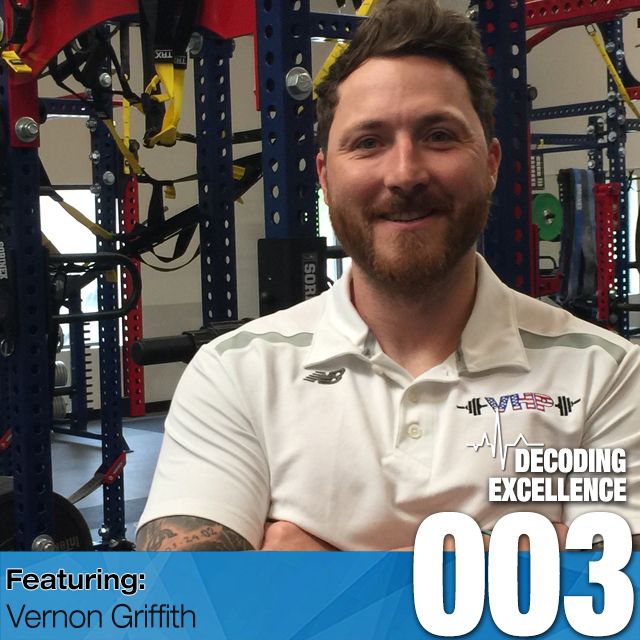
In this episode of the Decoding Excellence show, I am speaking with Vernon Griffith, Head Strength & Conditioning Coach and Co-Founder of Virginia High Performance.
Vernon and I discuss:
- How to build confidence in your female athletes.
The greatest impact you have as a coach. - Balancing the demands of home and work.
- His biggest influences on his coaching career.
- We discuss his coaching journey and his own personal process behind his coaching principles.
You can find Vernon on Twitter at @VernonGriffin4 or at his website VirginiaHP.com
Key Takeaways From This Conversation
Vernon Griffith is the kind of coach every young strength coach should study. Not because of a single method or program, but because of how he carries the profession. Here is what this conversation reinforced for me.
1. Confidence Is Built, Not Given.
Nobody hands an athlete confidence. You build it, rep by rep, through earned success. Set standards that stretch them, then let them clear the bar. Small wins, stacked daily, become belief. A mentor's line I still live by: "Always Earned, Never Given." That applies to confidence most of all.
2. Your Greatest Impact Is The Person, Not The Program.
Ask any veteran coach what mattered most across their career and none of them say the periodization model. They talk about the athletes they shaped. At the beginning, the middle, and the end, it is about the athlete and the progress made. Jills and Joes, not X's and O's.
3. Trust Cannot Be Microwaved.
The coaches who get the most out of athletes are the ones athletes trust most, and trust takes time. You cannot shortcut it. Care personally. Challenge directly. Be where your feet are. That is the whole formula, and there is no hack for it.
4. Balance Is A Leadership Decision.
Coaching will take everything you give it, including your health and your home life if you let it. Protecting your team starts with being a whole person yourself. Leadership is not a switch you flip at the facility door. It is a 24/7 identity, and the people at home deserve the same standards you demand at work.
5. Know Your Influences, Then Become One.
Every great coach can name the coaches who shaped them. The debt you owe your mentors gets repaid to the next generation. Develop people as people. That is how the profession moves forward.
That is what I took from my conversation with Vernon. Give the full episode a listen at the top of this page. And if you are a young coach, find your Vernon: someone whose career you want to study, and then go learn everything you can from how they carry themselves.
This episode of the Decoding Excellence show is brought to you by Vald Performance, the makers of the NordBord, DashBord, and the GroinBar.
They can be found at ValdPerformance.com
Stay updated with the podcast by following me on Twitter via @AdamRinglerIn addition to those social mediums, you can head over to AdamRingler.com/Newsletter and sign-up for my weekly newsletter. This is a newsletter for the curious. It's chalked full of interesting articles I've read through the week, things I'm exploring and finding fascinating through my week, and a collections of thought experiences and resources I've cultivated.
It's essentially a Birchbox newsletter for performance-related articles, research, and daily musings.
Thanks again for listening to the Decoding Excellence Show! I appreciate all the support growing this Sport Science, Strength & Conditioning, and High-Performance Coaching resource. If you have taken anything away from the show, please login to iTunes and navigate to the Decoding Excellence page and leave us a review.
Key Takeaways
- Confidence is built, not given. Set standards that stretch athletes, then let them clear the bar. Small wins, stacked daily, become belief.
- Your greatest impact is the person, not the program. Veteran coaches never cite the periodization model as what mattered most. They talk about the athletes they shaped.
- Trust cannot be microwaved. Care personally, challenge directly, and be where your feet are. There is no hack for it.
- Balance is a leadership decision. Coaching will take everything you give it, including your health and home life if you let it. The people at home deserve the same standards you demand at work.
About the Guest
Vernon Griffith is the Head Strength and Conditioning Coach and co-founder of Virginia High Performance. He and Adam discuss building confidence in female athletes, balancing the demands of home and work, and the influences behind his coaching principles.
Listen and Subscribe
Find this episode of the Decoding Excellence Show on Apple Podcasts and Spotify, or use the player above.
Go Further in This Episode
Enjoyed this conversation? Here is how to get more from it:
- Read the transcript below to revisit key ideas at your own pace.
- Share this episode with a coach or colleague who would benefit.
- Subscribe to the Decoding Excellence Show on Apple Podcasts, Spotify, or your favorite app.
- Join the newsletter at adamringler.com/newsletter for weekly insights on human performance.
Episode Transcript
This transcript was automatically generated. While we strive for accuracy, some words or phrases may be misheard.
[00:00:00] As a coach, you would say it is kind of how you just said, like leaving like that legacy, that footprint, that impact on someone's life. I joke with my wife all the time and I'm just like, man, you know, five or ten years I'm going to have a whole lot of weddings to go to. And to me, that's, that's, I guess that would be my legacy. Sports Science, Strength and Conditioning, High Performance Coaching.
[00:00:27] Welcome to the Decoding Excellence Show. Today's episode is brought to you by VOD Performance, the makers of the Nordboard. If you haven't checked out their website yet, I highly suggest you head over there, whether it's return to play, injury prevention, or just plain performance testing. VOD Performance has the tools that you need. Check them out at VODPerformance.com.
[00:00:54] Today on the show, I'm speaking with Vernon Griffith, the co-founder and head strength in conditioning coach for Virginia High Performance. Today we discuss everything from building confidence and female athletes to the challenges of running a private business and still balancing work-life balance. We discuss elements of why he got into his coaching career and who was influential in his mentorship as he developed his own coaching philosophy. We discuss the challenges of being a great
[00:01:28] Husband and parent, as well as balancing the demands of a highly successful coaching career and business. This is a wide-ranging conversation. You definitely don't want to miss the experiences and wisdom that coach Griffith shared. And I want to, again, want to thank him for coming on. And without further ado, here's my conversation with coach Vernon Griffith. Vernon, welcome to the show.
[00:01:56] Hey, how's it going out of here? Hey, doing really well, man. I appreciate you taking some time out of your early busy morning that you have to sit down and talk some shop with us. I am just excited to have you on. How's things out in Virginia? We're busy, but that's a good thing. So staying busy with our programs. Have we got going on? Life is busy. Family is busy, but if I wasn't busy,
[00:02:27] I don't know what I'd be doing. That's like, you know, that's the response I get with a lot of coaches. Is that they just come in and I think we're all in this is where we're just so deep into what we're doing that it's like it's nice to come up for air, but if we don't have that chaotic sort of busyness in our life, it can be you don't know what to do with all the free time that you have. Yeah, I mean, I'll be sitting there on the weekend sometime and not doing something
[00:02:49] And I'll just I think there has to be something I should be doing. I'm forgetting something. I'm forgetting something all the time. You know, I wanted to have yarn because a couple of different reasons, but I think it's important to kind of maybe start at square one and have you give a little bit of an updated bio of what you're currently doing, your current role at Virginia High Performance, and maybe how you found yourself into this coaching profession that we all share.
[00:03:14] I'm not the coach that really likes to boast about himself. I feel like more people boast about themselves because they don't have the concept that other people boast about them. So I'm not going to dive too much into what I've done and who I've worked with, but I'm one of the co-founders at head strength and conditioning coaches at Virginia High Performance. I probably have a pretty cool story about how that got started. When people say opportunity is when luck is when opportunity meets preparation or something
[00:03:44] Like that, whatever that's saying is I was just in college for an old domain university and one of the other guys founders, Jeff comes, walks in with a USA wrestling jacket and I kind of just pulled him to the side. Big thing I say with young coaches, never be afraid to network and never be afraid to talk to someone because literally that one conversation changed my life. I kind of pulled him to the side and I was like, hey, man, you don't just buy that jacket from Dick Sporting Goods or Foot Locker. What do you do? We kind of got talking and from that day,
[00:04:16] I was like, hey, you want to work out tomorrow and he was like, yep, worked out with him probably every day for a year and a half and then with another one of the other founders, Alex, we just started talking about how youth athletics and Hampton Rose is such a hot spot for sports and performance. But the kids don't really have a high performance training place to have a bunch of places that say they are but you know, they're just after the money, not that we aren't either but they don't really have the child's best interest in hand. So we kind of got started with the idea
[00:04:46] And it's kind of grown since then. But I mean, that's from staying up at their house at Jeff's house around the dining room table for hours on end. That's kind of how Virginia High Performance started and kind of how where I'm at now. We've been open for about two years and a couple months and we're doing we're doing really good to maybe provide a little clarity when you say Jeff, right? So you're talking about the other co-founder Jeff Nichols. Yeah. Just so that audience members can can follow along here. Now, I find this because I just don't know, it's weird like you can have
[00:05:20] Some of these similar conversations with people and then somebody drops a line like the USA wrestling and for me, I grew up in Michigan and you know, my whole youth life was surrounded by USA wrestling and team Michigan and freestyle wrestling, folk style and that's what ultimately led me on my own sort of career path going to Michigan State to wrestle and then find out very quickly that I was a very small fish and what is otherwise a big 10 wrestling huge, highly competitive conference for it. And then I found myself on the flip side of being a graduate assistant in charge of
[00:06:03] Strength conditioning for wrestling. But so, did you have a common like shared love or passion with USA wrestling or did that just lead into the conversation between you and Jeff a kind of a touch point that you then sort of explored and scratched? I mean, not really. He had a friend that is involved with wrestling in Iowa, I think. I'm not sure if he helped with USA, somehow he was involved with it. So he gave him a jacket and I mean, I've never been a big wrestling fan. I didn't grow, I didn't go to a school that really emphasized wrestling, but I mean, a lot of people joke with
[00:06:40] Me about being a social butterfly and this and that. I mean, I'm just, I like to talk to people, I like to, you never know who you're going to meet. I'll be at the bank or at the grocery store and I'm talking to the person behind me, not that I'm out to get something, but you're always, I mean, you never know who you're going to meet, you never know what store you can take from someone. So I just just went up to him and was just like, hey man, you know, what's your store? What's going on? And we just hit it off, hit it off well and you know, that's all history. To put it maybe
[00:07:07] A place in time, when when was this? What like was it during undergrad around those, your pivotal college years? Was it post college where you had this sort of interaction, the serendipitous sort of moment where you're like, oh, hey, and by the way, we started working out and then hey, we co-founded this joint venture together. What, where were you in your sort of lifespan and explain a little bit about maybe the your thoughts of how that led to where you're right now? It kind of was a little interesting. I mean, when I was young, I joined the military,
[00:07:47] I got out of the military because I was tired of being gone so much, went back to college. I met, when I actually met him, I was a senior. And I mean, the strength conditioning field, I mean, to be honest, it's it's very competitive. It's it's hard. It's the job security isn't that best. And it's a grind. Like people, yeah, a lot of young kids, they just think it's all glamorous. It's all these big followers on Twitter and Instagram and you know, I'm going to be famous and I'm going to be rich and like, no, it's not that. And so I kind of it was just kind of
[00:08:23] Luck. I mean, it was just the opportunity. And then when it met in that time, it's like I like you said, serendipity. It was just it's crazy to think that that one point in time, if you ever think that like when I had that one fork or I made that one decision that changed my life, that literally changed my life. A lot of the people I was going to school with, you know, they're working at nothing's wrong with it. They're working at banks or insurance places or, you know, it's hard to find a job and we just happened to hit it off and you know, things grew and you know,
[00:08:55] We're doing we're doing really good right now. And we're going to explore that a little bit later in the show because I think there's some unique sort of experiences that you have as a co-founder and as a business owner. And that's, you know, from a strength conditioning coach. I know that the CSCCA, one of the roundtable discussions was just discussing how many people have the opportunity to retire as a collegiate strength conditioning coach. And it's so very little. I mean, a lot of coaches get into, you know, at least sort of this public sector collegiate coaching
[00:09:33] With absolutely no backup plan of what to do if that job doesn't exist for them. So a lot of the times they're forced into trying to make these decisions out of necessitating and not necessarily out of, you know, a wanderer, a driver, a passion. So I think you have a unique experience to discuss a little bit of that other side of it, you know, like the life of a business owner, the life of a co-founder, the life of a guy that has to manage a staff and manage what is otherwise, you know, a clientele that doesn't necessarily continue to turn over every four
[00:10:09] Years, like you see in the collegiate sector. But let's dive into this because I know you talked about you know, you had this, this luck is win preparation meets opportunity, right? And that you just happen to be in this moment where it all sort of fit together. But I want to kind of dive in deeper be, you know, the coach behind the coach or the person behind the whistle. I want to get an understanding, like, what is it about coaching that that that pushed you into it? Like what is what do you get out of coaching? What do you get out of working with athletes that maybe an athlete
[00:10:52] Doesn't even understand or doesn't realize? I mean, the reason, I guess you would say my driver or my why is because I never had that. My father wasn't around much when I was younger. I didn't have that positive role model. I don't have, I was having this conversation with another coach when they were like, what was that one coach to change your life? And I don't have that. I didn't have this amazing coach that when I was reaching my hand up for help to pull me up and say, I got you son or to provide me some sort of positive feedback or to be that guiding light. I didn't have
[00:11:27] That. I didn't grow up in a household that, you know, college was a priority. It was just kind of like a, you know, a thought that maybe one day but probably not. No one had those aspirations. I didn't have this, you know, this positive person, you know, let me know that my world is much bigger outside of my little city or my high school that the world is huge. The opportunities are endless. So that's my why is to empower kids with the confidence that, you know, I'm not trying to be all whatever it is. And you can do anything with your life kind of style. But, you know, we're so
[00:12:04] Obsessed and as you're younger, all you think is what's in your fish bowl, what's in your 10 closest group of friend network, you know, what you see, you know, on a day-to-day basis. And then when you experience life outside of that, you're like, holy shit, like this is, this is crazy. You know, all these, all these endless opportunities. And that's kind of, that's kind of why I'm doing what I did, why I got out of the militaries to get back and, you know, impact youth. I made a decision that I'm not going to be rich. I'm going to work for a long time. I'm going to work long hours.
[00:12:36] But the impact that I'm going to make on children is, is well worth it. I had to talk with one of my people I was training this morning. And we were talking about coaches chasing awards and stuff, which is fine if that's your thing. But my awards are college scholarships. When my kids go to college and they send me a t-shirt with their school on it, that's my award. That's my goal, that's my why. To let kids know that, you know, you can do so much in this world once you stop holding yourself back. That's, that's kind of, that's kind of my why.
[00:13:08] There's a couple of things I want to dive in on this. And ever, please stop me if, you know, if I'm digging too far, I just, I think it's, there's a couple of things you said that were resonating. So, you're not the first coach I've talked to that got into coaching. That became, I guess the manifested themselves into this position to be influential for what is otherwise a person in their life that wasn't there. So, I find it fascinating. And I think important that you didn't have this coach, you didn't have someone that is essentially doing all the things that you're doing
[00:13:50] For them. So, is this a, is this for you like a way of giving back to like a, essentially like a younger version of yourself? I'd love for you to explore on that a little bit if if you can provide some, some, I guess some details on that. I mean, it's one of my favorite things to say is is, you know, be the person that you needed when you were 16. Like, that's, that's, that's easily one of my favorite things to say when coaches say, you know, what, what do you believe in? What's your philosophy? It, it goes way past coaching. Coaching is whatever. Coaching is X's and O's. That's fine.
[00:14:28] It's about, you know, building the confidence and powering kids to, to make decisions. It's, when you really think about it, kids aren't allowed to go to the bathroom, you know, without raising their hand, but they're forced to make decisions when they're 17, 18 that literally could affect the rest of their life. But we just think of them as miniature adults when they're not. They're children, they're kids. And we forget that because we just were so caught up in, you know, well, you got to have a plan, you got to have this, you know, plan to change, like plans change, and I'll
[00:15:00] Plan, you know, be flexible. Don't be this on me, be this on meb of, of life and potential. Don't be this just locked up version of a paper with a, a timeline of in five years, I'm going to be this, you know, have that, but then be this on meb of change. But back to, back to what you said, it's, it all goes back to, I just, I didn't, I didn't have that. And I know what it feels like to be sitting there and I would hear stories. And now that I'm a part of it, kids, their kids come up to me and they say, hey, coach, you know, you know, what should I do or what school should I go to?
[00:15:32] I'm being recruited by this. What do you think? And I remember being that kid being like, man, what should I do? Where should I go? And everyone's just kind of shrugging their shoulders like, I don't know. You know, maybe you should stay close to home because of this or, or, you know, my mom saying, well, you know, maybe, maybe, you know, we, yeah, there's no really jobs with that. Maybe you should join the military. And I'm just sitting there like, well, you know, okay, I didn't, not saying I wasn't, you know, and, and a very confident kid or I very goal oriented. But when I was in school and I
[00:16:08] Joke with my kids all the time and my, my wife or my kids will come in and I'll be preaching to a kid about grades and they'll be like, for what the hell are you talking about? You never made good grades. Right. Because I, I didn't make it a priority when I was at high school and when I got college, I realized it was different. So that changed. But I didn't have someone to just step in my face and just be like, Vernon, get your stuff together, man. Like what, what's going on with you? We're so scared to, you know, I think some coaches are especially in the private sector are so scared
[00:16:38] To step on a kid's feelings in a polite way because they feel like they're going to lose their client or upset them that they don't hold them to accountable when that's what kids want. Kids want a line. Of course, they're going to step across that line and you got to let them do that because if you always tell a kid to shut up and stay in their place, you're just going to close them down. But you have to give, you have to give them that line and hold them accountable. And that was my thing. I really never had a coach. I was pretty good at sports. So I was able to just kind of
[00:17:06] Act how I wanted in the classroom, not do homework. And because I was, I was pretty good at sports. And I wish I had that person that just sit me down and be like, do you realize what you're doing here? And if I had that, which, which, it's kind of, I guess, a two-sided story because if I did have that, I wouldn't be in the position I am now, I don't think. And since I didn't, and since I didn't have that, I'm putting a position where I get to affect so many people's lives on a daily basis. And that, I'm not sure what my path would have been, but I can say that I would not be as near
[00:17:41] As happy as I am now. I'm full. It's kind of cheesy to say, don't get me wrong. I want to be rich as hell. It's like anyone else. But I'm so fulfilled and happy with being able to help so many kids because whatever you believe in at the end of your life, whatever entity you want to believe in, when that, my day comes, I feel like I put in enough work that I'm going to be able to get in or whatever it is. When you, when I kind of joke around with people, I'm saying, when you die, you better want a packed funeral. Like, you don't want a funeral when no one shows up. Like,
[00:18:18] Impact as many people on a daily basis as you can. And that's kind of, it's, it's, it was my problem as a kid, and I've kind of turned it into, like, my thing. It's, it's my bow and arrow. I shoot that. It's, it's my thing. You were talking about discipline and, and especially being, sort of in the private sector and having that ability of having tough love and saying what is maybe hard to say to an athlete and, uh, in fear of potentially losing them as a client. But it reminds me of, like, when Mickey Murati said that athletes crave discipline. Are youth crave
[00:18:53] Discipline? Because very rarely anywhere are they getting being held completely accountable for their actions. So it's this sort of balance of providing this sort of discipline, but also allowing for them to maybe make mistakes and maybe to, to step over the line so that you can then come in and reassure or confront or, you know, be that, that mentor in their life to be able to pat them on the back and steer them in the right direction. You, you spoke about confidence and, uh, and building confidence in athletes. And it seemed like that was something that resonated in what
[00:19:31] You just said. But before we dive down that, that whole worry, you know, if you were to think back on your own sort of childhood, do you feel like you were a confident kid, a confident person leading up to where you are now or has things changed? And if so, how, how and what? Well, I mean, what were the, the steps that led you to, to that change if there was some? Um, I mean, I, I didn't go to the best of schools. So I, I would kind of say that I, what I, I maybe portrayed a confident person, but, you know, I wasn't the most confident with myself. I was a smaller kid. I mean, I graduated
[00:20:10] High school at 150 pounds, soaking wet. I wasn't the most, I wasn't athlete. I mean, I wasn't amazing. This genetic freak. I wasn't not good at talking in front of crowds. Uh, it's why I like social media kind of post stuff up there and just kind of send it back away. I don't, I don't have to stand in front of a big crowd and say stuff. But, uh, I don't have this everlasting confidence. But I think it's just that I've never been comfortable with, with my position. And then, uh, as I've kind of learned, you know, strength and conditioning and, and kind of formulated my own hypothesis
[00:20:47] And formulated my own way of going about things, it's kind of giving me that confidence because when people hear it, they're like, holy crap. You know, that's, you know, I've never looked at it like that. And it just gives me, it kind of, and it's kind of like a flame that every day, it just burns a little bit bigger, a little bit bigger, a little bit bigger. And, uh, I don't, I mean, I, I guess I don't, I don't even know how to answer that one. I guess. Yeah, no, like, and that's, and that's perfectly fine. I mean, that's the, that's the thing is so much of these conversations are about,
[00:21:18] You know, and, and it's weird because it's somewhat on like a public sort of forum is this investigation into our own wise that, uh, that we all share. And, you know, like many of these questions that I, I ask, you know, previous guests and yourself is our questions that I sit down on a daily basis and ask myself and like, you know, how I answer it on Monday might be different than Wednesday. And it's this constant evolution of, of finding and honing and crafting what is your own reasons. And I think sometimes they change. And I think that's perfectly normal.
[00:21:56] Um, I kind of think, I kind of think, uh, with that, I guess you would, I guess you would say that when I became a parent, uh, for my daughter, it's almost like I get to, I get practice at parenting with all of my younger athletes that are older females because I get to see the situations they go through. And then it kind of, I bring it home. And I, that, that might be a turning point for me. I started looking at the world a little bit different once you have a kid and, uh, how kids are treated. And then I realized how other kids are treated compared to how I try to treat my daughter.
[00:22:30] And that, that'd probably be my turning point. I'm going to explore this for a little bit because I think this is, uh, fascinating because in a similar position of you, I'm a parent of a four-year-old, almost four-year-old daughter, you know, one-year-old son. And, uh, you know, I think strength and conditioning, as you talked to other people in the field, it's commonly known as a young man's game, right? The fresh out of college, you know, graduate assistant. I'm, I'm going to earn my chops. And when I work as hard as I can, you know, son up to sundown. But things change a little bit when you start
[00:23:05] To involve and incorporate a family. And you have the family dynamics. And, you know, a number of different podcasts have talked about, you know, that the travesty somewhat of strength and conditioning, right? Like you will give every single ounce effort attention, focus to your student athletes and completely neglect your family at home. And this is why, why you see, you know, sons and daughters growing up without a father or a mother or, um, that's never around. And I think the challenge is trying to be both present at home and at work and do your very best work and attention to the, the
[00:23:41] Various teams you serve in life, both your family as a team and the team of athletes that you work with. So, uh, you talked about that turning point being when you had a, uh, you started to grow your family. I'd love to kind of see, I mean, like put me in your shoes if you could. Like that first couple months, maybe or that first year when you're juggling the balance of family, life, being a great father, being a great coach and that worked life balance. I mean, do you, do you have any remember, like memories or anything that resonated with you from that sort of stage of your life?
[00:24:21] Uh, I mean, there's no mystery about it. If you're a coach, you're going to work your ass off. I mean, we, we're, for the first, I mean, we've been in two years and we're still pulling here at 8am and, you know, we have clubs it would be here in the fall, some to like 10, 30 at night. And, uh, I mean, I give, I give thanks and I'm freaking blessed as hell to have my wife. And I remember one day, she just kind of sat me down and she was like, we get it, babe. Like, you're going to work a lot. We get it. You're really good at what you do. You love what you do and we don't want that to change.
[00:24:54] But when the moments that you are home, you got to capitalize on them. You got to be present in your presence. And I've kind of looked at that and that's, that's been my thing is when I'm at home, you know, putting down my phone. When I'm at home, do I want to, it's, it's almost like, uh, not to jump around, but one of my athletes asked me one time, they were like, Vernon, how are you always on? Like, how do you always have energy? And I was like, because that's what's expected of me. When my kids come in, they expect me to bring energy as a coach. If you want energy,
[00:25:26] You got to bring it yourself. It's, you know, the dynamic of the universe, energy needs energy. So I, and, and I would preach this all day. And then I would come home. And I'd just be like, oh, you know, be just down, just down, regulate, just take my shoes off, babe. I just want to take a shower. She's like, no, you can't do that. You know, your kids know you're this high energy, you know, tacked up person. And when you come home, you have to continue that. And, you know, it, I, that's been a big problem for me. I mean,
[00:25:56] Not a big problem, but something that I've worked on tremendously is just being present in their presence, because as a coach, we're going to have long hours. It's no mystery. You're going to travel. You're going to be gone. So when you are there making the most of it and making those lasting memories, last thing I want is my kids growing up. And then just having these childhood memories, I've had way too many concussions to remember my younger childhood. But I don't want my kids to remember them coming up to me and going, dad, dad, dad. And I'm being like,
[00:26:26] Oh, wait a second. Let me send this tweet out. You know, it's, I turn my phone over, put it down, just being present in their presence, because it's no mystery. We work crazy hours. But, and that's not going to change. I'm not going to walk into a coaching job or VHP is not going to be like, all right, guys, our new shift hours are from eight to three. That's just not going to happen. So it's when you are home, just making the most of it. And that, I mean, that's my, that was all my wife. I'm extremely thankful for that. She, she checked me on it. She's one of the, I mean, you
[00:26:59] Need people in your life that are going to check you whether it's friends, whether it's co-workers, whether it's significant other, but we, we have enough, yes, man, we have enough. All you're doing great coach, you know, pound emojis on Twitter, a great job. We got enough of that. We need people that are going to call people out, not positively. And just be like, hey, what are you doing? Like you're like my wife, babe, you're home, like be home, be present. You know, we want your presence, be present in your presence. And I was like, you know, that, that was kind of my thing. For months, I was
[00:27:30] Kind of lost at work and so busy. And then she checked me on that. And every now and then I'll slip and I'll catch myself or show catch me or my daughter will even be like, hey, dad, you've been on your phone for a while. And I'm like, you're right. I need to put it down. And it's in, it, being present in the moment, it reminds me, I say this all the time to my staff. And that is be where your feet are. And if your, if your feet that work, like let your mind be at work and be fully committed to what you're doing there. But boy, when you, when you walk through that door at home, be where
[00:28:06] Your feet are. And that's with your family, with your daughter, with your sons, with your wife, with your husband, whoever it might be, whatever sort of, um, with a place in your life that you're at. So I think that's, and that's hard, right? Like that's, that's the challenge. I mean, I think we get caught in this sort of loop where passion fuels what we do, right? We wouldn't be doing what is otherwise a, you know, a low paying job, a mediocre paying jobs. If we weren't just fueled by passion, like we're here to change people's lives. Of course, that fuels us. But at the same time,
[00:28:39] You know, like, it's very easy to see, you know, like, I'll go read this article into it or read this post here, if you're not doing X, Y, or Z, you're, you're behind the step that it becomes this sort of pervasive vicious cycle of you need to do more and more and more. And ultimately, you're going to burn the candle up from both ends and you're going to lose the loved ones of your life or neglect them. Certainly, if you're not, uh, if you're not willing to, to put up a barrier. And, uh, I've seen it, I've seen it, I've seen it personally when I was in the military. And that's probably
[00:29:12] The reason I got out is, you know, these guys, you know, love them to death. The same thing with long coaches, they'd have like retirement ceremonies or coaches that would, you know, retire from a holding a strength conditioning job for 20-something years or whatever. And they'd be up there with their families and they wouldn't know what to say. Because there haven't been involved with their kids' lives or their wife or they retire and they're sitting there hating their wife because they're sitting there and they have nothing in common anymore. You know, your job will always be there. But I
[00:29:43] Got 18 years with my daughter. And legitimately, I probably got 16. You know, she's probably not going to like me for the last two years. So however that works, I'm not, I'm not sure the process on that yet. But, you know, my job will always be there. Strength conditions will always be there. There'll be something that I can do always, but you, you just, you got, you only got so much time with your kids. And if you lose track of getting way off topic here, but a coach that has been a tremendous influence to me, probably one of my, one of my good, really good friends and a great
[00:30:16] Mentor is guys named Ken Wong. And he were sitting on the couch a couple of months ago. And he sat there and he looked at me in my eyes and being all goofy as hell as always. And he was just like, hey Vernon, who are you? And I just laughed out. I was like, dude, what the hell are you talking about? And he was like, what are you? And I was like, uh, he was like serious. No, what are you? And I was like, well, I mean, I'm a coach. And he was like, no, you're not. And I was like, okay, well, what am I? And then he kind of got me thinking. And I was like, well, I'm a father and a husband. He was like,
[00:30:47] No, you're not. What are you? And I was like, Jesus Christ. I don't know what I am. And he was like, he was like, you're, you've lost who you are because you're so caught up in the moment. If you forget who you are, he was like, what did you used to do before you were married? What do you like to do that's not working out that's not sports? What do you enjoy? Like do you enjoy music? Do you enjoy drawing? Like, what are you? Because once you lose track of who you are, you can't get that back. And same way with a job and a career, if you get so caught up in, we're so caught up in
[00:31:20] Defining ourselves, like anywhere you go to a conference, you know, everyone has the logo on their shirt of where they represent. Well, just fantastic. Represent who's paying you. That's, I mean, that's you're supposed to do. But you got to remember that there's someone behind that logo. And if you lose track of who's going behind that logo, you're lost forever. You can't get that back when you spent 25, 30 years being the logo. You said something about people up at the podium, other coaches at the podium, and wanting to think or say something about their family. And it's,
[00:31:52] It reminds me of, I guess, a chapter or paragraph in Urban Myers above the line, the book that came out. And I guess maybe a couple years ago where, you know, similarly, he is at the, his daughter is at the podium, accepting a award or a banquet or something. And you know, his thinking literally prepared a script, a speech to think her mother, but didn't write anything in about, you know, coach because didn't anticipate his arrival there. And it's just like, it puts it in such a frame of reference when, you know, like, you stand at a podium and you want to think and you don't know
[00:32:32] What to even say about your family because you've been so removed from your family. That that's, you know, I look at it with my own children. And I think the last thing I want them to ever think is that I wasn't around. And I wasn't, you know, mentally and physically. And I think that's, that's a challenge. But to, to turn this thing a little bit because I do think that there's some, some tremendous things about understanding where we come from and why we do what we do. But I want to kind of change the perspective, the frame, to recognizing and maybe certain
[00:33:08] That dive into how are we building confidence with athletes? And I see it on your social media. I see it on Twitter that the athletes that you train at VHP look like they're enjoying themselves. They, they're proud to train. They look engaged. They are excited about the progress they make. And I'm just curious about how you as a coach, as you as a program, sort of whether it's organically, whether it's systemized, how do you build that confidence in what is otherwise young athletes? I might not have that confidence. Well, I mean, for one, it's building, to me, that's everything.
[00:33:51] That's the, that's the number one thing that translate over into sport. Can you get an athlete jump higher on a platform doing explosive movements, power movements? We can argue what's better all day. Any coach can say that they're, you know, they're judo or karate is better than the next jazz karate. But confidence is the number one thing that put the portrays and goes over onto the court or the track or the field or whatever it is. And it starts with building that initial relationship. If you don't have a mutual relationship or respect, then you're never going to get to that point.
[00:34:26] And in my experience, when kids are comfortable with their coach and with their situation, they're going to respond better when it comes to the training environment. So the days of, like I like to say, like the bad coach mentality or the always yelling and the not relatable coach and the coach that I'm not listening to that music. We're listening to this. It shuts athletes down, not all of them. And some, and, you know, I'm not saying to be a pushover by any means, but allowing yourself to show a little bit of, you know, for them to relate to,
[00:34:59] Like a big thing I say with my interns is one of the quickest ways you can show that you're normal to your athletes is to admit you're wrong with something. Because then they're like, oh wow, that coach just put down his door. So maybe now I can say something that I feel. And the second, I'm always asking, I'm always asking, you know, probing with what's going on in their lives. You know, who are they, you know, are they dating someone? You know, are they having a good, you know, how's school going? Always finding out these little cues because as you build
[00:35:26] These relationships, and I understand in the collegiate setting, you're dealing with way more kid, you know, way more of a turnaround than I am. Every hour you got, you know, 40, 50 kids rolling in. I get that. But trying your best to just, you know, build that relationship of respect. Because then you, then the confidence is just through the roof. I mean, I have young ladies that I like to say a lot of my clients are young volleyball and softball players. And they're so confident because they were never treated the same as young men. Of course, young men go into a gym and
[00:36:00] Throw some weight on the bar, you know, bigger, stronger, faster, let's lift. And for some reason, girls aren't treated like that. And I'm like, why, you know, why can't a girl train the same as a boy? You know, when it comes to planes of movement, their sports are, you know, the same. So they should be able to do the same things. And the second you treat a young lady with that same, you know, coaching, they respond to that because they want that. Girls want to be equal to boys and they are. They want to do the same things. One of my favorite things to do with young ladies is pull-ups.
[00:36:30] We do pull-ups every week, programmed in, you know, it could be different tempos or ISO or eccentric or whatever. But we always do pull-ups. And my old concept is, one of my interns asked you, like, why do you do so many pull-ups? Well, I'm not so many, but you do them so often. Besides the fact that it's a great, you know, a great movement for upper body strength, it's almost like if I was to ever deadlift 600 pounds, probably not going to, but I would never forget it. And if anyone ever deadlift to 600 pounds, I'd be like, I remember that day. But if
[00:37:00] You have a young lady that jumps up on a bar and pulls her little arms up over that and puts into a full pull-up, she will never forget that. She will come off that bar and her face will glow brighter than if she was wearing any dress on prom day because she would be filled with energy and love. And this is confidence beaming from her. Like, oh my god, I did a pull-up. Girls aren't supposed to do pull-ups. And I just did one. And that translates on to core. When a lot of my volleyball players, you know, they're taller. So they're, you know, anteriorly rotated in. They're trying to come down
[00:37:34] To the rest of the population in their high school because they're taller. And they lack that confidence. And then I, you know, we get into their posture, whether it's certain movements or certain things. And their shoulders start resting back. You see them walking around. And I like to say, be cocky, be confident. Because when you're walking around, that big chest, not only is the healthier position for your body, but it's just, it just beams. And when you're around other girls that confidence is beaming, you want to be a part of that. So to me, confidence is everything. If you empower a young
[00:38:05] Athlete, you know, with the strength or the ability to do some movement, whether it's physical or emotional or mental, whatever it is, then they're going to be a better athlete because that's going to translate over. Whether strength and power, we can argue specific movements, maybe not. But confidence, you cannot, like, a confident kid is scary. I have 13-year-old girls that will literally, when they go to their coach and their coach asks them to do a movement and their knees buckle in. They're like, well, well, coach Vernon said that that's not good. And then they start
[00:38:36] Explaining why. Valgus needs, well, my Valgus, you don't want to have Valgus need because this for that. And then percentages, and their coaches are like, holy shit, like why would you tell them that stuff? Now they won't stop saying it. And I'm like, that's amazing that a young 13-year-old girl is not afraid to speak up for herself. And to empower them with science, we need more young ladies to believe in science and math. That's what we want. Just the emphasis on STEM and trying to get more young women involved in a science technology, engineering math, all that. And confidence can
[00:39:09] Be scary. I think, you know, like, it's a force to be reckoned with. I see that. I'm just threatening. I see that with my daughter. I feel like as a four-year-old, she's more equipped to face the world than I was when I was damn near 18. And of course, there's some positive shaping and a lot of trying to shape her environment and her mentality for some of that of what I see as a deficit. And otherwise, young women. But to relate back to what you said, because I very easily see that with our athletes, you know, and I work with a pretty much all-female population here at
[00:39:45] Wichita State. So, you know, I could easily ask 90% of them. Like, what do you remember most, right? And it will be a conference championship. They're first time going to maybe the NCAAs for the first trip. But a lot of them would also respond and do respond that the first time they've gone from a green jump stretch band to a purple jump stretch to doing the first bodyweight pull-up or chin-up. And being able to, like, jump off that bar and have that smile stretch ear to ear. It's, it is. It's the equivalent of a 600-pound deadlift for a male or something like that.
[00:40:24] It's a huge lift to their confidence and to their ability. It's feeling comfortable. It's so underrated. Like, when it comes to like all my, we always put chalk on our hands just because I feel like it enters that mentality of like, oh my god, I get to put chalk on my hands. Like, I'm about to lift. And it's just, it starts there. And then the first time I probably noticed it when I started like realizing like, this is it. Like, this is a game changer. It's not, you know, whether you do a plyometric or a French contrast or this or that. It's confidence. When I realized
[00:41:00] There was a game changer, I had some volleyball girls doing jerks. And a couple of them were like, oh my god, this looks crazy. Like, this is scary. There's no way I can do it. And then they, they pop their feet and that bar is locked out overhead. And you just see their eyes biggest soft balls like holy crap. I just did that. And they're like, oh my god. And then it was every, ever since then, I've just been like, you know, this is it. And this is where it's, this sets the tone for everything. What's, what's fascinating for you and what I'm interested in is because
[00:41:31] You're seeing these athletes at a younger stage than I'm seeing. So you're going to be on the front line when this sort of empowered young female youth start to enter that training age. And I would imagine that you get to see that earlier than a lot of coaches in the collegiate system. And to build on that, I'm just curious. I mean, have you started to see it? Is it, you know, our athletes coming already a little bit more prepared with the idea because I do think that we've shifted sort of what is societal and cultural sort of viewpoints that now it's,
[00:42:10] You know, I think women are supposed to be strong. They're supposed to feel empowered. Are you seeing that transfer over to your facility earlier or if you haven't, why do you think it hasn't? I still think there's always going to be a situation, I guess, not a situation, but the other day one of my girls was flexing her bicep in the mirror and she was like, oh my god, Vernon, oh my god, oh my god. And I was like, that is freaking awesome. And she was like, no, no, it's not, it's gross. And I like stopped the whole weight room. And I was like, everyone
[00:42:43] Look at her. And she was like, I don't want to do it. And I was like, flex your muscle. And she did. And it was a room full of, you know, older military guys training. And they were like, everyone was like, bustin' out cheering for her. And she was like, is it that cool? And I'm like, hell yeah, it's that cool. Like, there's still going to be that stigma, of course, about women being stronger and lifting weights and having muscles. But I do think it's getting slimmer. And that starts with telling them that it's cool. Like, lifting weights is awesome.
[00:43:15] Being strong is awesome. Like having, I say to my girls, if a boy ever tries to hold your hand and you have more calluses than him, run away. He's not, he's not, he's not worth it. Like, you know, be and be intimidating. Be confident. Because if you're that person that's strong and confident, you're going to have a happier life because you're not going to have people that are around you, because they're going to be intimidated that they don't want to win. Like, people, the only people that want to win are going to surround you. Because they're
[00:43:46] Going to feel that confidence. And, you know, any situation you're in, if, if you're surrounded, if you're in a group of winners, you know, some person that that's not a priority to them is probably not going to come into that group. You're not going to have to worry about, and I say this the young girls all the time, if you're confident, you're not going to have to worry about some burnout boy coming up to you. Because he's going to be intimidated that you're successful, that you want to succeed, that you want to be influential, that you want to own a business or be a doctor.
[00:44:14] Like, that's scary. So, some people that's scary, no different than people nowadays, they'll say something like a lot of the older coaches that I still hear, I mean, you're going to hear this no matter what's the end of time. But, you know, I make more money than my wife or I wear the pants or this or that. Hell, I don't, I could care less. I want my wife to be at this freaking powerhouse. Like, that's amazing. I want her to do that. And that shift, I think, is coming. But it's, I mean, it's no different than anything else. It'll take time and there'll be certain situations
[00:44:46] Where it'll be more or less. But for the most part, the young ladies that come through VHP, all my girls are, I mean, they're just confidence that come. Some people would say even a little bit too confident, but I like that edge. I think that edge is good, certainly. And, you know, it's one thing at two. I know we talked about being a parent, being a coach, but especially being a parent of a daughter, I think it really, it grounds you as a coach. Because, I mean, you hear as you just shared, I mean, people having the ability of saying that, you know, I make more, I do this or I do
[00:45:20] That. But like, as you as a father getting on the same level as a daughter, would you want to say that to your own daughter? And like, I want my daughter to make 100 times more than what I make. And I'm going to be, you know, like, I'm expecting that. I hope that. I wish that for her. And I wish that for every athlete, every female athlete that I work for and work with. So, I definitely think that you, you do empowerment and you do confidence building in some of the best that I've seen as well. It also comes to allowing kids to express themselves. Like, when it comes to like a weight room
[00:45:58] Setting, like, when I grew up, when I played sports, it was, you know, not the bad cop, bad coach mentality, but it was like the be quiet thing. So, and I just kind of thinking about how coaching works is a, I was in a volleyball game one day, volleyball match for one of my girls. And their coaches like, all right, cheer, cheer, you know, cheer each other on, cheer each other on. But then I would see a practice and they would like lock it up, you know, whatever. And I started and I was like, wait a second, where did we miss the boat? That we want kids to be quiet and practice, but then
[00:46:32] We want them to be vocal in a game. So, in the weight room, it's, I'm not the coach that shuts them down because I want them to be confident. I want them to be vocal. Respectful at the same time because that translates into confidence and vocalness on the court. So, it's almost like the cell phone mentality is, we want kids to get off their cell phones and they probably put their cell phones down for an hour or two a day at practice and then we want them to not communicate. You know, we just got rid of the problem and then we're not letting them communicate which is
[00:47:04] Also the problem. So, it's, it's that shift of mentality which brings that confidence about because they're vocal, they're talking. That's what we want. We don't want kids closed off on their phones. We take away the phones and then we still tell them to be quiet and then be vocal on the games. So, it also, it's also falls on the coach as well. I mean, I'm no different when I'm in my daughter's softball games and the coaches are like, cheer the dugout. But then in practice, they're like, all right guys, everyone be quiet, pay attention or be quiet, be quiet, be quiet,
[00:47:29] Be quiet. I'm like, wait, you can't tell them to be quiet for just seven hours during the week and then on that one day on the weekend for two hours, you're like, all right guys, everything I said, do the opposite. Cheer each other on. It doesn't, it doesn't work. Yeah, the incongruency on that for sure, it can be confusing and then just it clouds the clarity of the message from a coach for sure. I want to turn this around a little bit and put the put you in the spotlight a little bit and can I ask you some questions here about how you prepare
[00:48:01] Every day, but with that and thinking about your own personal experiences and we all go do a job, we all go do something that we're passionate about. But how do you prepare to go in every single day and change young athletes' lives? I mean, like what do you mean like my process, my thought process? Yeah, let's dive down into maybe the first sort of 90 minutes of your day or maybe the drive-in or kind of how you get yourself situationally prepared for the first session of the day. Not that X's knows of what we're setting up, but how does you as a coach mentally shift yourself
[00:48:48] Into that process to deliver what is otherwise an outstanding session for your athletes? Well, I mean, it all starts to be prepared for one. If you're not prepared, your kids are going to know. Like kids are the most honest people, they're more honest than any adult you'll ever meet. If you're unprepared, they're going to call you on it. And it's about being prepared for one. And for two, I mean, my thing I guess would probably be music. Like music gives me going, it puts me in a mood. When I'm driving in, I play music that makes me happy when I get into work.
[00:49:26] If I don't have clients right away, I listen to music. But that gets me going, gets my energy going. And I'm pretty lucky with whatever hormonal balance I have in my body that when I need to turn my energy on, I can. And I'm a very high energy person. But I always bring it. There's never a day unless I'm sick or something. I mean, the things come up. Life happens. But my kids will ask me, hey, coach, what's going on? I'm like, man, I've had it. It's been a crappy day. And they're just like, got it, but bring us the energy. And I'm just like, all right, turn me up, coach. And I'm like,
[00:50:01] Okay, but it's it's the volume of life. It's not just volume of, you know, music or decimal level, but that volume of energy just radiating it. I mean, it comes with, I guess rhythm in the morning, having a set thing you eat for breakfast every day. I drink the same. I've been on this little hippie tee thing that I've been drinking lately, which I freaking love. But the same routine every day, when there's change, of course, that kind of throws your day off a little bit. But to me, it's my same routine every day. And that sets me up for success. Vernon, is there
[00:50:36] Anything that still makes you nervous as a coach or as a choo? I mean, as a father, as a husband, but maybe specifically as a coach, what scares you? What makes you nervous? I mean, I am not this, I guess I can portray this sense of confidence when I'm in a weight room or something like that. But I'm nervous anytime I meet new kids. I'm nervous anytime I'm, you know, doing something new whenever I go to a new place when I'm meeting new coaches. I mean, for this damn podcast, I was nervous as hell. I mean, I'm always nervous, but I feel like
[00:51:17] There's something about that. When you care about something so much, you should get nervous. I mean, that's your body's sympathetic response to something. And so, I mean, I get nervous about when I write a program and I'm like, all right, well, we're, we're, you know, a couple weeks out or this, you know, sore now, I'm going to try something new. I'm going to, I want to try, you know, instead of focusing so much on squats this time, I'm going to focus a lot on trap or deadlift from a pad from a similar, you know, jumps position when it comes to volleyball players. And I'm nervous
[00:51:47] Because, you know, these girls are counting on me to give to make them succeed. And I'm trying to, it's not, it's strength conditioning is this constant and evolution and amoeba of training. I feel like when you get locked into one training plan all the time, not only do kids adapt, but they don't respond the same way. So I'm constantly trying to push the envelope. So I'm always nervous to, you know, how is this going to turn out? Am I going to get the same response? Are the kids going to enjoy it? If they don't enjoy it, then they're not going to, you know, that next
[00:52:18] Training session, they're about, oh, God, here we go. Now it's time to work out again. But I'm, I'm, I'm always nervous because I'm always trying to push that boundary. And the second you get comfortable, I mean, that's when you get passed. I'm, I always, whatever that quote is or saying about being uncomfortable, I'm always trying to, I'm always trying to put myself in a new position. That's why I agreed to come on, you know, to do this with you. You know, did I know what I'm going to say? Am I going to sound as smart and as amazing as some of the other coaches you probably
[00:52:48] Brought up here? Probably not. But it's, it's making me step out of my comfort boundary, which is making me, you know, that nervous response is bringing it back a little bit. But I'm always going to be nervous. I'm always going to have an upset stomach butterflies. I'm always going to be standing there not figuring out what to do with the hell I'm going to do with my hands and I'm talking to front people. But that's just me. You know, I think a two, twofold number one, you're phenomenal. So I think you, we're always our hardest critics on ourselves. And I think that's a hallmark of, you know, the,
[00:53:18] The people I've interviewed is a characteristic of success is that they are the, their hardest and most toughest critic. But twofold in the same aspects of what we do with our athletes here is that there's a level and there's a need for fear and noculation. There's a, we, we have to get them use to understanding and feeling what it's like to be scared and what it's like to have fear and then to be equipped with the mental tool sets and the skill sets to be able to handle that fear and thrive in it and not just survive through it. Yeah, it's healthy. It's healthy to be
[00:53:54] Scared. It wouldn't be a, you know, a biological response if, if we weren't meant to have it. So that's, that's awesome, man. I look at what you're doing. I look at you as an excellent coach and with this Decoding Excellence Show, it is really trying to find the intangibles and the stories that go into making people, things, programs, systems, whatever it might be excellent. And I, there is, you know, there's a webster's definition of excellence, right? That's easy. But I would love for you to define what you think it means to be excellent or successful or memorable or to leave a
[00:54:37] Legacy. What does that, when I say those words, what does that mean to you? And how do you define that and what does that sort of evoke from a feeling inside you? I guess as a coach, you would, you would say it is kind of how you just said, like leaving like that legacy, that, that footprint, that impact on someone's life. I joke with my, I joke with my wife all the time and I'm just like, man, and, you know, five or 10 years, I'm going to have a whole lot of weddings to go to. And, and to me, that's, that's, I guess that would be my, my legacy. I mean, to be honest, most,
[00:55:14] Especially young athletes, you're not going to go play professional sports, you're going to go on to be, you know, a business owner, a doctor, an architect, an engineer, but being that person that hopefully one day, they're in the same position and they're like, man, that coach Vernon, he was the man. And I like to say that we're not just coaching young athletes, we're coaching the next coach or the next dad or the next mom or the next mentor. That's what we are because kids are what they're raised to be, kids don't learn, kids don't grow up hating people,
[00:55:49] They grow up, that's what they're taught to do. So if you teach a kid that, you know, they can do endless things, then that's all they're going to know is all I know is success. All I know is, all I know is winning. I don't know failure. All I know is learning and growing. And that would be my legacy is just having all these kids that, you know, one day I would never, I don't ever want to, I'm not the coach that wants to pat on the back. I don't want an award. I don't want, I don't want any of that. But for one day, one of my kids to maybe be like, you know, I learned how to be a good
[00:56:25] Coach on some futuristic podcast when we're living in outer space or something. And they say, you know, I learned this from my coach. I guess that that would be my legacy. Having that that that's what matters to me is being able to impact as many kids as possible. I don't that that's success. Yeah. It's having a room, a closet. I joke with kids up. I guess here we go. A good thing I always say is is I want my wardrobe to can only be consistent of shirts from colleges my kids want to. That's awesome. That's that's what I want as a coach. And I say I can't I can't believe I forgot
[00:57:03] That, but that's that's perfect. That's what I want. I want every day I put on I'm wearing a UVA-Y softball shirt right now. That's that's what I want. I want every day to wear a shirt of a kid that got to further education and better their life and me to be a minuscule part of it. What was either reason? Hell no. Do I want to be the reason? No, but to be that small part to the point where they send me a t-shirt and say, thanks coach. That that's that's what I want. That's to me. That's why I do what I do. And I think that lends itself to a greater purpose than what is
[00:57:41] Otherwise maybe that the singular first purpose a lot of people get into this profession about, which is maybe I'm interested in strength and conditioning. I want to continue to be fit. I'm going to I like lifting so I'm going to teach other people lifting and then it manifests the changes to I want to win national championships. I want to be a part of pushing a team to final four and then it ultimately comes down to like as you go through your own maturation process, it's not about you. It's all about the athlete and it's all empowering them and setting them up
[00:58:17] For how they define success and leaving a legacy of sort of empowerment and confidence and a greater ability for them to go on for the rest of their life doing whatever it is they might want to do, whether that's preparing and equipping them for better sport or preparing them to have the mental and the physical tool sets of navigating what is otherwise life, which is hard sometimes. So no, I think you're and that's the reason one of the reasons I wanted to have you on the show because I find this similarity between high level coaches like yourself and other high level
[00:58:55] Practitioners in all different demands and disciplines, whether it's coaching or education or cooking or art or whatever it is that it's it is ultimately not about them, it's about the person receiving whatever it is the craft that they do. So I cannot thank you enough for that. I want to wrap this up with a couple different things here. What would be now I've stolen your time from you and I asked you to kind of come on and I thank you for doing so but you know it's been a sort of an us sort of sharing our collective experiences and backgrounds but if we could turn this around
[00:59:37] And say what is one thing the audience could do at from a request from your standpoint what would you ask of them to do whether it's personally in their own profession and their own discipline and their own coaching what would be that request that you make of an audience or a person listening to this podcast. Well for one I always think about it you didn't steal my time. It's hopefully it's invested time. Hopefully someone listens to this conversation conversation and hopefully someone takes something from my ramblings which some people do and I don't know but it would be listen
[01:00:21] Like actively listen like care what's going on people overlook what's the the best component for a coach or best whatever and you hear leadership or you hear experience or you hear endless traits and I'm like or you just give a crap like if you just honestly care like you would be so astounded by the results that you would get like if you really immerse yourself and you really love what you do to the point where everyone brags about how much they love what they do and you honestly care like it's amazing like if you care and you spend time and you really give something what the 110 percent
[01:01:05] Whatever it is and you honestly put forth that effort and you listen to people and you ask your athletes you know what do you think I always ask my athletes like hey is there something you want to do not that I care and we're going to do it but hey what is your mindset like what do you think you should be at making them a part of the decision you know when you're talking to your kids when they tell you about their school there you just drive and listen into the radio you know a little bit more than listening to them or do you turn the radio off and you actively listen or you if you
[01:01:36] A part of the moment do you really care it's so overlooked but if caring I mean it's it's so important and it's it's not flashy it's not cool I'm not going to put anything on Twitter about it's probably not going to get any responses but if you honestly just care about what you do and care about your athletes it's it's not just athletes your your family your parents your your wife if you care and put forth that effort that extra effort and go that extra mile it's never crowded there and people love that coach I can't thank you enough for like you said investing your time and giving
[01:02:16] Back to our community our industry and sharing your experiences and your wisdom and kind of the things that's made you successful and the things that that scare us and the things that you know you've found to be personally rewarding you can just so everybody knows you can find coach Griffith at on Twitter certainly at Vernon Griffith for do you have any other social media or anything if if somebody wanted to reach out there's something in this that resonated and a young coach or old coach or whomever says you know what I need to I need to call you I want to get you on the phone
[01:02:57] Or I'm passing through Virginia and I want to kind of sit down or buy you coffee or whatever pick your brain where can the audience meet find you what's the best way for them to reach you et cetera you can send me a message on Twitter my same I have the same handle for Instagram my email is Vernon at VirginiaHp.com I mean if you send me a message I mean I'm gonna respond I love it when coaches respond to me nothing makes me more upset than when I do finally reach out to a coach because it takes a lot of humbleness to reach out and they don't respond if someone reaches
[01:03:34] Out I'm gonna respond and help out anyway I can so if you need to get a hold of me social media email I'll give you my phone number we can talk I'm up for anything I'm always down to learn and steal someone else's ideas perfect yeah and same same goes obviously with this show and everything here coach I want to thank you for taking the time out of your morning and coming on the Decoding Excellence Show I look forward to reaching back out to you and connecting and and hope we can continue to have this conversation that lasts much longer than
[01:04:08] Just an hour so coach Vernon I appreciate it thank you so much hey thank you for having me on Adam look forward to talking soon hopefully one day we can meet you know I can steal some more your ideas perfect well thanks coach I until next time we'll talk soon yes sir I want to thank coach Vernon Griffith for coming on the Decoding Excellence Show and sharing his wisdom and time with all of us I took a lot away from this conversation the tips and materials that he shared regarding the balance between work life the empowerment and the confidence building in young athletes I think
[01:04:49] Is incredible and something that we all should continue to strive to do and I think that coach journey into strengthening conditioning his why his personal manifesto if you will for the reasons that he got into strengthening conditioning is an honest look and a humble one in which we should all continue to strive for I appreciate coach Vernon Griffith's time and hopefully if you've taken anything away from this show please share this show on your social media of choice whether it's Twitter Instagram Facebook wherever please continue to go on to iTunes please give us a five star
[01:05:30] Rating that only helps us get a little bit more exposure so that we can continue to impact young coaches lives the journey into this show originated from wanting to scratch my own itch which is to better understand the components the untangibles the tools the tactics the techniques that go into what makes a coach excellent it's a continuous pursuit of mastery and a better understanding of what it takes to become and to continue to evolve into a tremendous and excellent coach until next time thank you for listening to the decoding excellence show