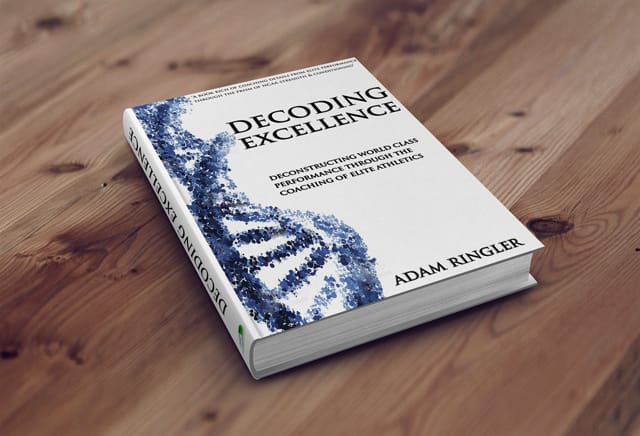
Decoding Excellence Book
Decoding Excellence is the book I needed when I started coaching. It is a collection of the lessons, frameworks, and hard-won insights from building high-performance programs in collegiate athletics, written for coaches who want to get better at the craft and leaders who want to build something that lasts.
This is not theory. Every chapter comes from real situations: managing 200 athletes as a one-man department, building an internship program from nothing, learning to lead when you have no authority, and figuring out how to sustain a coaching career without burning out.
The Story Behind the Book
I did not start as a coach. I started as a wrestler at Michigan State who lost his identity when he walked away from the team. I got rejected from business school. I stumbled into kinesiology almost by accident, the way you find your true love in a romantic comedy after dating everyone wrong first.
Then I landed at Wichita State responsible for 200 athletes across six sports with no staff and no blueprint. Women's basketball, volleyball, golf, tennis, baseball, and the entire track and field team. One coach. Two hundred athletes. Figure it out.
That is where this book was born. Not in a classroom, but in the daily grind of solving problems nobody had even formulated yet. I built an internship program from volunteers off the street because I needed to be in two places at once. I learned to listen before fixing. I discovered that scaling excellence means creating systems other people can run, not being the hero who does everything.
This book is those lessons, organized so you do not have to learn them the hard way.
Inside the Book: Five Modules
The book is organized into five modules, each tackling a different dimension of what it takes to coach and lead at a high level. You can read it cover to cover or jump to the module you need most right now.
Module 1: Coaching Strategies
The craft of coaching. Thirty chapters on rallying your troops, outlining the path forward, and enticing others to help you build something bigger than yourself. Learn how to fail forward, embrace pressure instead of fearing it, and set standards that outlast goals. Dive into coaching pedagogy, deconstructing what makes successful coaches successful, and creating competitive environments where athletes thrive. Topics include stoicism applied to coaching, defeating imposter syndrome, saying less to communicate more (signal vs. noise), and identifying the future leaders on your roster.
Module 2: Business Management Strategies
Running a performance department like a business. Twenty-one chapters on vision, hiring, and building systems that scale. Learn to replicate bright spots instead of fixing weaknesses, develop an unshakable mind, and understand the difference between thermostats (who set the temperature) and thermometers (who just read it). Covers organizational growth hacking, the power of listening over hearing, how to hire your first employee, retaining your greatest assets, gaining organizational capital, and avoiding the common traps that sink well-intentioned programs.
Module 3: Culture Building Strategies
How culture actually gets built. Not through mission statements, but one brick at a time. Learn why shortcuts hurt more than they help, how to check your crops (audit what you are actually growing), and what it takes to create genuine engagement instead of compliance.
Module 4: Leadership Strategies
Leading when it is hard. Fifteen chapters on the realities of leadership nobody warns you about: letting go of people, avoiding decision fatigue, widening your options when you feel trapped, and leading from the front when you would rather hide. Covers developing your workplace culture, building better communication channels, playing the long game, and the lifetime leadership principles that compound over a career.
Module 5: Life Balance Strategies
The part most coaching books skip. Eleven chapters on sustaining a career without sacrificing your life. Why saying no is necessary, how to build a morning routine that actually sticks, the power of habits and rituals, creating whitespace for creative thinking, avoiding distractions, and performing under pressure. Because the best program in the world means nothing if the coach running it burns out in year three.

Who Should Read This
Young coaches trying to figure out the profession. Experienced coaches who want better systems. Anyone who leads people and wants practical frameworks instead of motivational platitudes. If you manage a team, build culture, or try to get better every day, this book was written for you.
About the Author
Adam Ringler is the Director of Performance for the Indiana Fever. He has spent more than two decades in high-performance sport, with stops at the University of Colorado Boulder, Wichita State University, and Michigan State University before moving into professional basketball.
He hosts the Decoding Excellence Show, a podcast featuring conversations with coaches, scientists, and leaders across sport and performance. He writes about strength and conditioning, sport science, and coaching leadership at AdamRingler.com.

See where Adam has been featured in podcasts, lectures, and media: