#076 - Behind the Scenes of CU Basketball Summer Training | Cardio Chats
Go behind the scenes of CU Basketball’s summer training in this Cardio Chats episode. From NIL challenges to altitude acclimation, VBT, plyos, and our legendary dunk contest, I share the raw, unfiltered details of how we build stronger, faster, more resilient athletes in Boulder.

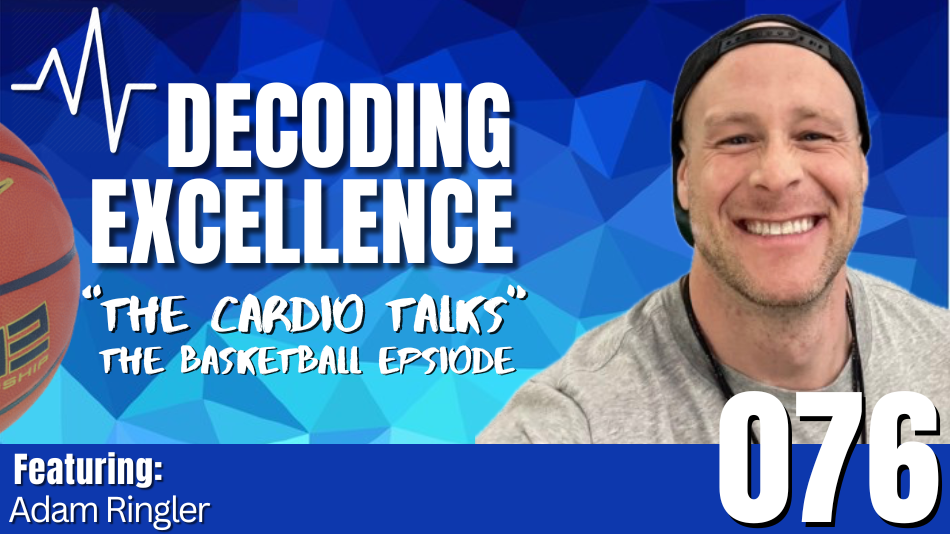
In this “Cardio Chats” edition of the Decoding Excellence Show, I’m pulling back the curtain on our Summer Basketball Training Program here in Boulder, Colorado,sharing the real behind-the-scenes details of how we prepare our athletes for the demands of a long, grueling season.
This is raw, unfiltered, and recorded mid-Zone 2 ruck walk,no studio, no edits,just me sharing what’s really happening in our summer block: the successes, the challenges, and the lessons learned.

During the Cardio Talk
I comprehensively break down the following topics:
- The death of Long-Term Athletic Development in the NIL era
- Managing NIL contracts, constant roster turnover, and short prep windows
- Using VALD Performance testing to fast-track development and identify individual needs
- Benchmark data for return-to-sport baselines
- Triaging immediate needs vs. “nice-to-have” improvements
- Safe altitude acclimatization & training volume progression (CSCCa/NSCA joint guidance)
- Building a standardized summer plan that branches into tailored individual programming
- Exposure to sport-specific stressors,loading tendons, ligaments, and muscles for durability
- Integrating soft-surface training to reduce joint stress while increasing volume
- Adding gymnastics-style movements like crawling, tumbling, and rolling for coordination and robustness
- Training linear & multi-directional sprint mechanics
- Structuring our four-day training split:Day 1 & 2: Progressive overload strength training (Upper/Lower)Day 3: Escalating Density Training (EDT) conditioning circuitsDay 4: Tissue prep for intensive plyometric and power work
- Using leadership development by seeding EDT teams to encourage athlete-led problem solving
- First half of summer = tissue prep (ankle/knee/hip focus)
- Second half = power development through jumps, bounds, speed deadlifts, and VBT barbell work
- Avoiding plyometric progression errors with long-duration isometrics & tendon prehab
- Leveraging Output Sports VBT to train in the speed-strength zone
- Applying Post-Activation Potentiation (PAP) in jump & power sessions
- Ending summer with CU’s legendary dunk contest,weighted balls, dodgeballs, deflated balls, and more to challenge grip, creativity, and athleticism
Whether you’re a strength coach, sport scientist, or high-performance practitioner, this episode is a complete blueprint of how we’re navigating modern college basketball’s evolving landscape,balancing science, art, and the gritty realities of athlete development.
If you’re serious about training design, athlete monitoring, or building durable and explosive players, this one’s loaded with practical takeaways you can apply immediately.
Thanks again for listening to the Decoding Excellence Show! I appreciate all the support growing this Sport Science, Strength & Conditioning, and High-Performance Coaching resource. If you have taken anything away from the show, please login to iTunes and navigate to Decoding Excellence page and leave us a FIVE STAR ⭐⭐⭐⭐⭐ review.
If you haven't already, you can head over to AdamRingler.com/Newsletter and sign-up for my weekly newsletter. This is a newsletter for the curious. It's chalked full of interesting articles I've read through the week, things I'm exploring and finding fascinating through my week, and a collections of thought experiences and resources I've cultivated.
 Adam Ringler

If any of the material resonates with you, I'd love for you engage with me at @AdamRingler
Key Takeaways
- In the NIL era of roster turnover and short prep windows, use testing to fast-track development and triage immediate needs versus nice-to-have improvements.
- Structure summer in two halves: tissue prep with an ankle, knee, and hip focus first, then power development through jumps, bounds, speed deadlifts, and VBT barbell work.
- Earn plyometric progressions with long-duration isometrics and tendon prehab, and expose athletes to sport-specific stressors so tendons and ligaments are durable before intensity ramps up.
- Use soft-surface training to increase volume while reducing joint stress, and add gymnastics-style movements like crawling and tumbling for coordination and robustness.
- Build leadership into the plan: seeding EDT conditioning teams forces athlete-led problem solving, and finishing summer with a creative dunk contest keeps buy-in high.
Listen and Subscribe
Find this episode of the Decoding Excellence Show on Apple Podcasts and Spotify, or use the player above.
Go Further in This Episode
Enjoyed this conversation? Here is how to get more from it:
- Read the transcript below to revisit key ideas at your own pace.
- Share this episode with a coach or colleague who would benefit.
- Subscribe to the Decoding Excellence Show on Apple Podcasts, Spotify, or your favorite app.
- Join the newsletter at adamringler.com/newsletter for weekly insights on human performance.
Episode Transcript
This transcript was automatically generated. While we strive for accuracy, some words or phrases may be misheard.
[00:00:00] Sport science, strength and conditioning, high performance coaching, welcome to the Decoding Excellence Show. Hey everybody, welcome to this Decoding Excellence Show. As always, I'm your host Adam Ringler and we have a fantastic show where I'm diving deep into the full discussion of our summer breakdown of training. I'm going to get into all the topics, I'm going to talk about some of the testing, I'm going to talk about our system. I kind of want to just dive deep into the explaining
[00:00:52] Some of my rationale. Like it, hate it, use it, discard it, really doesn't matter, I just want to share a little behind the scenes with you regarding the summer training program that we are implementing here. So if you are interested in training, the what, the why, the how, the win. This is a great show for you, so stay tuned. Hey everybody, just like the intro said, this is the Decoding Excellence Show. I'm your host Adam Ringler. As always, I've been doing this for, I don't know, 70, some 80, some podcasts at this rate. So today is no different. We have a
[00:01:26] Great show today. I'm going to talk about the summer training program that we've been implementing with our women's basketball team. We'll talk about testing, we'll talk about training, we'll talk about win, where, how, what, and everything else. So now, like always, this is a cardio talk, which means I'm doing my 50 minute rock walk through my neighborhood. So at this rate, you might hear things like motorcycles, you might hear dogs barking, you might hear cars, you might hear people walking by. That's because I am multitasking. This is not a studio. This is not a studio mic. Here I
[00:02:06] Am. I don't have a road, although I'm thinking about getting a road go wireless microphone. I just for a better audio quality. However, this is just me, my iPhone 45 pound rock on my back, getting some vitamin D and get some steps in this morning. So nonetheless, I want to talk a little bit about our summer training program. So we've done this before on these cardio talks where I get long winded, I get talking and then obviously I start losing my breath. That's what Peter Atia would talk about as our zone two, right? Zone two being here I am. I'm actually not in zone two,
[00:02:45] Whatsoever, 92 beats per minute right now. So I need to pick up my tempo with some hills coming up here. So that should be a little bit better with raising my heart rate. However, right? Zone two would be where you can sustain a conversational rhythm to your voice, conversational tone and pace and words. However, so if I get a little bit long winded and I get a little out of breath, that's because I'm pushing the cardio. Yeah, but like the intro said, we're going to talk about our women's basketball summer training program now. I want to start with maybe laying the expectations
[00:03:23] Of this, right? And by doing so, you get to understand the context of what basketball programs are dealing with across America right now. And that is massive roster turnover through NIL, through House V in CWA, through general managers and contracts and money and all of this stuff. So I won't get into that aspect. That's just the name of the game now, right? That's the reality in which we are operating within. So with that said, what we've seen and what I've seen other programs see is that at this rate, we are always going to be navigating large roster turnovers, right?
[00:04:09] For the old school programs, so back in the day, the Kentucky's, you're right, I'm talking more on the men's side. The one in Dunes, you know, where they might have six of their entire team go pro, you know, first round draft, second round draft type of deal, right? Women's basketball, we've never really had to navigate that. That's just been something in the 20 years of coaching women's basketball, I've never had to see these massive turnovers. So that said, now that that's sort of the reality, we have a much smaller condensed window of time to develop and prepare our student athletes,
[00:04:49] Right? Our athletes for the rigors of competition. So we need to, boy, we need to be efficacious with our training or testing or diagnostics, our eVALs, our assessments to better expedite the training process, right? If you were to think five, 10 years ago, right? You might have an athlete red shirts, plays low minutes for second year, right? Hers, oh, what would be her red shirt freshman year? Works her way through her red shirt sophomore year, her minutes are picking up, right? Her red shirt junior year, she's more about contributor. Maybe she's coming in a six, six person off the
[00:05:33] Bench, perhaps? No. Nowadays, you get one year, you get one year to make an impact, because if not, most likely you are heading to a new program. You are heading to a new program. You are either transferring for, you know, a different NIL contract or you're going down a level to play at a different university. So what that means for us is that we don't have multiple years to employ a long-term athletic development model. We have essentially, from the moment they arrive on campus, to that season to prepare them to be a contributor in whatever way that their performance
[00:06:22] Allows for. So we need to be, like I said, at the onset of this sort of dialogue here, we need to be very efficacious with our assessments and ebabs. So upon our athletes arrival, as part of their physical pre-participation physical, we are employing several different technologies and forced assessment tests. We will look at things like their anthropometric data, their, you know, sit and reach flexibility. We'll look at their mobility through, you know, acquitted IMU, accelerometer, gyroscope, sort of output sports, range of motion in kilometers,
[00:07:04] If you will. We could also use the dynamo, the vault performance dynamo, to be able to do, you know, mobility assessments on our athletes. And then, obviously, we have the whole suite of applications from a forced assessment standpoint. So we will northboard. We will force frame. We will do, you know, knee extension for, obviously, quad strength. We will do the northboard for hamstrings and posterior chain strength. We'll do hip adduction and abduction. We'll do the shoulder ash test for eyes-wise T's and shoulder asymmetries. We'll do an IMTP, essentially a belt squat
[00:07:43] Variation, or bilateral and unilateral force asymmetries. We'll do a 10-5 hop test, or RSI. We'll do CMJs for, you know, obviously eccentric braking and concentric peak force and landing peak forces. So we're going to do all of these things. Now, not only does it establish a comprehensive baseline prior to real physical activities, right? That's important because the season is, what the season is. Now, you know, it's a physical league. It is basketball, is contact. And we know through injury surveillance data and NCAA data that there's a high likelihood of season ending injuries. Now,
[00:08:31] Knocking wood, been successful. I'll let her. In the event that there is a season ending injury, we want to have pre-participation, physical benchmarks that are athletes either achieved at one point in their career to at least begin to establish a percentage or a timeline or a percentage-based criteria or progression back towards clearance of that athlete back to a return disorder. So that's where having these physical benchmarks and baselines is vitally important for the return to play, but also for the longitudinal development of our student athletes. I want to
[00:09:18] Be able to show that they came here and their peak concentric peak force was X. And now, after seven, eight months of training, it's X, you know, 1.5 X, right? I want to be able to show that to administrators to our sports med, to our sport coaches, to our sport supervisors that we did our jobs, right? We got exactly better over the course of their 10-year year at our university. But wow, it's important to be able to show progress while it's important to capture baselines. In addition, my feather really, really helpful. Considering the advanced timeline for physical development,
[00:10:03] Considering we don't have multiple years to play a long-term athletic development model with our athletes, we need to take a course direction with our training that goes not A to B to C to D all the way to C, but we need to be able to find what their exact rate limiting factor is and ruthlessly attack that, right? We don't have the time to take multiple years and show up multiple deficits and areas of development. Yes, listen, we will work on improving everything. That's part of a sports performance program. However, if we know that there is something that is standard deviations,
[00:11:02] Away from normative data, and everything else is only a half a standard deviation from normative data. And it makes sense. It makes biomechanical sort of sense to reallocate a larger amount of time towards fixing this asymmetry or fixing this to standard deviation and abnormality of force or asymmetry or of whatever. We're going to do that. We're going to spend our time focusing on that. So that athlete will have a much different training program. We'll have a much different warm up protocol. We'll have a much different cool down plan. We'll have a much
[00:11:50] Different accessories and voluntary work to be able to show up some of those missing links in her program. And this is all done so we can be faster, maybe better, and deliver this athlete to a I guess metaphoric or hypothetical point in the season where they are ready to perform. That they are absolutely ready to perform because we've shared up their great limiting factors and deficits of their training. Now, that becomes a really vital piece when we do our boy, this one is walked. Kick him a butt right now. This is the most steepest incline part
[00:12:39] Of the walk. And then obviously you start talking. And that heart rate gets jacked up here. So bear with me as I'm struggling to catch my breath if you're hearing me breathing through the microphone. Okay, so talking a lot. But this is the podcast. This is the cardio talks. What do you expect? It's a walk and talk. So here we are. We've done our preparticipation, preparticipation, and physicals. And now we've also done all of our baseline testing. We have a plan. We've identified what the rate limiting factors are and what is there, maybe primary, secondary, and tertiary areas of
[00:13:28] Development, but need to develop it. Then we probably need to discuss what the plan would look like. So from here, this is where we go into our standardized, some our training block. Now, as an overview, let me discuss maybe some philosophical things. I want to tackle during this physical time of, you know, general physical preparation, GPP, right? These athletes are coming off of a extended time at home where they may or may not have endured some level of physical training. Now, all of our athletes have access to regi athletic. They are assigned voluntary
[00:14:18] Non-tracked bridge programs that they can utilize during this period of time to prepare for the months of which they will be here in Boulder, Colorado training. That said, however, we have to assume that these athletes probably haven't done a as stringent and rigorous strengthening program is what they watch when they arrive. So that means that there's several different things we want to attack if you will as they come here. Well, tissue prep, we need to get these athletes exposed to stressors of tissues in very targeted ways, right? We need to do so in ways
[00:15:02] That don't trigger too much inflammation in that area. We need to load tendons and ligaments in ways that maybe stimulate some collagen or remodeling in those areas without triggering tendonitis. So the use of isometrics and long duration, low intensity isometrics. So our primary responsibility in the early window of training time is to prepare the athlete in a way that allows them to gradually in a progressive manner employ more and more intensity for their training. This the summer months continue to go. So things like volume and intensity is reduced. We're allowing them
[00:15:50] To acclimatize back into altitude, back into training, back into intensity as safe. By the case, just matter that allows them to stay healthy. Now, depending on all those things, let's talk about some higher picture. 30,000 new goals, but what this program should look like. I want some linear lateral movement, if you will. So linear sprint, pure delinear sort of running, some running mechanics involved in this program. We obviously need dynamic warm ups, things to prepare the muscular tissues and the surrounding
[00:16:31] Body tissues for activity. And that should be somewhat of like a ramp protocol. At least that's what I kind of generally end up programming as far as range of motion and body temperature and activation and muscular activation. And you know, again, progressive over time and we go through that. And then obviously make it our linear curve delinear and lateral movements as we go through linear days, lateral days, multi directional sort of moment days. Now, in addition to that, we're not sprinting in the beginning of our workout and building some of those tolerances for more higher intensity
[00:17:15] Change direction and basketball like movements. Then I'm a big proponent of utilizing soft surface type of training. So we end up rolling out a gymnastics mat, we bear crawl, we lateral bear crawl, we forward tumble, we cartwheel, we teach basic physical education, gymnastics like movements. Now, we teach these movements because here's a recognition.
[00:17:47] Physical education programs across America do no no longer teach these movements. They do not teach how to cartwheel and stand walk, bear crawl or move their bodies in ways that are for it. And if that's the standard operating procedure for most American physical education programs, then I think it's important being that we're in a contact sport to teach each athlete how to invert, how to roll, how to tumble, how to tuck, take a charge, how to get on their hands and knees and feet, how to lock their shoulders in a bear crawl,
[00:18:27] Quadruped position. All of these things are important and all of these things teach vital full body, muscular contraction, and kinesthetic awareness and patterns. Now, with that said, whether we're sprinting, so we typically will train four days a week or two days that focus a little bit more on linear sprinting. Another day that focuses on more multi-directional type of change of direction sprinting or tissue prep. And then the other two days of our training, we're either utilizing the gymnastics mat to do crawling patterns, tumbling, basic gymnastics
[00:19:04] Like movements, or finally on the fourth day, a hopping, pogo, lower body knee, hip, ankle, Achilles prep. So think bilateral pogo hops, more extensive type jump patterns, short coupling type movements, pogoes, lateral pogoes, backward pogoes, single leg pogoes, bounds, double bound, short response bounds, broad jumps, broad jumps and do a vertical jumps, single leg jumps. So we're doing so again in a way that progressively over time goes from a soft surface to a harder surface to the hardwood where these tissues have an opportunity to have a progressive density,
[00:19:55] Progressive intensity, progressive surface to allow for operation and climatization to those surface types. Now that covers maybe the first 10 to 15 minutes of our long training. What we do over the next 45 minutes is really also really important.
[00:20:24] So we typically would deploy a four day, I've already sort of said this in the and the layout of sort of our organizational plan with the two sprint days to sort of locomotive days and then the other two crawling and pogo days. We're training four days a week. Now with that said, we are typically doing an upper lower split. So upper and Monday, lower and Tuesday, upper and Thursday, lower and Friday. That's the typical structure of our plans. Now with that plan, our first two lifts of the week are what you would expect from most
[00:21:08] Classical strengthening programs. We're going to start out because it's early summer, a little bit more volume, a little bit more or a little less intensity. We're not training for heavy singles or triples, we're not powerlifting, we're not chasing max efforts yet, but building some volume progressively over time to get them prepared for higher periods of preseason volume when they come back in August, September, and we're training in October. So the intensities are a little bit lower. The movements, however, are similar. We're going to squat our lower body days
[00:21:52] And we might start off with a zircher or a goblet squat and start building tissue prep. We're going to do some front foot elevated range of motion, sort of unilateral squatting, lunge type movements. We're going to train the neck out of the posterior chain through sore neck hamstring rollers and RDLs and single leg RDLs, Nordic hamstring balls. We're going to do all those things. We're going to train calves and adductors and abductors and we're going to train all of this stuff. Hip flexors, this is your classical strength conditioning programs, if you
[00:22:27] Will. And we're going to do the exact same for upper body days. Start out with lower intensities, higher volumes over the six weeks of summer access for eight weeks. We will progressively add more and more volume and then as we get closer to the end of the summer training months, we won't increase the intensity as well by lowering the rep targets.
[00:22:53] But while we lower the rep targets, our upper body day and much akin to our lower body, looks very similar. We will do some type of horizontal pressing, we'll hammer the horizontal and vertical pulling. So things like pull ups, things like eccentric pull ups, things like pull ups with the isos at the top or various sort of ranch emotion isos. We'll do double arm pulls like a seated cable row, we'll do a single arm row. Our program sizes a lot of posterior upper body work. So we row and we vertical row, vertical pull, you will, whatever.
[00:23:36] A lot, a lot. I've always say a healthy shoulder is a strong back. We're going to make sure that our athletes backs are ridiculously strong. So much like that, I know our bread and butter movements when we get into October and we get into our sort of training phases to do non-con and conference. During this summer block, I like to take some time and slow cook it. I like to do movement setter, not that. So we may start off with an incline barbell bench press and work through building some tissue tolerance and some volume there. We might do a decline bench press
[00:24:13] For funzees and get some pressing in that sort of pattern. Why? Because there was some variety in our training program. I don't want to be flat bench pressing for our 12 months straight. So we're going to employ a lot of different things with a rotator cuff for the forearms. Obviously, we're going to do some type of arm farm because fastball players are going to look jacked. That's number one. But a lot of back, a lot of chest, a lot of core, a lot of midline, stabilization, core work, anti-rotation, type of anti-extension type movements for core strengthening,
[00:24:50] Right? To create a strong pillar, a strong base to be able to host up and push off an arm bar off of. But we're training that. It's a very conventional looking those Monday and Tuesdays that lower body or that upper body and lower body split early in the week. Now what we do towards the end of the week though is the fun part, right? This is what I love. So our next upper body lift, if we've already lifted upper on Monday and we lifted lower body on Tuesday, we had Wednesday off. Although there's really no off days, right? People come in and do their
[00:25:26] Individualized plans and they do their recoveries and they do their extra conditioning. If they need that, they do all of their individual prehabs. But let's just assume Wednesday is this voluntary adopt. What we do Thursday is our upper body positioning circuit. So we will end up doing what we call escalating density training, Charles Saley. And we're going to start with three rounds. And we've gone up to 15 minutes. So it's total time of 45 minutes. But we'll start off the early summer period with 10-minute blocks. But essentially it's an
[00:26:03] AMRAP. As many rounds as possible of several different upper body exercises conditioning, low-intact conditioning, and core within an exercise block. So as an example, it might be a 45-pound plate bench press for five reps. And then they go and do a hurdle kick-through sit-up variation for 10 reps. And then they might run over to the skier. It can do 200 meters of skier. And then they might run over and do a low cable row for 10 reps. And that's one completed round. And they have a running clock 10 minutes to get as many rounds as possible. So I might have a group
[00:26:41] Of three or four athletes in that station. I might have another three or four athletes in a second station with different exercises and different low-impact conditioning. And then I'll have the remaining athletes in a third station. Very similar. Some type of push, some type of pull, some type of core, some type of cardio. And we do this. And obviously our athletes are wearing cart rate monitors. That cart rate monitor is being broadcasted to our TVs in real time. We're seeing the cardiovascular conditioning happen in real time on the televisions. But we're also having
[00:27:15] Them log each of their completed rounds. So not only do we get a heart rate response, internal load metric, we also get to see their output being recorded in a across these three 10 minute periods, 30 minutes total work time. I completed a total of 19 rounds. Great. Here's your training impulse, your heart rate response. Here's your output 19 rounds. That's an equation for us. We look at sort of the output. What did you get 19 rounds? What did it cost you? Your training impulse. And we have both sides of that coin. That will be done in week one.
[00:27:55] Now, for standardization, we may not increase that or we may find a weighing factor that allows us to do some level of standardization if we do increase the rounds. But if we don't, then in week six, when your training impulse is now less, but your output is now goes from 19 total rounds to 26 rounds. You've had the same amount of work, or actually, sorry, you have the same amount of duration of work. But you're moving more intensely. You're doing more work in that time. And it's costing you less internal load captured by training impulse. That, my friends, is what we call fitness.
[00:28:41] They've gained fitness in those six weeks. I love that because not only are we conditioning our athletes for, you know, 30 some minutes dedicated, but we're also doing so in a way that's not impacting their joints, their ligaments. They're not running 11s or 22s or down and backs or line touches. They're doing so in a way that allows them to leverage versus climbers, skier to rowers, air dyes. They're also being so quickly through the lift that they're getting muscular endurance. They're getting cardiovascular response.
[00:29:20] Sorry, it's a very hydrapping area right here, so my audio might be terrible. But they're doing so in a way that keeps their heart rate elevated, trains muscle groups from hypertrophy, rep range and endurance range. But doesn't so in a way that also delivers cardiovascular response. I love our Thursdays. It's cardio. It's endurance. It's hypertrophy. Our athletes are getting jacked. They're getting fit and they're preparing for the demands and rigorous of the season training. Now, sure, we still do our our bear cross series.
[00:29:54] We still do our dynamic effort or our dynamic warmups. We still go into all of our station breakouts and do, you know, our three or four exercise prep to get ready for that eating tea, if you will. Well, there's also a sense that I didn't really discuss this part is that I take the top three highest scoring individuals and I sign them to groups. They're the group leaders. So if you scored, let's say you're the group leader, 26 rounds across those three minutes, that's kind of ridiculous, but let's pretend we did. You're the top dog. And the top dog always
[00:30:37] Gets to pick what station they want to start at, station one station two or station three. And then the silver medalist in our group gets picked up of the remaining two and then our bronze medalist. Well, guess what? You you get whatever is left over, but whether you're gold, silver, or bronze medalist, you are the leader of your group, your group of three or four acts. Now, because of that, there's a leadership opportunity in these conditioning EDT circuits. You get to, again, I get to convene. I get to, okay, I want my three leaders to come here.
[00:31:10] We're going to talk. This is what I need to do. This is how our what our mission is today. This is what I need you to coach up. We're going to change these things. I need to communicate these things. It is leadership in real time, your communication in real time. And that is such a vital thing to train when you have new athletes joining our programs, like we do in the NIO era. How do we how to be led, how to communicate, how to communicate, under fire during the rest, during stress, all of those things. In addition to that,
[00:31:44] Right, it allows me to come to those three leaders and say, I need you to lead your group better. And you feel a sense of ownership when you're the leader of your group. Like, I need to lead from the front on the top dog anyways. I need to set the example of how this group is. Now, every week based on the results of that week, I receive the teams. So, if you're to think of seeding a bracket, one, two, three, for that third person, you get going back the opposite direction, four, five, six, going down the bracket, you know, seven, eight, nine, going
[00:32:20] Back up the bracket, nine, seven, eleven. I keep doing that. So the groups are always shuffled, right? So there's always new people going in and out of the group each week. And that gives you an opportunity to, if you've never been a leader, to have an opportunity to lead, but also to have different personalities and different leadership types, archetypes, people that need a kick in the butt, people that need an arm around their shoulder, people that need motivation, people that need encouragement, people that need visual encouragement,
[00:32:53] People that need verbal encouragement. It gives an opportunity for the leaders to lead different types of people, which is so necessary because there's not one leadership style. There's also not one style person that is the archetype to being led. You have to read the room. You have to understand what that person needs to be able to be savvy enough to be able to deploy that leadership strategy for them. So that's our thirst. And I love our thirst, right? To kick in the butts, conditioning, heart rates are elevated, leadership is developed,
[00:33:27] Endurance is developed, hypertrophy is owned in. Now what we do on our last lift days, our Fridays is really dependent on what three-week phase that we are in that early portion of their summer. It's tissue prep. If we're in the second half of our summer, essentially summer access, if you will, it's not a full summer like June, July, August. When the second half is powertrain. So let's break this out in a two-part series. Number one, we're always going to hit the court to your dynamic. First, we're then going to always go into our extensive low amplitude, low intensity
[00:34:08] OGO series. This is still on the soft surface gymnastics mat. It's also windy today. So I apologize if there's a bunch of wind. I'll try to, it's somewhat of the post edit. I'll try to have some of the wind and background noises. But we're always going to do the pogos because that's tissue prep as well. That's also a climatization to more intense stretch shortening cycles, Achilles prep, eight prep, tenonitis prep. So we're going to hit that. Then we go up to the weight room. We do our three-station breakouts. This might be as an example, no perfect example. We might do a
[00:34:41] Single leg hurdle with the stabilization counter movement landing. That might be one series. Down on your left leg, come back on your right leg. Then you go to the second station. And it might be we're standing on a select block. It's an ankle stabilization foam block. And we're moving a kettlebell to the side of our body and doing a fashion like we're weaving a basketball. I mean, we might be doing that for some slight ankle perturbation on the select block to develop some ankle stabilization. That might be our second station. Our third station might be bandit TKs
[00:35:19] With the squeeze and an ISO. Five-second ISO on the terminal knee extension position. So we're getting things to warm up the clouds. We get things to prepare landing mechanics. We get things to warm up our ankles. We do that for two sets. We're going to go to the fourth display while we're doing that through two counter movement jumps, hands on hips. And now we're ready to go into our real lift for the next 45 minutes. Now, like I said, break it up into two different phases, if you will. The first phase is preparing the tissues. So we did some, you know, our primary block
[00:35:55] Would be some trap bar dead lifts with a controlled three-second P-central. So we're not even centrally really prioritizing. And it's light. I'm teaching mechanics. We're teaching body position. We're teaching spinal alignment. We're teaching control during that eccentric coming back down to the floor of a trap bar. A trap bar deadlifted to build. Why would we do that? Well, we're doing that because in the second phase, I'm going to do some trap bar jumps and have some body awareness of how to actually control that eccentric.
[00:36:31] Now, I typically will superset that trap bar deadlift with something like a band assisted vertical jump. So, again, a pogo up, emphasizing quick, explosive, short contacts off the ground, ground contact times. These are your typical band assisted type pogo opposite, you see, popularized aren't everything, social media, et cetera. But in this tissue prep base, we're not trying to jump very high. We're emphasizing pulling the ground, attacking the ground, and just focusing on the quickest contact time
[00:37:11] And just getting slightly up in the air. So, why? Because we're acclimatizing to those impacts and those stressors. Again, we have to assume that they've come up a period from March Madness, final four, April, let's just say, all throughout May, which is transfer portal season now, right? It's recruiting, it's official visits, it's building disaster. The period of time training in May is kind of ceased, I think, in the modern basketball world when you're re-recruiting your own players, you're fruiting people through the transfer portal
[00:37:45] In a very expedited transfer window all the time. So, these guys may have not trained from May, four weeks there, June, another four weeks, eight weeks of time off. You can't assume that they're ready for intense wild metrics. So, recipe for tendonitis and Achilles pain. So, that said, that might be our primary block, our secondary block. Our things like Spliswa Isos, right? We do a bunch of those, or we might be doing of work. We're working on more of the intrinsic muscles of the feet. I also like to do a banded
[00:38:31] 90-degree isometric knee extension. Why? To get some Telatendin logo, right? In a pain-free or at least as low of a pain to build some tolerance and some tissue adaptability that Telatendin as well. Make body settings, okay? So,
[00:38:58] First of all, the summit is just a big isometric day. We're doing things like polycan step-downs. We're doing things that look like tendonitis pre-ab, right? We're doing spanner squats. We're doing ankle staves. We're doing all, you know, range of motion through the ankle. And it's to prepare the body for basketball season, right? These guys are obviously doing individuals with the basketball coach, right? So, they got individual sessions and skilled development sessions. But my job is a physical preparation coach is to get them prepared for
[00:39:35] Basketball season. It's a long, long season. And I am well willing to provide two to three weeks to really target some of the key areas, attendance, and muscles of our body through isometrics, to prepare those tissues and those structures for more intense loading for the remainder of the entire season of training. So, that's what that first half looks like. Now, the second half is where we take those eccentric trap bar, got lifts, and we turn them into high velocity, low intensity, although it's not really super low. We put our VBT output sports units on the bar.
[00:40:20] We're emphasizing triples, free reps, high concentric, meters per seconds, probably 1.2 is our green range. And they're starting off at a starting weight of, say, 95 pounds. If they get three reps above 1.2 meters per second on these trap bar jumps or trap bar speed that lifts, if you will, you do. Oh, this is loud. So, we do have the performance track system in our weight room. So, we'll put up some bands essentially a deadlift setup so that the trap bar is set up in between, you know, two attachments on the floor. So, it's banded trap bar jumps. Just to have some
[00:41:02] Accommodating resistance or some resistance as they reach sort of terminal velocity terminal position of that trap bar jump. Do I accelerate them at the top of the movement when velocity should be the highest, right? Nonetheless, we do that in a way to emphasize power production and interaction center. Why? Because we're at least to be explosive and jacked in conditions and strong. So that Friday, lower body days, all about power production, hang a root program, if you will. And so now we take those explosive trap bar jumps. We again, we supersed it in that primary block
[00:41:40] With those banded pogoes, but now we're not just doing short contact times. We're actually loading up. We're getting a little bit of some range of motion throughout that knee and ankle hip complex. And we're actually producing as much high jump and we're leveraging the fact that the band is assisting. So ground contact speeds will be a little greater because the band is assisting. The jump heights will be a little bit higher because the band is also assisting. But they get to feel like dang, I'm being explosive. Now, when we move to second block, we're doing
[00:42:12] Spliss-watt ISOs. We're now doing a controlled eccentric rear foot elevated spliss-watt into a powerful concentric, explosive concentric. Now, instead of doing it for ISO duration, we're doing it for three reps. We're going back over to the perform x track system. And we're doing now band-resisted spliss-watt alternating jumps. So it's the same body position as how they're dribbling most of the time. One lead leg in front, trail leg, they're dribbling in the pocket. However, they're in that spliss-watt position.
[00:42:48] And now we're producing concentric force. We're jumping in the air, we're prioritizing vertical displacement, we're scissoring our weight in the top of the band, band, blurry on that descent. And then we're repeating that for six total jumps or three of each leg. They do that band-resisted and then they take the band system off and they do it with body weight. So now we're getting some type of post-activation, potentiation. One in the rear foot elevated spliss-watt, two in the band-resisted spliss-watt jumps, three in the body weight spliss-watt jumps.
[00:43:32] Let me tell you, utilizing that PAP are athletes, vertical jumps, relative peak powers on the force plate and vertical max touches, all increased week over week through exposure of this. Now, third block might look like, again, we would normally be doing quadisos, spanner spliss-watt, TKEs, and things like that. We're not.
[00:44:00] And then we call our dunk contest. That's where we use things like med balls, weighted balls, and we're doing some, you know, pounded hurdle jumps into a dunk contest, right? So our taller app, 10 foot, we'll raise that. Six, or we'll lower it to nine six. For our smaller guards, we'll have it down closer to, I don't know, nine foot, maybe. And we're now dunking a series of, whether it's a dodge ball, like a soft foam dodge ball, to grip it, a deflated, you know, basketball, a weighted ball, a net ball. And we're just getting some power
[00:44:38] Production down. If you've been in the game long enough and you've known, like, we can teach athletes how to clean. You can teach athletes how to snatch. You can teach athletes whatever, Olympic lifts you love to deploy. I'm gonna tell you that I get the most amount of power production, and the most amount of smiles and shit talking. There it is, of course now. When we just do a dunk contest, it is such an easy hack to get power production by making it more sport-specific than trying to teach basketball athletes to care about a snatch. So time costs,
[00:45:17] When we only have one season to really develop them because of NIL, because of the landscape of college sports, I'm not taking five months to teach them how to clean and snatch. I'm just gonna have a jump-up weighted pass ball with the buck-shout buck-shout bell around their hips. So that's the external load. All right, with this buck-shout bell arc, they attach it to their hips. They do a dunk. They're now dunking 10, 15 pounds. Okay, take the buck-shout bell off. Grab a weighted ball, dunk that. Okay, now the weight's even less. And now we're taking advantage of,
[00:45:53] Again, post-activation potentialization. In a sport-specific manner, that's going to be replicated on a court, hopefully I'd love to see one of our athletes don't mid-game. That'd be sweet. And our athletes are having fun with it, and because they're having fun, they're actually trying harder. That is so many positive wins that I will take that agreement, time and time and time, again, it just makes sense to me. And that's essentially our power day. Yes, we're gonna do some anterior tip work. Yes, we're gonna do some calves work with long, eccentric,
[00:46:28] Drop stretches, right, just to put some load through the Achilles spout flaps. And you think of all of the NBA athletes with the fall step or negative step, but how that heel drops and how that stresses that Achilles. And we've seen those pop time and time again. So we're gonna stretch those tissues and get those in those positions, very reputable positions under different loads. And that's a 30,000 foot view of what the program looks like. And we ride that out, essentially that tower block with the remainder of the summer.
[00:47:02] But we have some level of what you would say is a traditional strength conditioning program. On our Monday and Tuesdays are upper and lower body strength days. That's progressive in nature. Rep start higher. They finish lower. We build strength as we go through the six weeks of summer access for us. Our Thursdays are our conditioning upper body circuits. We're increasing those, we're shuffling athletes around for leadership development. But we're increasing our work capacity. Our endurance, our conditioning effect. And then our Friday's, our lower body
[00:47:42] Junk days, power days, first half of summer's all tissue prep, the second half of summer's all power production. And when we do that, we have a well-rounded comprehensive strength conditioning program that allows for our athletes to target what they need to target to be successful all season long, while also having an individualized program where they get to attack their rate limiting factors from their PPE, their pre-participation evaluation, physicals, where we've identified asymmetries or left hamstring, the right hamstring, the right quad, their left Achilles,
[00:48:18] Their CMJ stiffness, their relative peak power, whatever it might be on our PPE, pre-participation, physicals, and e-vows, and our base lining and benchmarking. And we have an individualized plan of attack for them. So and so's warm up is different. This person's knee extension is a little limited, so she's going to do more TKEs and Spanish plots, where another athlete can do more shoulder, pre-hab, crossover symmetry bands, where another athlete's going to do more ankle stabilization with other athletes going to do more banded treadmill
[00:48:55] Walks, like a TKE back pedal, if you will. And this provides the athlete an individualized approach, but also a global approach where they can leverage strong strategic and comprehensive training plan for their eight weeks or six weeks of summer access.
[00:49:20] Guys, I think that's going to be the show today. So if you've taken anything away from this cardio talk, it's a little bit longer. I slowed up my walk, heart rate's looking at 109 beats per minute. But if you've taken anything away from this show, the comprehensive breakdown of our summer training program, I want you to share this show with a friend, send this episode to another coach, to an athlete you work with, maybe to a sport coach and say, Hey coach, we need to be doing some of these things. But you've taken anything away from it. I appreciate you. Thank you so much
[00:49:51] For tuning in to this coding excellent show. Until next. Hey, everybody, that's going to be it for this podcast. As always, if you missed any of the episodes here in the Decoding Excellence Show, you can go and explore the back catalog. I host all of our episodes, not only on every sort of podcast hosting site, whether it's Spotify or whether it's a YouTube or anywhere else, but you can go to my website. It is Adam Ringler dot com forward slash podcast. From there, you can listen to all of the interviews, whether it's other sport
[00:50:28] Professionals, whether it's the monologues, whether it's the basketball discussions or the sport science and tech. Go to the website, check it out, listen to the podcast. I'm telling you, you will take something away from the back catalog of the Decoding Excellence Show. Now, one of the ways that you can support this show now, there's two really, you could go to Adam Ringler dot com forward slash newsletter. You can sign up for my newsletter. And in this, you're going to get access to everything, the cool things that I discover from a monthly basis, new books I'm reading,
[00:51:06] Things I'm discovering, articles that I found related to sport science. That's really cool and coaching. So pop in your email there. And that is just an easy way of supporting the show. And you'll get free behind the scenes access to all the cool things I'm discovering. If you took anything away from this episode, I would encourage you. No, I would beg you to share it with any of your friends, your coworkers, your family members, share it with somebody that could get a little bit of value from hearing what we discussed today. And as always, I appreciate you. I thank you.
[00:51:39] Until next time, stay strong, stay healthy, keep pushing on.