#042 Volleyball Roundtable with RJ Abella and Eduardo Fiallos

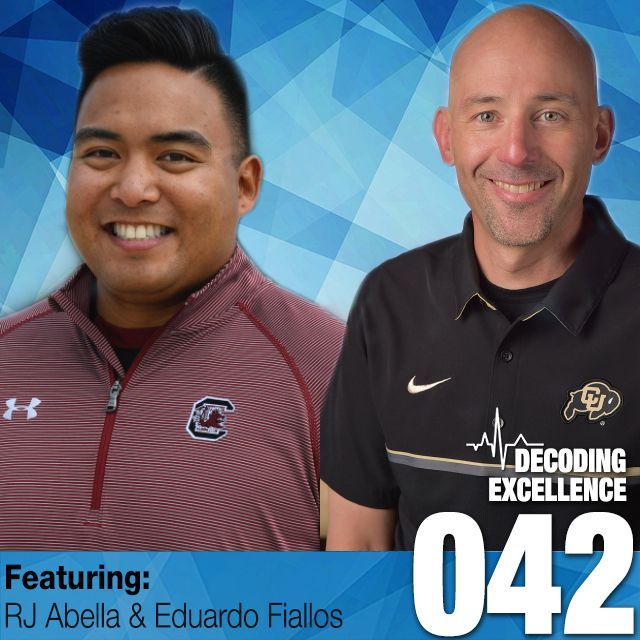
In this episode of the Decoding Excellence Show, I'm hosting a volleyball roundtable special featuring two of my good friends and fellow volleyball coaches, University of South Carolina's Beach Volleyball Assistant Coach RJ Abella and University of Colorado's Volleyball Technical Coordinator, Eduardo Fiallos.
RJ Abella enters his sixth season as assistant coach and recruiting coordinator for the Gamecocks, working with the program since its inception. Abella came to Carolina in the spring of 2013 as assistant coach for both the indoor and sand volleyball programs and made the transition to full-time beach volleyball assistant in the spring of 2015. He was named to the American Volleyball Coaches Association's "30 Under 30" list in 2014, recognizing 30 rising coaching stars at all levels of volleyball who are under 30 years old.
Eduardo joined the Buffs after spending four seasons at the University of Denver. In 2016, he served as the director of operations and from 2013-16, he was a volunteer assistant coach. Eduardo, who coached three seasons at Denver, was part of three straight Summit League Championship teams and three consecutive NCAA Tournament appearances for the Pioneers. Eduardo has been a coach at the collegiate level since 1997, spending time at five different universities. Eduardo was at Arizona (1997), Cal State-Dominguez Hills (1997-98), Louisiana-Lafayette (1998-99), North Carolina State (2006) and Denver (2013-16).
I had a blast recording this show and I know you'll take away a few GREAT things from it!
You can catch up with RJ on twitter at @CoachRidge and Eduardo at @EduardoCoaches or at his website at EduardoCoaches.com
In addition to those social mediums, you can head over to AdamRingler.com/Newsletter and sign-up for my weekly newsletter. This is a newsletter for the curious. It's chalked full of interesting articles I've read through the week, things I'm exploring and finding fascinating through my week, and a collections of thought experiences and resources I've cultivated. It's essentially a Birchbox for performance-related articles and musings.
If you are looking to help grow and support the Decoding Excellence Show, navigate over to Buy Me a Coffee. Buy Me A Coffee is a an easy & fun way to support the show. For the price of a Grande Latte ☕ you can support the show and help us maintain the quality of the content.
One hundred percent of the contributions go directly to supporting the hosting fees associated with operating this podcast. As always, thank you for supporting the Decoding Excellence Show!
If any of the material resonates with you, I'd love for you engage with me at @AdamRingler
Thanks again for listening to the Decoding Excellence Show! I appreciate all the support growing this Sport Science, Strength & Conditioning, and High-Performance Coaching resource. If you have taken anything away from the show, please login to iTunes and navigate to Decoding Excellence page and leave us a review.
Key Takeaways
- RJ Abella built his reputation on DataVolley at Wichita State under Chris Lamb, but being the numbers guy was a blessing and a curse: it opened doors with USA Volleyball while pigeonholing him away from the coaching roles he actually wanted.
- Missing out on his dream job as a USA Volleyball technical coordinator changed his outlook. He realized the athletes had been jersey numbers to him, and the relationships he had built with them were worth more than the data work itself.
- No team is ever the same team twice, even with the same roster. The training-first approach that won at Wichita State did not transfer to South Carolina, and repeating the same thing while expecting the same result is the trap Chris Lamb warned his staffs about.
- At South Carolina, head coach Moritz Moritz built the beach program on culture and relationships first, spending more staff time on athletes' lives off the court than on X's and O's. The results followed: 23 wins and an NCAA tournament berth in 2017, then 24 wins and a number six seed in 2018.
- Eduardo Fiallos treats numbers as a conversation rather than a verdict, asking athletes what a performance felt like and reconciling their experience with the data. His closing advice matches RJ's: never compare your path to another coach's, because you teach who you are.
Listen and Subscribe
Find this episode of the Decoding Excellence Show on Apple Podcasts and Spotify, or use the player above.
Go Further in This Episode
Enjoyed this conversation? Here is how to get more from it:
- Read the transcript below to revisit key ideas at your own pace.
- Share this episode with a coach or colleague who would benefit.
- Subscribe to the Decoding Excellence Show on Apple Podcasts, Spotify, or your favorite app.
- Join the newsletter at adamringler.com/newsletter for weekly insights on human performance.
Episode Transcript
This transcript was automatically generated. While we strive for accuracy, some words or phrases may be misheard.
[00:00:00] Sport science, strength and conditioning, high performance coaching, welcome to the Decoding Excellence Show.
[00:00:30] Hey everybody, it's your host Adam Ringler and today for this episode, rather than advertising for some sport performance technology company about whatever latest gizmo that they may have, I want to remind you of two things. Number one, I have a monthly newsletter that goes out chocked full of great research articles, interesting tidbits, quotes, books I'm reading, things I'm finding fascinating, it is essentially the birch box of newsletters. You don't know exactly what you're going to get week to week, month to month, but what you can guarantee is that it's
[00:01:04] Going to be chocked full of good things. Head over to AdamRingler.com, forward slash newsletter, pop in your email and sign up today. You will not regret it and I won't spam you with 8 million different emails every week, every day, every month. So check it out, AdamRingler.com, forward slash newsletter. Secondly, I get emails and messages every single publication talking about how can we support the Decoding Excellence Show and the mission that you're bringing to us. And the easiest way is buy me a coffee. No, don't actually physically buy me a coffee.
[00:01:41] Head over to buy me a coffee.com, forward slash AdamRingler. And there you can find in an easy donation way. You can pop in your information and you could essentially buy the show a coffee, a $5 latte, if you will. And what we'll do with that is those proceeds from that donation will go immediately into the hosting fees for both the website and the Decoding Excellence Show. So we can continue to bring this show to you via iTunes, Spotify, whatever podcast player of your choice. So check it out, buy me a coffee.com, forward slash AdamRingler.
[00:02:20] We have a great show for you today. It is a roundtable. It's my first attempt at recording a three person audio, including two incredible volleyball coaches, the first who is returning to the Decoding Excellence Show, Eduardo Fialos. He is the volleyball technical coordinator here at University of Colorado. And he was also on episode number 29. And you can check that out at AdamRingler.com, forward slash 029. And check out that episode. And then I'm also joined with my good friend, RJ Avella. He was, and he's had a fun career track, but we crossed paths at which
[00:03:01] Tall state university, where he not only was their data valley volleyball technical coordinator, but also was promoted and rose through the ranks, coming in assistant coach. And then also very soon after, and he's participated within coaching at the USA volleyball level. And then made the move to both indoor and beach volleyball at the University of South Carolina. After a couple of years there, he then moved to just being beach exclusive. And it was a great episode to catch up with my old friend. It's been a while since I've chatted with RJ. This was a really fun episode to record with
[00:03:39] Both Eduardo and RJ. And I am very excited about bringing it to you. We get into coaching, philosophies, our backgrounds, how we came together. Some of the lessons that we've learned along our own coaching journey. So without further ado, here's my episode with these two great coaches. So I appreciate your patience because today has also been sort of a crazy day. My office was supposed to be really quiet today. And we're now in our media buff room, if you will. Oh wow. Isolated away. It feels very official with all this hardware around us.
[00:04:15] But and then with Ed, we've had a couple candidates on campus for interviewing. So we're all over the place, but I'm glad we got to make this, got to make this thing work. Yeah, now we can all relax and just chill and chat. That's right. I wanted, I was trying to get him to, to meet at a brewery, but we figured that streaming that might be problematic. Now, you know, you never know about brewery internet. Oh man, if you, if that was in the meeting notes, I would book a flight and be there. And we just kind of jumped into it, right, which I love that because it's a little bit more,
[00:04:55] I think authentic. But one of the things I want to make sure that I do is I want to give you both a small opportunity. Ed, you only get 10 seconds. RJ, you get the bulk of the time. Only because RJ's raised more money than me. He's closer to the center of the stage for the our debate. But I do want to give you an opportunity to just sort of share with the audience, sort of your background. That's something we just went right into it. It's like, hey, RJ, how's he going? And they're like, who is this guy? In case my, in case any of these people that might be
[00:05:28] Listening doesn't, doesn't know your brief background. But can you, just for the listening audience, just sort of essentially give, you know, like a brief update, a brief background to sort of how you got to where you're at right now? Yeah. So I, I originated my volleyball, I guess, my collegiate career was when I played at Newman University at the time was an NAI school in which talk came. And actually my, my first gig at coaching started at Newman because I had to medical red gray shirt. And I had a knee injury, men's volleyball resources are very, very low as
[00:06:09] Them being at a small school even lower. So I was actually kind of like a student assistant coach since I couldn't practice. Anyway, they cut our program. I transferred to Wichita State University, which is the bigger school in Wichita, Kansas was a manager there was there learning the numbers from my head coach, Chris Lam got pretty, pretty good at numbers in the game. And he ended up hiring me upon graduating as a full-time assistant because they added a director of operations position. Funny stories, I was actually preparing to hopefully get shot at the director of operations
[00:06:46] Position. And then he just kind of throws a curve ball and is like, you get your degree and you're my other assistant. I'm like, whoa, didn't expect that. So did that, still did a lot of numbers work as an assistant. And fortunately, a lot of people kind of when you're trying to understand numbers and it was kind of a hot thing back then, people seek out those who know a lot.
[00:07:17] So we kind of got hit up a lot. USA volleyball found me and they've had me work with a lot of other programs. But I spent most of my time with the men's and women senior national teams during a lot of domestic international competition. And then our breakout year at Wichita State, we end up going to the sweet 16. And I guess that's kind of the higher up you go in the end to take tournament and stuff like that. If they're job openings, then they kind of look at the staff of those programs. And I got hit up by South Carolina to come work at South Carolina for both
[00:07:58] Indoor and start the beach program with my head coach, Maritz Maritz. And then I spent two seasons coaching both programs, which I have the utmost respect for all those schools that have worked and their staffs for work for both because I was my body hated me. I was I was hurting coaching for both those programs and recruiting for both those programs after two seasons, administration wanted to separate the programs. And they gave me the option to choose who did I want to work with. And it's not like they were trying to kick me off the door and like,
[00:08:38] You got to select one, but they're like, we want to keep you around what makes you happy. And knowing beach volleyball was kind of the wild wild west. It only been I think at the time, it might have only been a collegiate sport for maybe four years. I wanted to be kind of on the the forefront for the sport and kind of maybe help influence how it grows. So I took the leap of faith where all my indoor friends made fun of me for making the switch to beach volleyball because they're kind of like, you realize where women's volleyball is on the
[00:09:14] Totem pole of sports and collegiate athletics. And you're climbing up this ladder and then you're just jumping off the top of the steps and going back towards the bottom. And you know, I really didn't care. It could have been a bad decision when career wise, but regardless, I am the happiest I've ever been. Being with my head coach here and then the landscape of our sport and we just finished up our six season and about to start number seven. So that's kind of where I come from. That's that's awesome. And appreciate you sharing that for the audience.
[00:09:54] Ed Ardo, your background. I'm just a small town girl living in a lonely world. But I don't stop believing. You do not stop believing. So I grew up in Arizona. I went to the University of Arizona and I played club volleyball there and started coaching club like junior club volleyball during my undergraduate career as well. And I was working as a manager for the Women's Intercollegiate team at Arizona. And that's how I met Chris Lam because he was good friends with Dave Rubio who still is the head coach at Arizona. And so that's how this whole circle comes
[00:10:36] Around is because we all know Chris Lam. Then after I graduated, I bounced around at a division two program in Southern California, a division one program in Louisiana. I did some teaching in high school and then eventually ended up coming to Colorado and coaching club volleyball at a well-known junior's program called Front Range Volleyball Club. And that was where I got really into numbers. And that that program was sort of at the forefront of using numbers in in junior's volleyball. And then that that led me to being really into the numbers and eventually
[00:11:24] Learning data volley like RJ talked about. And learning data volley got me the opportunity to be a volunteer assistant coach at the University of Denver. And then that followed or following that, I had the opportunity to come here to the University of Colorado as the technical coordinator. So now I do I do video and numbers. Like I get I get to be the nerd pretty much all the time. And it's it's really cool that my job is specialized enough that it gives me the freedom to really dig into a lot of a lot of the number stuff and and figure out you know what what more
[00:12:09] Is there to be learned you know like RJ you talked about being being able to help set the direction that that your sport is going to go in. And I kind of feel like I have the opportunity to do that in analytics for volleyball where there's still a lot of territory out there to be covered. And I since I only have to worry about the numbers then then it's sort of incumbent on me to drive drive the sport forward in that way. So I really really love the fact that I get to do that while also getting to everyday observe one of the best division one programs in the country
[00:12:53] In one of the best volleyball conferences in the country. I get to be in the gym every day with that program. So I get to see a lot of really cool coaching stuff going on and that keeps the coach side of my brain constantly churning as well. No thanks and thanks for sharing that. Well I'm curious RJ just because I I remember talking with Lam years ago when you were working at Wichita State and him talking about you as you were his dad of all a guy but you were looking to get into coaching because or and you didn't want to be pigeonholed as a dad of all a guy.
[00:13:32] What was that what was that transition like for you? How did you work to keep yourself from being pigeonholed? Wow so it's funny you you asked that because I remember so it it all started with I was a manager Chris Lam was all about the numbers and at the time I didn't know what dad of all he was when I first showed up and because everything was just so old like he had his big white board and I stood by this white board and I would just lots of tallies for different things and then at the end of practice I had this Sony digital camera that I would take a picture of the white
[00:14:13] Board I would print out all the stuff and then I would import it into an Excel spreadsheet and I was like this is just not efficient like it's take forever and then the other assistant at the time was like well we have this program that I mean it supposedly takes all the stats for you but just no one's ever really used it so I was like well I'm gonna learn this program because if it's a lot more efficient than what I'm doing right now then heck yeah I'm gonna learn it so then I did that forever and I got you know being with Chris Lam like the number like a guy that just
[00:14:53] Asked the most out of the box questions when it comes to trends and training and stuff it's cool learning from him but then the problem I did come across was that when you become so good at it and not saying like I was amazing I think I was very proficient in it more people will see out more number stuff from you and then you kind of become the expert and the people person to go do and then so it's almost like it's a I always said data volley was like a blessing and a curse was that yeah you can get really good it opens doors but then you're just kind of stuck
[00:15:33] In that world because that's all the work you get is data volley stuff and like I got cool like traveled with USA volleyball with the men's and women's senior national teams and all that fun stuff but it wasn't necessarily opening doors on the coaching side and that's what I knew originally it I guess it's my first come to realization but uh USA volleyball my goal was to be a technical coordinator for a men's or women's senior national team and there was a technical coordinator position that was created for beach USA beach volleyball and I applied for it
[00:16:17] I was a finalist and then they said they were hiring from within and I was kind of like heartbroken I'm like you know what forget this and you know some of the athletes were like you know we heard about it we're bummed but you know we're really excited to be around yourself and it was kind of at that moment where the relationship aspect between the athletes and I'll admit it when I first started out at which stuff stayed in the data volley stuff everyone was just kind of a number because that was my job is type in jersey numbers and what they do and so it was just like a bunch
[00:16:54] Of numbers but it was kind of after that shut down from a USA volleyball technical coordinator position which was one of my dreams I realized like wow there's so much more to it develop I had this relationship with athletes that I didn't even know about you know and so it's like lost it felt pretty good and it's like if you want to get some more of that then you can kind of get into the coaching side of things and then that's when I got really really heavily involved from there just opportunities popped up loan behold there was some staffing changes that which stuff stayed
[00:17:30] And then the assistant coach position opened up and Chris Lam hired me so yeah it actually started from not getting a job is kind of how I really really go from numbers to coaching it's always I find that fascinating like as one door closes like so often it can be pretty devastating like a dream job or something that you're really trying to aspire to get and then you know closes but like you don't know what other opportunities open up or what other doors that that as that door closes brings forth oh it's it's amazing it's like and it's funny because I wouldn't have ended up at
[00:18:11] Witch toss state as a manager and the data volley guy unless this Newman University dropped this men's volleyball program which is where I was at so I was like man I so devastated about that now much can be a manager and now like here I am sitting in my own office be like wow none of this would have happened if they didn't drop the men's volleyball program to backtrack just a little bit so you know and I'm pulling a little bit of this offline but also a little bit from memory right so from a historical standpoint we cross paths both you and I are Jay and then Ed we've
[00:18:48] Obviously we're we're here physically together in the studio so we obviously cross paths but you and I have cross paths at witch toss state university you were there you know several years before I got there two years before I get there I get there in 2010 by that time you're already an assistant coach so I didn't know like the data volley side of you are Jay I only knew like assistant coach RJ but I knew of your history I knew of the fact that you were the the guys that took you know the guy that did the numbers and I saw you interact the athletes and then sort of move
[00:19:24] Into this coaching position I didn't really know about you know this job and and they're falling through and data volley so I always just knew you as like this guys are really really good coach and he's really smart with knowing the numbers and how to apply the data to the actual coaching side of volleyball so you might not remember this but I actually like when you first started someone like we had not really like a true common connection but I don't know if you remember but I'm I still am right now but I was big into Olympic weightlifting yeah I see the video so on your
[00:20:02] Instagram like you're still crushing it I'm going at it but so back then I was trying to learn like on my own yeah and I was on these like weightlifting forums and stuff like that and I already posted of like a technique video like someone helped me out and they saw Wichita State like in the background and one person's like hey I have a friend I think you want to high school with them and he's like he's a new strength conditioning coach there and I'm like no way this new guy actually works with volleyball work the team I work with and the guy was referring to you that's
[00:20:35] Crazy I don't know if I ever told you that but I think like just playing six degrees of Adam Ringler yeah it was so he was like I I think you want the high school with the guy that I will definitely if that forum is still available I will try to find out who the track down this weight lifting forum from 10 years ago yeah find my post history but I thought that was really funny I was like and then I just man I remember because I would well won I remember the first thing was I kind of chuckled when it was like we would do the spring conditioning and how you have the
[00:21:14] Circuits in the gym and I remember like because you're just you're so organized like you're like I was even telling my head coach like look at this packet that he produced for the pre show like the welcome letter and then the what to expect and like that's awesome but I remember you had your workout like so planned out like just to be efficient and on top of it and I just kind of chuckled because I was like oh new guy doesn't realize that doesn't matter what you're going to do with this program you can spend hours on it and you can have to just throw
[00:21:49] It out the window and do what the head coach wants. Well you know and to comment on that I think that that prepared me for coaching right that like that that aspect in that I think my personality type and Ed you know me a little bit you get to see what I do when I warm up the team is I like order I like structure I like predictability but moving and transitioning into which I'll stay really challenged that perspective out of me and that it forced me to think of multiple contingency plans multiple best case scenarios if I couldn't get the scenario that I
[00:22:31] Was looking for. So you know like type A Adam Ringler personality is yeah let's prepare packets let's have this structure let's progress from one thing to the next thing but like life is messy and sport is messy and I think I always take that away like as a part of a learning curve that you know Lambo my time at which I'll stay really allowed me to to become more flexible I still like to gravitate to structure and order but that forced flexibility was something I think I personally needed. Oh that's something definitely I learned because I remember there was a huge always have
[00:23:09] I mean Chris Lambo would always have these speeches that would occasionally pop up like every year like there may be skits a year but I remember one when he would always ask the girls who knows what the definition of triage is and everyone always thinks about the medical like oh medical emergencies like but it's like it doesn't necessarily have to be medical like it's just what do you do like how do you problem solve at that moment at that time without being prepared and just finding a way and I definitely learned that with Chris Lam we're kind of on that staff
[00:23:47] But it's pretty cool because I think back then I would complain about just kind of the randomness and the impromptuness of things but I look at my career in life now and how I can find a way to get things done on short short notice and short time and hey Ed that's that can kind of be like your career also as like things change and you gotta you have to be the one to figure it out and make everything work and I think that's a that's a skill that I think a lot of people at least I know for me when I was first experiencing it I would make excuses and be so pissed off
[00:24:30] But a little more mature and grown RJ now gets it and wouldn't trade those frustrating experiences for anything because I've benefited from it now it's interesting it makes me think about well we were at lunch today with our we're looking to hire a director of volleyball operations and one of our players asked the the candidate that stereotypical interview question you know where do you see yourself in five years and I just kind of went like I don't have an answer to that and I don't feel bad about it because like I just
[00:25:11] Think like like if I went back five years from now would I have ever thought that I would be doing what I'm doing now if I went from there back another five years would I have ever thought that my career would have unfolded the way it has and that that's the kind of thing I look at and it's like yeah it's really nice to have that plan and all that but it's almost like how often do you ever see those being successful how often do you ever see those plans really playing out the way that you had it drawn up and and I don't think that's a bad thing like I think some of
[00:25:42] The structure is good you know and and being able to see into the future and have like expectations or or like goals I think that that's good but at the same time I don't know I worry about how much structure that demands and how possible is it when we're really bad at predicting what's going to happen next week oh I I'm in the same position it remind I'm going to kind of add on to that but then I have a question for you when it comes to structure and planning that I I'm excited to hear your answer about but actually I'm just going to ask I'm just going to ask that question
[00:26:23] And I'll build on but what is the craziest thing that as a director of operations what is the craziest I guess triage moment that you've had to deal with because I've had one of my best friends when I was working with indoor here at South Carolina one of my best friends was a director of operations and the stories she would tell me about some of the craziest stuff like what is one of your craziest stories of I've got to figure it out and get it done yeah I think top of the list was walking into walking into our hotel in Macomb Illinois to we were playing Western Illinois
[00:27:09] The next night I'm at the University of Denver at the time I walk in to check our team into the hotel and the person working at the front counter is like I don't have any reservations for you oh my yeah that that ended up being I mean like like just the the comedy of errors that it took to get to the point of us walking in and that poor person not having not having any record that we were supposed to be staying there like you know like I just remember like nobody freaked out not me not my staff not the not the people working at the hotel even so like it's a small town
[00:27:59] It's a it's a little hotel we don't have a lot of options and Western Illinois had had a home football game that was going on that night so like all the hotels were already full so there were a lot of options the guy who was working the front desk just starts making phone calls like and he's got like a buddy of his that works at the hotel with him who was coming in to work the next shift and had just stopped by to say hey that dude gets on the phone as well so like I've got two hotel employees making phone calls trying to make arrangements like figure out what happened but
[00:28:39] Then make arrangements for my team meanwhile our coaches have decided to go ahead and just start doing the scouting report in like the breakfast area in the hotel lobby so we get like a bed sheet from somewhere they they tape it up to the wall and they take out they take out the projector and and the computers and just go for it and so like the kids sat around for a little while but then they got video out of it and eventually because a bunch of the people that that were staying at our hotel had not checked in yet these two guys that were working at the hotel found called other
[00:29:22] Hotels and got rooms booked somewhere anywhere so that way when those people walked in to check in the guy at the at the desk was just like look I'm really sorry we over booked but I've got I've got a room for you at this place just go there you won't have to pay anything here's the address I'm really sorry and and yeah like it was amazing so like he managed they managed to keep our entire team there I mean it took a few hours but uh but our entire team got to stay at that hotel and everybody who was booked at that hotel got a room somewhere else and nobody lost their
[00:30:09] Temper nobody lost it at any point and it was it was amazing when I looked back on it I was like I was tired I was I was just done um but at the same time I was so thankful that like everything ended up being okay and fortunately we knew that the match the next day was probably going to not be super stressful because otherwise I think maybe our moods would have been a little bit different but yeah I was probably the craziest but it was it definitely all worked out really well and that was awesome that is the cool thing that a one that's just a miracle pretty much would
[00:30:51] You just pulled off and what those two guys pulled off like I've never heard of that crazy story the one thing that I thought that was always cool was that you kept mentioning that no one like everyone was chill like no one lost it talking with like our athletes and things like that that's kind of a big thing for us is you know at the end of the day you get to control what you want to feel or how you react and I think majority of people would there would be some sort of irritation going on and uh I won't lie even for me I've propped like I'll be honest I'd like to
[00:31:30] Say I wouldn't be irritated and I would just be chill and let's figure it out I'll be realistic I probably still would be pretty irritated about the whole situation but it's pretty cool that everyone in that situation was like ah let's just figure it out get it done that's really cool and maybe maybe that's why everything floats so smoothly it's because that there wasn't that anger that couldn't really slow things down or just be an obstacle when it's easily avoidable so I think that's really cool yeah and I think a lot of it too was just like like yeah I was I was a little
[00:32:05] Edgy at first but it was just like I watch these guys be on the phone almost non-stop for like two and a half hours and and I'm like how can I be mad at them like they they didn't do this but they're working their butts off right now to fix it so like I'm I can't I can't be mad at these guys like they're doing everything they can for me right now that's awesome I mean you you've pretty proficient out there hitting the roads recruiting and you know scouting the next best talent I mean what about what about some of your crazy stories maybe not from a dovo standpoint but even just on the road
[00:32:48] Things didn't go as planned and you had to adapt and overcome oh man so I just I was telling this story to coaches out in California because I just came back from a two-week recruiting trip out there but I remember I had a recruited tournament in Saint Petersburg Florida I my I had a connecting flight to Atlanta so I finished recruiting flying from Saint Pete to Atlanta we're like it's I think it's like an hour and a half to our flight maybe I think maybe just like an hour and a half we're in a circulate like a holding pattern around Atlanta as you do and they're like oh we just kept
[00:33:26] The weight we're in a holding pattern and like all right cool and then we're doing it for like 45 minutes then it turns into like an hour and a half and I guess the whole Atlanta airport completely shut down and so they said that well we're running out of gas we need to land at a different airport to refuel well if the entire airport of Atlanta shut down think of all those gates and planes that they cannot land there so everyone scrambling to find an airport where they could refuel all the airports like buy Atlanta and even all the way down to Florida we're all full so we ended up
[00:34:06] Turning around flying back to Panama City Florida it's like we just came from Saint Pete Florida we're all we're like 10 minutes from Atlanta then we have to fly back and then we're in the plane for like two hours they would not let us deplane and then all of a sudden they let us deplane and then everyone's back and then so it's like I think I left it like eight or nine in the morning the next day after recruiting it's like 10 pm when we finally landed to Atlanta now the problem is all these planes are mass rushing back in so now there's no open gates so now you're stuck on
[00:34:48] The tarmac waiting for like another 45 minutes for a gate to open up so you get in there and I finally get into Atlanta I think it's like midnight I think and the funny thing is Atlanta is only three and a half hours away from Colombia where I needed to be and we had practice the next day um and the next flight to get me back to Colombia wasn't until the next day in the evening I'm like this is ridiculous I can just get a rental car so all right so I go down to the rental car places one they're completely sold out and the rental car places were closed so I'm thinking
[00:35:30] I'm only three and a half hours away how can I get there and it's this is the craziest thing I've ever seen in Atlanta but it was like a scene from the walking dead where and how funny Atlanta was the walking dead was filmed but I kid you not like if you've gone through the Atlanta airport just through the lot like the the terminals and like through everywhere there's just a body on the floor laying down like it there's people legitimately sleeping like it's I've never I'd probably high-stepped over a hundred people just walking around the airport and then I find it a greyhound
[00:36:10] Ticket and that greyhound isn't until like four o'clock in the morning so I take I book it on my phone take a taxi and you go down to a very bad part of downtown Atlanta like a very very bad part and my taxi driver is like all right I'm gonna drop you off but you need to get out of the car right now because I cannot be here for a long time so get out now like what the heck it opens up the door and just sort of pushes you out I run and I'm like I'm gonna get some rest in the station and then there's just an interesting cast of people at the greyhound station at like two in the
[00:36:56] Morning in downtown Atlanta and I definitely did not guess I just hugged all my belongings and sat in my chair waiting for my ride board the bus at three and a half hour drive is actually like five because it stops and all that and I remember my head coach I could see him at the station and everyone's onboarding the bus and his face seeing the the interesting cast of people that boarded the bus like I never forget that face but then I made I made it to practice but that was my craziest track I've had some pretty wicked travel stories so that was my craziest
[00:37:39] One today sometimes I just I like when I hear stories like that I just laugh and think the things that we do to get to practice right right it's one thing for the athletes to show up and you know dropped off right in front of their arena but don't underestimate what coaches do to also try to get to practice and be where they need to be at the right time oh totally and that's why you know even with with our athletes like they totally kind of give us a hard time if we're slightly late to practice because of something and I'm like you know what and we're actually held accountable
[00:38:17] As well but it really like it's really cool to see like people really do do a lot to try to be at practice whether it's not just the players but support staff even or even managers it's pretty amazing what hoops you'll jump through just so that everybody can be together for that however long your practice session or training session is I want to kind of maybe switch switch some of the rules I don't have a crazy recruiting I don't recruit as a strength coach and you know or set up meals although lately I have we'd probably have some real different looking athletes yeah
[00:38:58] So I don't have really too many crazy stories but I thought maybe switching gears right Ed's been at a couple places from our conversations and you know you've you've managed to navigate from your playing career at Newman to a technical manager at Wichita State and then back to assistant coach at Newman and then various clubs and national teams and back to WSU and then now to South Carolina to both you guys really like what is maybe something in a recent transition from one organization to another or from one position to another from Dada Valley to an assistant or from
[00:39:34] An assistant back what is one thing that you've like learned or had to change we were kind of talking about adapting to scenarios right and a lot of it's kind of driven by maybe like your mindset and how you can tolerate and remain cool what is something that you've had to change about your approach or your philosophy or coaching or tactics or principles or any of that as you've navigated these different jumps Ed. So I was having a conversation recently with a friend of mine who's an assistant coach and we were talking about if you had you know if you were in my position
[00:40:11] What would you do kind of thing and and I found myself kind of hedging a lot in in the answers that I would give you know and and I said look I'm what I've what I recognize now is that in my position as a technical coordinator or in my position previously as a director of operations like I'm I'm much more just a cog in the machine and I'm I am I have my opinions and I'm happy to give my opinions because that way hopefully I can I can help inform the decisions that that take place in my program but ultimately like my job is just to give my opinion and I don't have to
[00:40:57] Like the decision doesn't stop at me the buck doesn't stop on my desk so like I don't I don't have to be super strongly invested in anything and if I don't feel great about a particular option I can say I don't feel great about this option and like I like there aren't a whole lot of bridges that I feel like I want to die on and that's the luxury of the position that I have and I think that that's that's a really cool thing in some ways in that it'll it gives me a lot more flexibility in how I approach everything that goes into a decision because I'm not going to
[00:41:40] Have to turn it around and sell it to my administrators or sell it to my team or or anything like that or to the public like I don't have to I don't have to commit myself overly to anything I can hedge all I want I can be uncertain all I want and it's okay and and so in that conversation that I was having with him I I was just kind of contrasting that like look man I assume that there are things that you feel really strongly about and who am I to tell you that you're wrong about what you feel strongly about because this is what it takes to run a program when you have to
[00:42:19] Have opinions about everything and those opinions matter like those opinions affect people you know so you need to be committed to those and you need to be as certain as you can be of how those things are going to play out you know and and so I like my position from the standpoint of that flexibility but at the same point at the same time it's like I almost feel like man I'm I'm I'm hiding myself from all kinds of serious decision making I am hiding myself from all sorts of tough situations and it's just because hey I don't have to and I can just throw my hands up
[00:43:00] Well let's let's do this what about what about you RJ was there anything as you've navigated your career over the last decade and and more about coaching that you've had to that's resonated with you or that you've had to change or think about I'm not saying that you have to change things I mean there's some things that you all like but anything that that you didn't foresee as a something that you would have to sort of navigate an obstacle that you might have to navigate yeah I think for me the biggest thing and then I guess it's like in my opinion you do have to change
[00:43:39] Like yeah and it doesn't have to be like drastic but so my time at Wichita State what I learned I'm so grateful for was how to see what's really happening on the court like I have statistically what what do numbers certain numbers mean and things like that like but that was kind of for us at Wichita State at the time like we didn't have the the top recruits in the country you know Chris Lambo always talked about like the top part about Wichita State was that when kids want to come and visit Wichita State well you have Kansas you have Kansas State you got Missouri you got all
[00:44:21] These schools right around the area that these other that these recruits will go visit as well and they're like oh there's so much more there so we're gonna go there so it's kind of like kind of I hate using the reference when it comes to numbers but kind of like the money ball approach well we have to get these athletes that were maybe overlooked or something like that or and then we don't have to take a shot when someone references money ball oh I I hate referencing that but it's just how everyone kind of can relate numbers analytics you mean like money money bars
[00:44:57] Being saber saber metric yeah so um so that was kind of the approach and so when I'm at Wichita State it's like we're all about training like yeah we're gonna teach some things very unorthodox it's gonna be different but it worked for us like you have a mid major school like Wichita State taking down some big schools with bigger more polished and more recognized athletes than you know these girls literally that were working on a farm you know um and so I come to South Carolina and where the volleyball program isn't necessarily uh where it's at now um
[00:45:45] And it was kind of really really struggling and I kind of took this same approach like we're all about training we're all about grinding and it worked at Wichita State this is what's gonna happen and with that team makeup like no it wasn't gonna work like that and it was at that time I kind of remember one of Chris Lam saying and it was always at the end of each game for the end of the season and fortunately for me when I was at Wichita State every last game of the season was at the end state tournament very very fortunate for that to happen but he would always tell the girls like
[00:46:27] No take this time to talk to your seniors because you know this is the last hurrah and no matter what no team will ever be like this team and he's like even if no one was graduating at the end of the season next year this it's the same people and all that but it's it'll not be the exact same team um so me moving to South Carolina and realizing what we were doing at Wichita State it's not working like my approach is it's not working but it just reminded me it's like yeah no matter what like you can never replicate the exact same thing um and so moving out here I learned that from my time
[00:47:20] At Wichita State and it's like and I find myself at the end of each season telling the girls like no matter what guys like this season enjoy it for what it is and what we do because next year even if we have the exact same roster makeup it's not gonna be the same and that's something that I've really taken to heart now is that you can't do the exact same thing expect the exact same result um that's uh another lamboism is always asking what the definition of insanity is doing the same thing over and over and over and expecting the exact same result so yeah that's I guess
[00:48:01] That's what that's what it was for me making the move from Wichita State to South Carolina then on top of it making another switch from the indoor side to beach volleyball which is just so brand new all in all yeah I wanted to follow up on the beach aspects right and just to lay some of the foundation for it right so and obviously you got out there earlier than this but like 2015 season comes around and you uh you have this 14 and seven record which was I think at that time one of the highest of that era that time 2015 for you guys 2016 you come around uh 20 matches for the
[00:48:43] First time in the programs history and it's relatively new I think at South Carolina right and then 2017 comes around you best the 20 matches by uh winning 23 duels and then you make your way to the NCAA tournament and then even what would have been last year right 2018 24 wins and then you get this six overall seed in the NCAA tournament so like what you guys got going on there is working and it's interesting to just hear like how you are still approaching that despite building or success that you're still constantly looking at the team and saying it's a different team it's a
[00:49:20] Different roster this team will not be the exact same team and still managing to try to find ways of changing uh approaches despite building or on top of the success maybe that's leading you guys to the success that you guys are having well it's it's been a pretty crazy roller coaster ride so my head coach maritz maritz that's his real name his same first name same last name he's a big relationship and culture kind of guy not really so big into not and he's very proficient with the training and things like that but he if if you were to give him something to light up his
[00:50:00] Eyes just mention culture and relationships and he's like a kidney candy store and he was so big on that and then here's me coming from numbers x's and o's training outside the box and I won't lie at the beginning it's like what the heck man like we got to be doing this we got to be doing this we got to be doing this but he's maritz is sees the big picture and talking about the culture of the team how do we cultivate relationships um with these players and get them to be the best they can be not necessarily the best out of everyone but the best for them and so it's kind it took I won't lie it
[00:50:46] Took me a couple you like two years or so to really kind of dial it in some um and then it's crazy because I mean we still trained super duper hard it and we're outside the box with a lot of things because that's just how I was brought up when it came to training but it's really cool now because we only really talk about x's and o's during our practice time like we spend more time talking about the relationships with our athletes and then when we talk to the girls if it's not practice or like a scouting meeting we're talking about their relationships with their teammates
[00:51:30] And how are they awesome teammates or their roommates or their family or a significant other um and it was kind it's really cool where when we focused on that like majority of the time that's kind of when the excellence on the court kind of started appearing we didn't change anything volleyball-wise but when we started putting the emphasis on our culture and being the best version of me and being the best version of Maritz and each player being the best version of themselves that's when we really made big strides and I thought it was really cool where you know
[00:52:10] At Wichita State we didn't compare to what we do here at South Carolina for beach volleyball it was very training numbers um watching video getting better on the court and it's kind of like well if you're winning you're happy on the court you're probably going to be happy off the court and at South Carolina for beach volleyball it was the exact opposite where we're like let's take care of everything off the court so you can be your best on the court and it's so cool how we take two different approaches yet you can still have the exact same type of success
[00:52:51] Um so I thought that was something that was really cool for for me to experience to bridge on that and then I would turn it over to Ed and I've been pretty vocal about this from a sports science standpoint is that we often as just sports scientists sort of get into this realm of looking at everybody as like you said in the the opener as sort of like a number like this is subject 1475 and their force output is so-and-so and this is what their wellness questionnaires say and this is what she does and I think a lot of the times in the conferences lately that I've been
[00:53:26] Going to we have you know sports scientists that that discuss like well how it's so important to develop a relationship with these guys that they need to feel like they are something greater than just a subject number a test number and I you know as sitting in the audience I'm like of course they do they need to feel that connection so to hear to hear that as well with you that you know you try to manage everything on the the outside of the court to affect the inside of the court I think that's that's awesome Ed you sort of have you know and based on just our conversations
[00:54:04] I don't don't let me put words in your mouth by any means but a similar philosophy of like using numbers not to define a person but to help sort of help pull them along in that relationship what you got anything I mean like tell me what your relationship is to this this last 10 minutes or five minutes what what's going on here so I think about the cliche of they don't care how much you know until they know how much you care and as as much as I totally agree with that to me there there's so much more there's so much more embedded in that idea so much more subtlety there
[00:54:46] That that I don't think we recognize or or act like we recognize in our relationships you know because I I think of one of my best friends and a guy that I learned a lot from as a coach I mean he could he could be so hard on athletes that he worked with but what I saw him doing though was investing in them first and I think that was something that wasn't that a lot of people didn't get the opportunity to see was how much how much he put into them and how they recognized how much he put into them so that way when he got on them when he was hard on them
[00:55:38] They had a deeper context there was so much more to their relationship other than just he yells at me when I make an error I think that that's part of it like they've got to know you care in that regard but but the other thing and and this is where I think my my role applies a little bit more is that I think a lot of times in the cliched very simplified version of of you know how much you care that that we as coaches treat it like I need to care about them socially so I need to ask them how their parents are how their how's their brother how school been
[00:56:22] You know are you going to prom all that kind of stuff that if I have those kinds of social conversations social interactions with them then I'm sending the message to them that that I care about who they are and I think that that's true to a point but at the same time to me it's almost like how much how much value is that in building a relationship beyond like the conversation I have with the person who sits next to me on the airplane you know oh how's the weather oh where you from you know what do you do like I don't feel like we're best friends when we get off the plane
[00:56:58] And I don't think our athletes feel like we are their best friends when we have those kinds of social interactions with them so to me as as someone who interacts with the athletes around the numbers I'm looking to talk to them about the numbers and make it a conversation that isn't just you you had a you know you hit 300 today you know you passed a two four today you know it it's like well what did it feel like describe describe to me well like you know if they want to know how they passed in practice well what if what did it feel like you passed did did you feel like you it went
[00:57:40] Well was it a struggle you know so like now they're getting to tell me a little bit about their experience and I'm sort of trading that for the information that they want and then they have the opportunity to balance out the numbers that I have with the experience that they had and and sort of see what how those two can be reconciled and they recognize that I was a part of that interaction and they see that I care about how they were in practice today you know that and that what they are doing in practice makes a difference so I'm not just treating them like a jersey number
[00:58:23] I care about well what did that you know if you had a rough day what did it feel like you know like what what caused you to struggle kind of thing and and so now they see me as being an ally who's with them in their struggle that I am a part of the team that is there to support them as they're working to to meet their own goals and and I think that is one of the big ways that I'm showing them that I care and and they seem to respond well to that that seems to have served me pretty well and and now I feel like I'm creatineg a much better relationship and I'm helping them feel like
[00:59:02] They're in a better place to do their job and I think just so that this audience can you know navigate to different outlets where you both are and both you guys are quite social on social media right you Ed has a has a website called Eduardo Coaches which is also your Twitter handle yep and Instagram yep my goodness you've you've got the entire social media lockdown fortunately there are not a lot of other coaches named Eduardo that's speaking English that's speaking English right and RJ you are both active on Twitter and Instagram if the audience have not managed to
[00:59:46] Catch an avocado report from you it's they're they're missing out if they have not seen your Instagram um your IG stories of you and the Olympic weightlifting gym um and then traveling through airports then they also are missing out but your Twitter handle is coach Ridge is that the same for your Instagram yes yes coach Ridge all around all around saying it same with Adam Ringler everywhere I want to I want to wrap the show up with maybe uh ask a new RJ first and they'll go with you Ed as far as maybe the the best piece of advice or that you've either ever received or now that you're
[01:00:27] Rounding out coaching for you know 12 13 years add a little bit longer what said what would you want to give to a young coach like that that same RJ that steps into the gym coming off of the end of his playing career and starting his coaching journey what advice would you give that person that RJ that version of yourself wow uh it's kind of a twofold and one it might be a cheesy answer but it's so true and fortunately like I get to mentor and kind of talk with a lot of young coaches that are interested in progressing up the ladder um and even kind of get their foot into collegiate
[01:01:07] Division one or whether it's indoor beach I tell them to one sub to this podcast but two to listen to Ed's episode when he was first on because I actually I think I might have texted you Adam or something I was like this is amazing like but it's it's such a good I for some reason that just really hit home to me so for for all those young coaches that they're aspiring dig back to whatever episode that Ed was on because I love it there's some awesome nuggets there that I seriously shared that episode with so many so many people um so I'll make sure to add that
[01:01:48] Episode in our show notes so perfect that way that audience can just sort of navigate through the show notes and then secondly is you and this kind of works with recruiting also but you can never ever compare your path or your experience to someone else's um I think a lot of coach like I always say like my journey to where I'm at I'm the unicorn of collegiate beach volleyball coaches or just I guess volleyball coaches in general how where I came from to where I'm at now good luck trying to replicate that and at the end of the day you should never try to oh well RJ did this or this
[01:02:31] Person did that I should do it like you you can't compare yourself with other people and let alone from even like social but they see on social media um like everyone's so unique that there's just no blueprint to it I mean you can you can see guidance and look for direction but at the other day your process is your process and it's unique to you that's awesome Ed how about uh how about yourself man I I've asked you I think I might have asked you this several episodes ago but I'd love to hear if there's a new answer that's sort of resonating in your mind a little bit yeah I
[01:03:09] Mean can't step in the same river twice I don't think first of all RJ thank you for the compliment that seriously man that that hits me um they um I think there's there's a couple things that come to mind and they're they're tied together one is um the idea that um if I try to be like you then who's going to be like me like it's my job to be like me um and I think that that's how one of the ways one of the things I take away from what you were talking about RJ and then the other thing that's tied to that uh this is a relatively newer idea for me but it really crystallizes a lot
[01:03:52] Of what I feel and believe in that is uh we teach who we are um and it took me a long time to figure out that um me anything that I do as a coach as a teacher as an educator uh needs to come from an authentic place from who I am um and so the advice that I want to give to to people who are starting out is if you're going to teach who you are then you need to figure out who you are you need to figure out what what sorts of things matter to you what sorts of things are important to you um you know like I talked before about like the bridges that you want to die on um figure out
[01:04:45] What those are and figure out what you want those those things to be like and almost more importantly than that because I think that gets us stuck uh stuck in thinking about tactical or technical or philosophical things one of the things that's super important for me in terms of who I am that I want to teach the place that I want to teach from is that the the place that I teach from has to include what I believe about my athletes what I believe about my learners and what they're capable of doing and I think that says a lot about what I believe about human potential um and
[01:05:25] And that to me is probably where I've learned the most that that is the most applicable to my coaching philosophy and how I behave when I'm working with learners um it it's about me coming from an authentic place so I want to send the message that you need to find your authentic place you need to figure out who you are and I will do anything that I can to help you figure that out. I just appreciate both your guys' candidness and ability to articulate sort of not only your own paths and your own coaching journey not that they should try to emulate the pathways that you guys
[01:06:06] Both establish um as a recipe to the successes that both you guys have but just the the willingness to be transparent and vulnerable and and share and uh to to share some of the the stories that you've had and how we've sort of uh cross paths in uh in our careers and one stop or another or the the six degrees of connection and separation that we have between coaches and it is truly a small world that we live in and uh maybe a nice little reminder that you never know the level of influence one person has to another and and what level of connection that you may have so it's a good reminder
[01:06:46] Just to be a great person and both you guys are outstanding people and the reason why I wanted both you guys on the show so I appreciate both of you guys coming on thanks man thanks for having me man
[01:07:03] Hey everybody that is going to be a wrap for this episode of the Decoding Excellence Show hopefully you took something away from the conversation that I shared with Eduardo Viales and RJ Abella to incredible coaches but also probably even better people uh we got into the weeds about life and stories and our own coaching journeys and the backgrounds and relationship that we have with data and how we can improve uh the relationship that we hold to our student athletes and that we have with our student athletes through the way that we approach using numbers and using data we also talk
[01:07:40] Quite a bit about how we can build culture and some of the things that is deliberately done both on and off the court to affect the performance on the volleyball court but more so it was just a fun episode to catch up with two great people and two of my friends that I have uh continued to be blessed with knowing but also sharing my own coaching journey with so hopefully you took something away from the show and as always there's a number of different ways that you can support the show right the first thing is I have a monthly newsletter that goes out it is located at atomringler.com
[01:08:16] Forward slash newsletter and like I said in the intro it is chocked full of great articles research papers um sort of daily notes things I'm finding fascinating and experimenting with and being a human guinea pig with to try to change my own behaviors my own habits but ultimately to really try to improve my life and get something a little bit more meaningful out of it so uh head over to atomringler.com forward slash newsletter pop in your email and I promise you you'll get the welcome email and you'll start receiving those monthly updates and you won't regret it I'm not
[01:08:51] Gonna spend send you a bunch of spam messages or anything like that I really think that you'll get a lot out of it and uh and check it out I get questions every single time we publish either an article or the latest update to the Decoding Excellence Show and the question I often receive is how do I support this show well we have a new way that the audience and the crowd and everybody else here can support the Decoding Excellence Show head over to buy me a coffee dot com forward slash atom ringler it's actually not buying me a coffee I know the name sounds sort of uh confusing or misleading
[01:09:31] But what it is is it's a platform of sort of a crowdsourcing way of uh of donating to the show and the idea is that you would donate a coffee right five dollars four dollars or whatever to the Decoding Excellence show and what we do with this is we turn the proceeds directly over to supporting the hosting of the Decoding Excellence Show aren't whether it's on Spotify or aren't simple cast or iTunes and elsewhere and it it supports the hosting fees for our website and the Decoding Excellence uh Decoding Excellence Show so if you want to support the show you can buy
[01:10:07] Me a coffee you can buy seven coffees you buy yourself a coffee otherwise please head over check it out it is buy me a coffee dot com forward slash atom ringler I'll include it in the show notes and as always thank you for supporting the Decoding Excellence show