#020 Tyler Friedrich

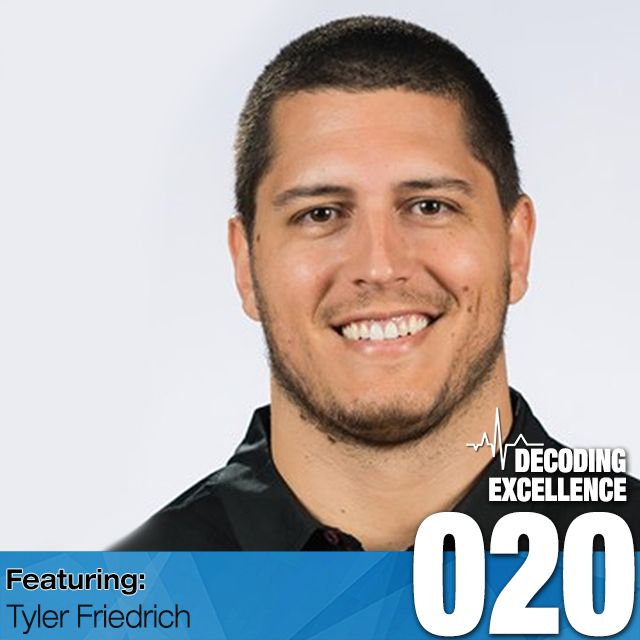
In this episode of the Decoding Excellence Show, I am joined with Stanford Sports Performance Coach, Tyler Friedrich.
Tyler Friedrich is a sports performance coach at Stanford. He is responsible for designing and implementing the sports performance programs for women's volleyball, beach volleyball, women’s rowing and men’s water polo. Before coming to Stanford, Friedrich was a Sports Performance Coach at Arizona State University where he worked with football, women's volleyball, beach volleyball, men’s and women’s swimming and diving, triathlon, hockey and wrestling..
Tyler also worked as an Assistant Strength and Conditioning coach at the University of Dayton, where he assisted with football, women's volleyball, track and field, women’s basketball, men’s and women’s soccer and women’s cross country. Friedrich earned both his undergraduate degree in exercise physiology (2010) and graduate degree in exercise science (2012) from the University of Dayton. Tyler holds certifications with USA weightlifting and the National Strength and Conditioning Association
Today on the show, Tyler & I discuss:
- His background into strength and conditioning
- Strong influences and mentors in his journey
- His own successes & failures within coaching
- Performance technologies and readiness
- Best advice he received during his career
- Recommendations for young coaches
You can catch up with Coach Friedrich on Twitter at @tfrieds75.
This episode of the Decoding Excellence show is brought to you by Vald Performance, the makers of the NordBord, DashBord, and the GroinBar.
They can be found at ValdPerformance.com
Stay updated with the podcast by following me on Twitter via @AdamRingler or visiting AdamRingler.com. In addition, you can also subscribe to my Facebook page at Facebook.com/AdamRingler to receive real-time access to high-quality articles, my daily thoughts, live broadcasts, and much more.
In addition to those social mediums, you can head over to AdamRingler.com/Newsletter and sign-up for my weekly newsletter. This is a newsletter for the curious. It's chalked full of interesting articles I've read through the week, things I'm exploring and finding fascinating through my week, and a collections of thought experiences and resources I've cultivated.
It's essentially a Birchbox newsletter for performance-related articles, research, and daily musings.
Thanks again for listening to the Decoding Excellence Show! I appreciate all the support growing this Sport Science, Strength & Conditioning, and High-Performance Coaching resource. If you have taken anything away from the show, please login to iTunes and navigate to the Decoding Excellence page and leave us a review.
Key Takeaways
- A winding path builds a better coach: Tyler's stops at Dayton, Arizona State, and Stanford exposed him to football, volleyball, rowing, water polo, swimming, and more, and each sport sharpened a different tool.
- Mentors compound: the strong influences along his journey shaped how he coaches, programs, and leads, which is why seeking out good mentors early matters so much.
- Successes and failures both belong on the record: being honest about what did not work is what turns experience into wisdom other coaches can use.
- Performance technology and readiness only matter if they change a decision: the best advice in the episode keeps coming back to asking better questions, not collecting more data.
About the Guest
Tyler Friedrich is a sports performance coach at Stanford, where he designs and implements programs for women's volleyball, beach volleyball, women's rowing, and men's water polo. Before Stanford he coached at Arizona State and the University of Dayton, and he holds degrees in exercise physiology and exercise science plus certifications with USA Weightlifting and the NSCA.
Listen and Subscribe
Find this episode of the Decoding Excellence Show on Apple Podcasts and Spotify, or use the player above.
Go Further in This Episode
Enjoyed this conversation? Here is how to get more from it:
- Read the transcript below to revisit key ideas at your own pace.
- Share this episode with a coach or colleague who would benefit.
- Subscribe to the Decoding Excellence Show on Apple Podcasts, Spotify, or your favorite app.
- Join the newsletter at adamringler.com/newsletter for weekly insights on human performance.
Episode Transcript
This transcript was automatically generated. While we strive for accuracy, some words or phrases may be misheard.
[00:00:00] You take the blue pill, the story ends, you wake up in your bed and believe whatever you want, you take the red pill, you stay in Wonderland and I show you how deep the rabbit opens, sport science, strength and conditioning, high performance coaching, welcome to the Dakotink Excellence Show. Today's episode of the Dakotink Excellence Show is brought to you by VOD Performance. VOD Performance is the makers of the Nordboard, the dashboard and the growing bar. Whether it's return-to-play, performance testing or rehabilitation, VOD Performance
[00:00:59] Has the tools you need. So you might be asking yourself, who's actually using this performance technology? I don't know, say 14 different NFL teams, over 19 NCAA teams, 15 different English Premier teams, 5 NBA, 6 MLB teams, and many, they have the tools you need to get the very best out of your athletes. Check them out at VOD Performance.com. Today on the show, we have Coach Tyler Friedrich. Tyler Friedrich is joining us from Stanford University and he is a sports performance coach and he is responsible for women's volleyball,
[00:01:38] Beach volleyball, women's rowing and men's water polo. Before coming to Stanford, Coach Friedrich was a sports performance coach at Arizona State University, where he has worked with football, women's volleyball, beach volleyball, men's and women's swimming and diving, triathlon, hockey and wrestling, a number of sports, so a wide breath of background to different athletic populations. Tyler's also worked as a assistant strength and conditioning coach at the University of Dayton, where he assisted with football, volleyball, trek and field, women's basketball, men's
[00:02:10] And women's soccer. Today on the show, we talk about a lot of different things, including some of the best advice that Coach Friedrich has received in his coaching journey, some of the successes, some of the failures, and some of the things that he does and how he utilizes technology to keep his athletes healthy and playing at the very best when it counts the most. This is a wide-ranging conversation. One that includes a lot of technical and tactical discussion about sport preparation, but it also includes many of the things that
[00:02:43] I like to discuss on each one of these, decoding excellence episodes, which is the intangibles, the tools, the tactics, the mindset that goes into elite performance. And Coach Friedrich shares his thoughts and some of the things that he has navigated throughout his own coaching journey. This was a fun episode to record with Coach Friedrich. I took a lot away from this episode and I know that you will too. This one will be a great one for you if you are interested in any of the sports performance technologies and Coach Friedrich's
[00:03:19] Journey. So without further ado, here is my conversation with Coach Tyler Friedrich. Hey, welcome to the show. How are you doing? I'm doing great. Thanks for having me. Excited to get this thing going here. Yeah, man. I am likewise. I know we've caught up when you guys came out and visited us in Boulder, Colorado, and we have shared a conversation together and just briefly touch base. But I'm glad to finally get you on the decoding excellence show and provide the audience just an opportunity, a lens to get into seeing
[00:03:59] And understanding who you are as a coach and for you to share your journey in your coaching profession about where you are and how you're doing. So before we get into some of the questions that we have in this interview, I'd love just to quickly have or provide an opportunity for you to share a little bit about what you're currently doing at Stanford and your current role and how that's evolved over the last couple of years, man. Yeah, so right now I'm a sports performance coach at Stanford University. My teams are women's volleyball, beach volleyball,
[00:04:37] Women's rowing and men's water polo. So those are my sports right now. Pretty highly involved. I would say my main priority is probably the volleyball team. It's one of our higher-party sports, probably one of our over the decades, probably our best sport, I would say, in terms of producing national championships. So pretty highly involved with them. We're doing, from a technology standpoint, we're doing a ton of stuff from, we're using the catapult GPS. We're doing a bunch of wellness tracking, fatigue management, all that kind of stuff.
[00:05:11] It's pretty highly involved, but currently those are my four sports right now at Stanford Excellent, man. And we're going to get into talking a little bit about volleyball and just your role. And the usual strength and conditioning touch points, wellness, questionnaires, monitoring, the workload, monitoring that you're doing and utilizing with catapult. But I'm going to maybe kind of rewind the tape a little bit because I think that's right now in that we're discussing sort of the highlight reel, right? And I know a lot of a lot of other strength conditioning
[00:05:49] Coaches would look to you and look at what you guys are doing at Stanford and say, oh, man, I, I wish I could do this. But without sort of full understanding of the journey that you've taken and sort of how you've had to earn your right into using some of these technology and through the various stops of other universities yet you've gone through. So let me rewind this and sort of maybe juxtapose the question to this, like, how did you first get involved in strengthening conditioning coaching and maybe not only how, but why? That's a great question.
[00:06:24] I've been involved in lifting weights and was about 12 years old. I was playing Pop Warner football and a kid that I played with his dad was a physical therapist. And so me and two of the buddies we went in there and started lifting, you know, kind of in the rehab area, they had, you know, we bench press and squad, all that kind of stuff and started to learn like some of the Olympic lifts. So from that standpoint, I've always been intrigued and always been involved in weightlifting and training for sport. I played sport. I've been in this sport and playing sports my entire life.
[00:06:54] And I played primarily football through high school and in college. And that's kind of how I got going with this. So I knew I wanted to be involved in athletics and one way or another. I wouldn't sure if that was physical therapy or athletic training. I just knew I wanted to be involved with athletes. So I did an undergrad at the University of Dayton and, you know, I enrolled as exercise physiology major, just kind of leaving it open. You know, there was, we kind of had two paths. One was more like a personal training type path. And one was more like the higher science side. And,
[00:07:24] And, you know, my sophomore year over the summer, I did an internship in corporate wellness. And absolutely hated it. It just was not for me. You know, I think it's a great industry. I think it's those are great jobs. But for me, it wasn't one of one. So when I went back to school in the fall, I sat down on my strength coach coach's office, Mark Toby. And I said, hey, man, I want to be you. I want to be a strength coach. I want to work in college athletics. I want to do what you do. And he said, all right, come work for me. We'll see at 6 a.m. Tomorrow. And, you know,
[00:07:54] The rest is history. So to speak. So was able to be really, really, really fortunate. And, and work with him. I last year as a wonder grad internships along the way. I spent a summer at an Olympic training center in Lake Placid, which was awesome. Spent one summer down at LSU. Coach Moffitt worked on the football program down there. Was hired back at Dayton as a GA. Was then hired full time. So again, extremely, extremely fortunate to, you know, two coach Toby and, you know, forgiven his opportunities early on. You know, it's kind of how it got started,
[00:08:29] You know, as the path has gone on, spent a couple years at Dayton, a couple of your three or four years at Arizona State. And here I am just running out my first year at Stanford, actually, just a couple of days ago. So that's been, that's been the path up to this point. Congratulations on the the work anniversary. And what a kind of an interesting, interesting journey, right? Like, and it's sort of mirrors some of my own in some respects, but to, to sit across from a potential mentor and sort of at this crossroads of life, like, what do it, what path do I want to go down? Is it
[00:09:02] Going to be exercise science and going to coaching or the corporate wellness or the personal training route? And then sort of to sit across from somebody and be like, you know what? I want your job. I want to do what you're doing. And then to have them take a to risk, essentially, on you and say, all right, well, sure, yeah, show up, show up 6 a.m. In the morning. That's, that reminds me so much of sort of my own sort of pathway at Michigan State, but I would have to imagine that at, at Dayton and, and no disrespect to Dayton, just, I think it's more of a representation
[00:09:38] Of the industry of how we're evolving and what we're using. I'm sure at that time, it wasn't, you know, heavily involved in using catapult or workload monitoring or wellness questionnaires, or the technology that you now currently have at Stanford. No, we had none of that stuff. I mean, it was just he and I, really for years, like we had, we had various interns kind of come through or actually I signed the department, but I mean, it's just the two of us. And I think there were 17 teams on campus. And a way we went and we worked every sport besides men's basketball
[00:10:09] And baseball. And we did everything. So every summer, I, I live in Columbus, I would drive down every summer and I would sand all of our platforms and then it takes resealum. So, you know, make sure year-to-year we were okay if a box broke where the ones are fixed in it or build new ones. All of our plate holder same thing was just, was just too much force. You know, so we did every little thing if, if the racks were broken or if anything broke, we were the ones doing it. We did all the cleaning, everything. So really great experience to start there just because it was tough
[00:10:47] And you learn a lot about how to make a lot out of very little. And we, you know, in, in, in hindsight or looking back on it like the intern comparison to the A10, like we were one of the top tier facilities probably one of the top, you know, higher level on athletic programs just in terms of like success. So we were actually like, there were schools that were, you know, they didn't have full-time shrink coaches. And so we were in a pretty good position but, you know, looking back on it now, after being through and being in, you know, some patch-up programs for four or five years, you know,
[00:11:19] It was a grind. But it was, you learned so much. And, you know, Mark, he was hard on me like he, and I really appreciate that I think just having played for him and then be in my shrink coach, I think, that he just, I know he felt very comfortable in being tough on me and holding me to a higher standard which, you know, long-term has benefited me so much. So I am forever grateful to him and, and, and kind of what we built together. I think now they built a brand-new way at room. So now they're living a good life over there. Like things are, things are looking
[00:11:50] Up for them since the last couple of years. And I think that's common, right? Like, and, and even in my own journey and in some of our interns' journeys, I try to share that same story and that, you know, so often it's, it's a young professional starting to get into the field that wants to, to immediately utilize the latest bells and whistles and it's, there's some, there's some, some wisdom in actually having to get your hands dirty and, and to go through and build it yourself and not have the tools, you become a better craftsman when you don't have to rely on technology,
[00:12:23] Get to build your own sort of toolset by yourself before having to have it right out of the box ready to go. Exactly. It's helped me so much with just, just simple problem solving. You know, I think if you're at a university, you know, it has everything, you know, in your intern, that's what you learn. You kind of forget what it's like, or you don't, you don't learn what it's like to have to figure everything out. Like, we didn't have nutritionists. We did the nutrition. You know, so you've learned things that you would never learn on the way, you know, depending on your
[00:12:50] Resources. And I thought, I'm not comparing one school to the other or saying that having resources makes you less of a strength coach. I'm just saying, you know, some of the things that you're exposed to in that situation, can you really benefit you as your career moves on? Yeah, absolutely. It's the, it's similar to like Ryan Holliday's book, The Obstacles the Way, when you don't have a nutritionist, you have the opportunity to learn that. When you don't have some of the workload monitoring technologies or sport performance technologies, you, you have to learn the craftsmanship
[00:13:19] Of how to do it. And I think when you get your hands in the engine and you're building it yourself, it makes you appreciate the tools, technology, and the resources you have when you actually do have them. But kind of, I, to continue to keep the thing moving a little bit, you've, you've already talked a little bit about coach Toby and some of the mentors that you've had in your own journey. But I want to continue to rewind this thing and maybe go a little bit further into your history. But along sort of maybe like your, your home life, did you ever have any sort of like your parents
[00:13:51] Or family friends or anybody that was really influential and to maybe set you down this sort of educator, this, this coaching role? Was there anybody in that sort of early life that, that helped inspire you or motivate you or acted as an influence for you? My parents have always been extremely supportive of everything I've done throughout my entire life. So I have not seen a single complaint, you know, in terms of my home life, I would say, my mom's a teacher. So that's probably where, you know, this internal drive to teach and educate
[00:14:28] Athletes or just individuals comes from. So I think that's just kind of in my bloodline. But you know, like in terms of the home life, I just, I think I just was, I was really fortunate growing up to have great coaches and along the way, like where the bit pop on her football or high school. Like I had a strength coach in high school. He was also our linebackers coach. He was a walk on Ohio State and so he developed a strength and conditioning and he was tough on us. And at the time, I hated him, to be honest with you, but you know, it was little things like that
[00:14:56] Where you just, you kind of look back on and laugh now. It's like if I just had known what I know now, like thing, I think I would appreciate those moments, you know, so much more. My entire family to kind of rewind again, like my entire family, we've always been highly involved in sports. So I think it's always been in that type of environment, you know, just it just fosters leadership, it fosters competitiveness and that's something that as you grow up and you enter the real world, that those are good qualities to have loyalty leadership
[00:15:28] Commitment. Those are all things that plan a sport, you know, your entire life essentially really helps, helps you develop as a person. And ultimately now as a strength conditioning professional. Yeah, no doubt. And there's, you know, there's a couple of things in that, that mirrors mine as well, you know, as we go through this, I think I'm finding more commonalities. And the more interviews I do with other strength coaches, I think there's more similarities than differences between us all, but like, you know, my mother as well was a fifth grade
[00:15:57] Educator for over 30 years. And it's like I think even for me, it's like that rich sort of education background, sort of mirrored and sort of seeped into my own life of, you know, I very early on in sport as well as I was, you know, wrestler, I never thought about really wanting to become an educator. But the more I got involved in sport and the more that I saw the vehicle of education and how it impacts people's lives, it was also very similar to your own journey in that regard. But, you know, I think somebody from the outside looking in and and and get to see sort of you
[00:16:37] On the stage that you're at with with a proverbial powerhouse volleyball team like you have and resources that you have as Stanford, they could very easily sort of assume that that's the highlight real, right? Like there's never, you must have it great. There's never anything bad. You've never had any failure. And so often the more that I talk with other coaches, it's almost like we've gotten to where we've gotten through failure, through adversity, through those hardships. And I was just curious from one coach to another, has there ever been a failure
[00:17:09] Or do you have any, you know, stories or anything like your favorite failures or apparent failures that that in the moment you're like, man, you know, like here I am, this is the worst thing that's could ever possibly happen happened to me. But later in hindsight, when it's 50, 50, you know, like or 2020 hindsight that later sets you up for success. Are there any things like that in your own journey that that maybe seemed like a failure, but set you up for success later? Yeah, I think that I think as you progress and as you get more and more experience, like these things just just pop
[00:17:46] Up. I don't think I've won like favorite failure or one that way stands in my mind, but I know that as years have gone on, when I was when I first got into this, I was honest, I was kind of a hothead inside a hard time adapting or adjusting to a coach changing a schedule. And so you sometimes use say things or you know, you make a decision that is a little, a little rash and it's not exactly like the best in terms of like most professional relationship and and understand that when you know when you work with a sport coach or athletic trainer, whoever it is, that maybe some give and take.
[00:18:17] So those are the failures along the way that aren't necessarily like earth shattering. They aren't necessarily like going to make a break in your career or I guess I couldn't make a break in career. It depends on what the mistake is, but those are things that as you go along, like you just learned from those and I look back and it's like, man, like if I had just been a little bit more level headed and just taking that and stride a little better, like I think that experience would have been you know, would have been a whole lot more smooth. And you know, my first year in Arizona State,
[00:18:44] You know, it's one of my thought trainers and I, we just did not get along. It just was, you know, and honestly, like for no real reason, I think we were both just a little stubborn, a little just kind of, you know, sticking to our guns and instead of just sitting down having like a civil conversation to give and take a little bit, you know, and meet in the middle, you know, instead, you know, we just were too stubborn about it. And so, you know, it was kind of a tumultuous relationship for my first six months there and that just wasn't necessary. And then, you know, we rectified
[00:19:12] The situation and the back half of, you know, she was a few as a GA, so the back half of her GA ship, I thought we were great. And it's just like, why do we wait six months to be like this and our relationship now is great. The service we're giving our athletes is so much better. Like, what do we, why do we take this long to get to this point? So I think it's little things like that that, you know, you just, that pop up, little feathers along the way, you know, whether it be things you say or things you do or don't do. I think that, you know, there's quite a few of those, you know, throughout my
[00:19:42] Career, you know, similar stories. I think that, you know, the, when you're sitting and you're talking with one coach or another that it's, you know, these little bushfires, if you will, right, that you necessarily have to be the worst case scenarios or the biggest sort of events. But it's so much better when you can just sort of have a civil conversation and put these fires out initially and move on and to have a great growing relationship after that fact. But, you know, I, I want to return back to this sort of mentorship aspect of it because that's a, you know, the listening audience
[00:20:18] Of the Decoding Excellence show loves the details of these things. And I think they're mostly type A personalities, maybe like myself. But, you know, was there anything that, you know, your coaches that you've worked for or worked under? Was there any particular way that you would say they helped shape your path to who you are as a coach today? Lessons or experiences or stories that really resonate with you that really made you the coach that you are today? I would say that the most common thread or the biggest commonality between every place that I've been
[00:20:56] And every mentor boss I have had has been they've thrown me to the fire. And which at the time it sucks, you know, I'm type A as well. So I like a plan. I like structure. I've known exactly what's going to happen. And as we all know in strength and conditioning, we plan our asses off. But it never turns out that way or very rarely does it follow like the script that we want. And so whether B, you know, down at LSU, Rathalympic Training Center or at Daytonate, whatever the case may be, it's been you know, the kind of kind of thrown into the fire and you got to learn on the fly. And again,
[00:21:33] Like I think at the time, it's brutal and it's frustrating and it could kind of put some doubt in your mind. But as the experience goes on and as as you know, the more more experience you get, you learn and you adapt and you grow. But all of a sudden like you're you're killing it, you're rolling, you're feeling really confident, you have a really good grasp on everything. And that to me has been, you know, everywhere I've been, it's kind of been that way. And you know, even down at LSU, Coach Moffat, you know, we, this was back before the five coach rule. This was, you know, this is a
[00:22:06] While back. You know, the interns, basically, they they would sign interns, five or six or seven, you know, they would typically walk on. But like, hey, these are your guys. So you're down on those on those racks on the end. And like, it's your job to get these guys right. So yes, while they're probably non contributors and they're grand scheme of things like that's, you know, for your first day on the job down at, you know, working with Coach Moffat. And if anyone knows Coach Moffat, he's a pretty intense dude. It's a pretty intense program. You know, here we go. Like we're rolling.
[00:22:35] So, you know, it's a situation like that. Same thing I date and like it's just like, hey, I mean, I'm a junior undergrad and it's like, hey, you're going to be, you're going to write the program and run the run the strength program for the women's rowing team. Here we go. Okay, like I really didn't know what to do. So, you know, you just learn along the way. And so that's one thing I'm ultra appreciative of all of all of my mentors along the way for having to put me through situations like that because it just makes you so much better. And that's one thing
[00:23:04] If I could like, you know, share some wisdom with the younger strength coach or, you know, interns or whatever the case may be, it's don't be afraid. You know, don't be nervous in situations. Like they're going to happen. But that's okay. Like you just got to stay calm, stay composed, fight through it. And when you get out on the back end of it, when you get spit out, like you're going to be a way better coach and be way more prepared for anything that's upcoming. And any job interview you can go into, like you can throw that out there and say, hey,
[00:23:31] Like here's something that I struggle with. Here's how I became it. And now I'm on the back side of this thing. I'm dominating. So that's something that I'm truly grateful, you know, across the board. And that sort of reminds me a lot of, you know, the same sort of environment that Ken Manny had at Michigan State and Red Wacam on the Olympic side is just that the intensity but also the aspect of really taking ownership of what your role was and what your job was. And, you know, like I remember the first couple of months on the job as a lowly intern. It's like, you know, you are wiping down
[00:24:07] Machines and you're putting weights away. And it's like you better have extreme sort of ownership of doing that because you are essentially putting your namesake on whatever various tasks. Absolutely. And it was like jumping in at whether it's the most mundane or mediocre task of what it could possibly be. It was like, this is a representation of you and your character and who you are and the level of attention to detail that you have. And that, you know, like you essentially earned your stripes as you continue to do it. So like for me, it was like, I'm going to make sure that
[00:24:42] This floor is the cleanest floor possible in these machines. The cleanest. And then over time, it's like as you go through that and you become a graduate assistant, like same way the representation and the attention to detail in the programming and the way that you coach. It's just it materializes to every aspect of what you're doing and coaching. So I you talked about that piece of advice. And I thank you so much for sharing it. I want to continue to go down this sort of advice giving road for a moment because I think that you are a guy that has a lot of real world advice.
[00:25:18] And you know, various stops along your way from Dayton to Arizona State. You're working your way through the pack 12 here. And now at Stanford, you know, we have and you're you're probably very similar in it in that, you know, we have these great high quality interns that are are facilitating and helping with programs. And they're learning so much right now. And I know that we have three interns here at this facility or our basketball only facility really basketball volleyball facility here at Coors event center. And tremendous interns that are smart and capable. And what I fear
[00:25:53] Sometimes and this is sort of that one coach to another and the mentorship that we provide is that sometimes I fear that, you know, their noses are deep in the NSEA textbook. They're going through their CSCCA practicum and getting that experience and learning anatomy and physiology and exercise science that maybe they're not having necessarily the real world experience, the real world advice. They need to be successful when they actually do get that first full-time position or that graduate assistant position. So either you've already talked about the flexibility and the adaptability
[00:26:28] A little bit. But is there any sort of advice that you would give to a young passionate, you know, want to be strengthening intern that's just ready to take that leap into that first full GA role or into that first full-time entry position? Is there any sort of advice that you would give them to make that jump from one level to the next? Yeah. So when I ran the interim program at ASU, we would tell our interns kind of the same thing is don't be afraid to hop in there and be involved in coach. But that being said, tread lightly, don't overstep your bounds. So I know
[00:27:09] It's easy to say and it's kind of it's it's it's a great area and it's kind of ambiguous in terms of what what is overstepping what is not. But we just kind of said, like, you know, listen, learn and then start like coaching where you can. So, you know, great opportunities or if there's any someone, you know, someone on an injured card, that's a great person to go lash yourself onto. And you look at like right now Arizona State, their current GA Tyler Schumate, he was an intern for us and he just lasts on with injury guys. So they're three or four injury guys that summer we had him and he
[00:27:42] Just coached the heck out of him and he hurt himself at position because he managed those guys with everything he had. And that's a great way to start kind of get your feet wet coaching because it's not really if you are wrong about something it's kind of low risk. But you also we as as full-time staff can now trust you. We start putting trust in you because you can handle this small group of guys. So then you can work over with our team. If you're available, I know, hey, you're going to watch these two racks. So you kind of slowly build that trust as you go. The second piece of advice I would
[00:28:15] Say is is stay professional. You know, as an intern typically you are not much older or you are like the same age as a lot of those junior seniors fit their athletes. So it can be really easy to kind of cross that line because you guys are all kind of the same age. So, you know, I don't know tread lilies right word but just be professional and understand like, okay, I am in this position. Like they don't I don't need to act or I don't need to be 20 to 1, 22 years old around these kids. Like when I'm on my own time, sure, but you know when I'm on the floor working with these athletes,
[00:28:48] I need to I need to be professional. I need to separate myself from that kind of like younger mindset and treat myself as a full-time coach even though I am an intern. And again, I think that just really builds the good report to the athletes. It builds good trust with the full-time staff and then, you know, we start applying for GA ships. You know, I'm I'm I'm sitting here back and you 100% like this is this guy or this girl is a real deal like they need. They are a must hire. Yeah, you know, that makes me think of I know when my for me during my first full-time role,
[00:29:23] Having just graduated from the Masters program Michigan State and being really only about two years older than our fifth-year seniors that, you know, I came into that role and I I think I was 29 years old for seven years, you know, like I just I didn't want them to be like, I'm only two years older than you and yeah, but I'm an authority figure and I want you to learn and I want you to kind of take take the advice that we're saying. So I think that's an incredible advice of remaining professional. I think it's something I kind of learned the hard way, you know,
[00:29:56] I was I had two teams at Dayton when I was in my fourth year, you know, so I'm literally coaching kids that were going to same grade as me. So, you know, like they're senior on the on the on the run team, they're senior on the on the men's tennis team, like I I'm coaching you and I but I'm also in your class and we're graduating together. So that's, you know, it was hard to kind of trade that separation. So that's something as, you know, it was a skill to be honest with you, like it's really hard in 2021 years old. It's really hard to to have that skill and have that
[00:30:30] Mindset. Yeah, but as each year went on, I was able to further further understand, like, okay, this is more and more important. I really need to create that separation. So it's skill that you acquire. But I think if you have the right mindset going in to your internship, like you said, like you're 29 years old for seven years in a row, like you got to do, if that's what you got to do, it's what you got to do and, you know, kind of go for an entangent here, like we have a lot of part time staff here at Stanford. I think we have five or six of them and all of them have done an
[00:30:57] Unbelievable job at creating that separation. Like one of our coaches, Molly Fyfer, who works with me, like she's done, she's 21 years old. She was interned for us in her last winter in spring as a senior in college. And she's here working with some of our fifth year Volvo girls who are literally older than she is. And you would never know. I mean, she's done an incredible job and hopefully she just like it hired from this because I really need her to operate. So, you know, so just to kind of go for an entangent, like those, they all came in, that intern class came in and, you know,
[00:31:32] With their mind right. And, you know, it's paying off for them because they went from being interns and now they'll be part time. And so hopefully in the next year or so, like they are working here or we get them full-time jobs, you know, done the line and they're going to kill it. So, you know, having that mindset, having that, having that ability to separate yourself is just set you up for an enormous amount of success. Through this show and through other podcasts and other shows that there's a lot of similar threats between coaches, right. And then there's a lot of similarities
[00:32:00] And commonalities between coaches that operate at a very high level. Program design, the way they think, the things, the resources they look to. But also, there's some differences. And we all have different opinions. And that was essentially makes it fun and it makes us human. And I'd love to sort of explore some of the opinions that you might have. And this is a common question. I love to ask the guests that come on this show. But is there any sort of bad recommendations that you hear in sort of strengthening or in education or in exercise science or whatever that seems to get
[00:32:40] Echoed through the industry or things that you say, you know what? Maybe I don't actually really agree with that. But you hear it kind of commonly thrown around in strength in the industry. I don't know if I hear like a commonly bad recommendation per se. I think some of the mistakes I've seen is whether it be any coach really young or they're indifferent, not being to make change or to learn more or not willing to be adaptable. I think the industry, as we all know, is constantly evolving. And especially now with the emergence of technology just kind of
[00:33:23] Ballooning and taking over, I think there's a lot of pushback from you all the generation of strength coach, which I don't know if that's right or wrong. I'm just saying that, you know, is it the worst thing in the world? So I think when I hear anyone act 100% resistance to something new or 100% resistance, you know, to learning or just even having some insight, I think that's that's the wrong way to go about it. And so, you know, there's, you don't have to agree with everything, but I think if there's, if you're doing, if we're using HRV, for example, to track,
[00:33:57] You know, fatigue, you know, whether you think that's worth it or not, you should at least look into it, you should at least see what kind of results you get. And if it turns out that you don't really like the way HRV, you know, the data it gives you, then you move on, you know, and that's just HRV, just a random example. So that's just kind of, so again, I don't know if it's like one singular or two like, hey, these are the worst things you could possibly do or the worst things anyone's told you. I just think being a resistance to change or just unwilling to even like look in anything,
[00:34:29] I think is a mistake. What I really like about that too is that and something that you and I share is that adaptability. And there's a phenomenal quote that I often share with our interns. And it's a Bruce Lee quote, and I have no disrespect to Kung Fu or anything like that, but you know, adapt what is useful, reject what is useless, and add what is specifically your own. So I share that all the time with our internship staff here is that look, you're going to see things that you might not necessarily agree with. And that is okay. That's fine, right? Take something
[00:35:05] From it, adapt what you really, really like, what you think is useful. And maybe disregard what is useless for your situation, for your environment, for your context, but at least show the willingness to understand something and try to explore something. 100% 100% like nothing should be out of the question, but we all have our, you know, what we like when there's things that, you know, we've seen along the way, and you know, our own philosophies. And, you know, I think everything should get a chance to see kind of where it fits. And if it doesn't work, if it's not going to work, then you just move on from it.
[00:35:39] I don't think it's, that doesn't make that idea or that concept wrong. It doesn't make it stupid. It just, it just doesn't mean that it isn't fit with your program, but it might work great with somebody else. So, yeah, I think it's, it's, it's not black or white. I think everyone's got to be able to, you know, at least show the ability to be adaptable if they wanted to bridge that question. I'd love to ask maybe a two-part question here. And that is, you know, within the last, say, three years, is there anything like, whether it's a new belief, a behavior, a tool, a resource
[00:36:10] That you're using that has improved sort of the services that you provide for your student athletes. And that's, that's sort of the first part of it. But then same question, right? Anything, beliefs, philosophies, behaviors, tools, resources that improved your life outside of coaching, right? So the coach that you are, the person that you are when you're not on the floor, when you're not coaching, is there anything that in the last three to five years that's improved your life? And then whether it's performance technologies or things are doing differently for your student
[00:36:41] Athletes to approve their sport performance, their durability, or their resolve. Yeah. So I think within, you know, within the weight room and within, you know, the by-programming, I think, as I've researched and implemented more and more fatigue management or workload management, I'm going to use systems for lack of a better word. I think that's really helped me with my programming, just understand how, what it is I'm doing, how, what kind of effect that has on the athletes internally or physiologically and also looking at like how our practice loads will affect
[00:37:20] The athletes. I think it's, it's, it's a way for me to kind of like bridge the gap between practice and training and make sure that one, we're training appropriately to manage the workloads of our practice and manage the workloads of our competitions and understand we can make sure our athletes can handle those. But also think it just gives me good insight to how each kid reacts to a certain type of training. Everyone is so different. And so if you're using a simple RPE scale and just doing a session RPE to get an internal load, you know, you know, I might have one athlete who is
[00:37:51] Just mentally just a stud and she might give the rate every workout, every conditioning session or three or four because she just can mentally overcome, you know, tough situations where someone else may not. So it's in every workout is going to be a seven or eight or whatever the case may be. So it's good to know how each athlete differs. So you can establish a, your relationship with each athlete is going to be a little different. So I think that's really, really important. And that's helped me more from the programming standpoint, but more from a like a person, like a relationship
[00:38:22] Standpoint, being able to personally connect with the athlete, have those conversations about, you know, again, if we want to talk just about being physical, if we want to talk about how to be better leaders, if we want to talk about how to mentally overcome like hurdles in the conditioning, you know, so that's really helped me from a sports performance standpoint. Just kind of that emergence of sport technology or just kind of using those, those recovery, you know, management models or however you want to call them. Yeah, absolutely. Yeah, sorry. Oh, no, yeah, go ahead.
[00:38:53] Please. Yeah, outside the weight room, you know, I think it's the years I've gone on. And, and you know, as each, as each year goes on, I've been able to just further and further be more comfortable in my role as possibilities. And so I think that has helped me outside to relax a little bit. I think I was a little high strung as the early years were on. I think it's just a lot of stress, like, and, and, you know, like it's long days and, you know, you string them all together. And especially like when I was working football at Arizona State, like, it's high pressure, man,
[00:39:28] Like every game you lose, you just feel that pressure. Like, man, like, are we going to get fired? Are we going to be good? So I think as years gone on, I've been able to better and better handle all of that. And I give all that credit to my wife. You know, she has been absolutely amazing. You know, she's been, you know, a huge catalyst for me and helping me or allowing me to, like, do this job and work the hours. I mean, she was an athlete herself. She played volleyball at Dayton. And so she understands the demands of what it takes to prepare for
[00:39:59] A season and prepare, you know, to be successful. And so she, she has been unbelievably great in terms of understanding, you know, how this job is. And she's fully immersed herself in the culture of all the teams I've worked with, at all the schools I've worked with. You know, and she's really, she loves the family atmosphere. So she's, you know, she makes it a point to be involved. And I think that's absolutely great. And that's what's kind of allowed me to do what I, to do the job that I'm most passionate about. I'm so glad that you touched upon it because I know
[00:40:30] That, you know, in other shows, I think not a lot of people have talked much about that. But the demands and the sacrifices that a spouse goes through when they, when they, in some respects, didn't sign up for the aspect of being married to a coach through the challenges, the demands, the stressors, the scheduling of what our profession sort of requires and not to put us at any you know, on a pedestal by any means, because there's so many different other professions that make even greater sacrifices both time and livelihood and security. But, you know, I really wanted
[00:41:13] To take a moment and say like, for my own wife, yeah, absolutely. It's a tremendous sacrifice that they make. But for any coach's wife or husband or whoever, it's a huge sacrifice. But I'd love to, because I know I was going to ask you this down the road a little bit, when you do feel sort of overwhelmed or unfocused or stressed or you, you know, you, whatever it might be. Like, is there any particular habits or routines or things that you do to sort of outside of the gym to restorative essentially to regain that focus, to regain that passion, to regain that sort of
[00:41:51] Attention, to manage your own stressor as a release to maybe provide you an opportunity to go back on the floor and to redouble down your efforts in your coaching. Is there anything that you particularly do? I wouldn't say there's like a recurring habit. I would say that in stressful, so like, you know, on that off day and the most stressful weeks of the most stressful months really making sure that, you know, my wife and I, Rachel, we step away, you know, on that off day and we do something for us. And I think that's been, it's that moment or it's that, you know, stepping
[00:42:31] Away that really reignites because you just, you have that day where it's just like, I'm thinking of nothing about work as hard as it may be, you know, especially like in an in season when you're really, you know, Monday, off day, you're still at work, obviously. You know, as hard as it may be, we work hard to take those opportunities to step away. And especially like in an off season, you know, if it truly is an off season and you have a Friday Saturday off, which are I know are rare, but we try again, we take advantage and she has done a great job in making sure like,
[00:43:03] Hey, like, let's let's do this. Let's go somewhere, let's, you know, take a little or do a staycation or something along those lines. Let's take time for us to go and just be together and that always reignites the flame to come back as you just get smart and are even if it's for 24 hours. And you come back to work, just feel a little more rejuvenated about about life outside of the weight room. And I think that helps when you come back in, you know, because, you know, the passion is there. And so that, that's typically like kind of how we handle, we handle those situations and
[00:43:36] That stress. Just to explore that road a little bit, not just stress management, but I wanted to kind of tie back into sort of the technology. And this show is by all means sort of an all encompassing choose your own adventure, sort of road show. So it's, it does happen to jump around all over, which is sort of the essence of the show. But, you know, to go back to some of the workload management and the tools, the technologies that you've used. And I know I asked you that about, you know, in the last couple of years, what have you sort of adapted to help improve the services
[00:44:14] That you provide for your student athletes? And I think that's a great touch point. And as a sort of a technologist myself and a kid that grew up in the computer and internet era performance technology is something that I'm fascinated by. And I'd love to sort of explore maybe some of the the tools that you guys are using, you've already mentioned, you know, like session RPE and workload management and the catapult units. My sort of selfish question is, is it, you know, like S5 units, are you guys using the smaller sort of indoor devices? And then to expand on that,
[00:44:54] What other sort of technologies does a Stanford that is heavily resourced and financially capable? What other technologies are you guys using to bring out the very best in your athletes? So with the catapult, we're using S5s. Obviously, we can't get any of the GPS metrics because we're inside. So we primarily, from a GPS standpoint, just look at, primarily right now it's player load, we're taking it small. I'm looking on my own at some different metrics as well, but we're just looking at player load and using that to to create our own acute chronic workload ratios for our
[00:45:32] External load. And then we're using a session RPE, so we just take RPE times duration for the internal load. And so those are our main two metrics that we're looking at right now from a workload management standpoint. In terms of like a wellness tracking, we do three surveys a day, we do a morning wellness, which they'll do HRV. We use HRV for training is the app. And so that's sort of we're fortunate enough to have teamwork. So like I just send out the link to our survey on through like a teamwork text message. They do a pre-practice survey. So let me go back. Our morning wellness
[00:46:08] Survey, you know, we do HRV, we ask like how's your social stress on a scale of one to ten? How's your academic stress? How's like your student athletes stretch stress? We look at we ask how many hours did you sleep? How was the quality of that sleep? And then what kind of day do you have upcoming? It's a difficult day, you know, on a scale of one to ten, ten being the most difficult. Our pre-practice surveys kind of revisit those things. We ask like, did you properly fuel for today's practice? How's your day been going? So we look at the difference between, so if they said, hey,
[00:46:40] Today's a tenth for me to the most difficult day ever. And then they come into practice and they're at a friend that we ask how the day is going. And it's a two. We say, hey, you're having a pretty good day that what's, you know, what, why was it so great? Oh, yeah, it's really hard test. I wanted it. I nailed it. And then my new, my 12 o'clock class got canceled and I had a really great lunch. So today's going great. So it's, but then we also see the flip side of that. We see, hey, like, say my typical days of three, they come into practice and they're there days of nine.
[00:47:07] And how's it going? And today's a nine, which is like, which is bad? So hey, what, what happened? Oh, I, I told you forgot to do this homework assignment or, you know, whatever the case may be. So it's good, it's good insight. You know, before we're going to a practice, how our athletes are mentally, like how they're kind of coming in and they're mentally emotionally physically. But lastly, we do a post-practice survey, which again, we ask them to give us our PE. And then we also ask some simple questions. Kind of like, hey, rate yourself, skill of one to ten,
[00:47:33] How do you feel at practice today or how do you, how do you feel like you performed? Did you feel a sharp and quick? How mentally sharp are you? How mentally engaged were you? Things like that. So we kind of get their own, like, you know, kind of some self ratings. So we can kind of go back afterwards and, and just kind of see like how they felt about their own performance. So it's a pretty comprehensive. We do it with just volleyball and beach volleyball. So it's pretty comprehensive in terms of everything we're collecting. But it's, it's great insight for us because we're,
[00:48:03] We're literally sitting here and looking at week by week and saying, okay, like we want our workload, external workload to be, you know, about a one for this week, we want to maintain a one, 1.0, you know, until we get to about the end of the tournament, then maybe take it down to a point nine, point eight, five, something in that range. And there's a lot of things in the country that's cutting the legs out this time of year with it kind of getting close to postseason. And we're pushing. So we're trying to maintain this workload that we built up, which is, which is awesome. You know,
[00:48:32] I think there's a stigma behind using GPS or using or tracking workload of, hey, like we're gonna, we have to, we have to reel everything in. Like we're doing just the opposite. We're trying to make sure we push to that very outer limit as far as we can go before we push too far. And because of that, we're seeing some really great data. You know, we're kind of getting in front of some illnesses. We're seeing that if we increase training load between 12 to 14% week to week, you know, we have some kids starting to get low head colds
[00:49:04] Or four for four and predicting it. And it's happened. And so we're kind of starting to like see these trends. I'm not saying we're going to prevent illness or prevent injury, but we're seeing these trends now that as the years upcoming, we can actually make some pre informed decisions based on our data. And again, everyone's the end of one. So everything is very individualized. So we take everything with a grain of salt. Like, you know, if you have some kids, you know, kind of in the red when we're close standpoint and we can't just like react, we sit down and we look at the
[00:49:31] Calendar, coach, I look at the calendar and say, okay, well, she's in the red today, but tomorrow is a travel day. So we're not practicing. And then we're, you know, so typically, so it's like basically an off day. And then Friday is just a sort of past practice. So we're actually going to be able to rebound a little bit for our Friday evening match and be just fine. So again, we take everything. It's easy to react when you see, you know, red squares pop up in your and your morning wellness or your post practice survey or whatever, but it's we take everything with with a grain of salt and
[00:50:02] Take, try to take the global picture and how we react to each athlete on an individual basis. No, I think what really helps out for you is that you have the understanding of not only the sport technology and what the metrics are and what you're looking at, but you also have a rich understanding of what the context in which the athlete is going to be exposed to. And sometimes I think when I've had conversations with other sports scientists that are slightly removed from the sport that they lack some of the understanding of the context. So, you know, they will see those red
[00:50:36] Squares. They will see, you know, player load that's exceeding their acute chronic and, you know, immediately go to try to pull back on that without understanding that the next day is just servant pass or it's a travel day or whatever and that we can use those moments of opportunities to allow them to recover and rejuvenate and to get where they need to be. And, you know, you touched upon it and I thought it's just bears worth repeating is that I think the commonality with GPS and using some of these player load metrics is that, you know, people from the outside looking in think
[00:51:12] That sports scientists and people that use technology want to restrict the sort of opportunities for a sports coach to practice, to train, to do whatever. And I think that couldn't be further away from the truth. We want to uncover when those moments of opportunity are to push farther, to push harder, to go greater. But when the windows close for particular athletes because of social stressors or academic stress or physical external loads, then maybe that's a time where we, like you said, very early on in the show, we adapt, we make a change, we do something different,
[00:51:46] We alter a training schedule to allow them what they physically need at that moment. And I think that's not, that's not being a player's coach, that's not being, you know, a pushover, that's being smart, that's using the qualitative data, the quantitative data that you have in a qualitative way to make the best decision you can for a student athlete to put them in the best possible place to be successful. Exactly. And we're prioritizing their health overall. So and by prioritizing their health, if they're healthier and performing better and winning more, they're going to have just a
[00:52:25] Better overall experience. So it's not just about the wins and the losses, you know, it's about the overall experience for the athlete and maximizing everything we can out of them. And again, it's on an individual basis. So if you're someone who never plays, that's maybe we can't maximize how we're training you. And we, it doesn't mean we can't maximize your workloads. So exactly right. Like it's, it's so much more than just wins and losses like the personal relationships, you know, if I can reach out to a kid and say, hey, like you slept three hours last night,
[00:52:54] Everything okay. Oh yeah, I'm just up late at the time for exam. Like, well, it seems so, so minor and seem, it may seem insignificant. Like that little reach reaching out just to make sure kids okay, goes a long way with your relationship with a kid. They know that I care about them more than just what they're doing on the platform or on the court. You know, I care about how they are as people outside, outside of the building. And that's me, I think just just in the end of the day, just goes so much further in terms of like the overall experience and development as, as humans.
[00:53:23] Yeah, I think we, we as a profession and there's, there's people that do this incredibly well. And this is, you know, my, I guess podium to, to say this to the audience, I might be potentially listening to this is that, you know, so much of what we need to do is continue to close that feedback loop and that if there are athlete readiness questionnaires or wellness questionnaires or metrics that we're collecting that we circle back and we have those conversations. And that's yeah, that is so important, you know, like to reach out and to have those touch points in an athlete's
[00:53:57] Lives and say, Hey, you know, I recognize that, that you're a little bit down or that you reported that your social stress is a little bit higher. Like, is there anything I can do to help what's going on in your life? And to have that sort of intimate one on one conversation of understanding all the various stressors and athlete has, I think really goes a long way into showing that, that we care because there's not a coach across the country. I don't think that that doesn't care for the athlete. It's just that there's a miscommunication in the, the behaviors that we might
[00:54:28] Potentially have by not having that conversation or not building that rapport, that relationship with an athlete. And that's something I see so often. So credit to you to, to, to physically have and return to those touch points and those conversations with student athletes. So I, I want to be respectful of your time. I know, you know, off days and come few and far between, especially in the, yeah, in the second half of conferences, we're starting to get further and further into this thing. So I just wanted to follow up and, and, you know, again,
[00:55:02] And maybe a last question or so and then wrap this up for you so that you can get back to your wife and, and to have a little bit of a Sunday for you. But, you know, again, I said that it's very easy to look at somebody like you in a position that you're at and think that, you know, you have all the resources. You have the, the financial aspects of, of Stanford being as well-funded as they are. But, you know, being successful, being in this position where it's a high profile, you know, Stanford volleyball is, is known as a proverbial powerhouse within volleyball.
[00:55:40] Is there anything that would, when being successful? Are there any potential downsides of, of all of this that maybe somebody an intern, a volunteer or a graduate assistant looking at a position like you have? Is there any potential downsides of, of having this success? Yeah, I think there comes, you know, obviously when it comes to having continued success, there's always that pressure to perform and, and, and professor to, to have this like extreme output of like, we're the best all the time. And I think when that happens, it's easy to try to
[00:56:18] Reinvent yourself year-to-year, quarter to quarter semester, semester, whatever it is. Like, I got to be on the latest and greatest because I was Stanford volleyball. And when it's won the National Championship, we're trying to repeat. So I got to find, you know, the latest and greatest and, and change the way I do everything. And that's not necessarily always the answer. You know, when I, when I was a full-player at Dayton, I was voted team captain and my head coach sat me down and he gave me the best advice I think I've ever been given. He said, he said,
[00:56:43] You were voted team captain because of who you are, not because of who people think they want you to be. So be yourself. Don't try to be something like now because team captain, some, you know, something different than you. And that to me is just resonated so much because that is an amazing piece of advice. And, you know, it's our strength coaches. While we have to be adaptable, we have to be, you know, on the front edge and try to be, and try to ever be adapting to, you know, produce the best program and give our athletes the best service. At the same time, I can't be changing
[00:57:15] Myself as a, as a person year-to-year out. It's because of some success that we're having. I need to stay humble. I need to stay hungry and I need to keep, keep on the grind and keep working hard and keep trying to learn as much as I can. It's never a finished product. And so just because we want a taping ship and, you know, the Tuesday before the taping ship, we were trapped our dead, let's be 90% for a couple of singles. It doesn't mean that that's, you know, okay, this is how it is. You know, I have to keep researching and keep evolving. So that's it. I feel like as anyone,
[00:57:46] You know, who stops at evolution of themselves as a coach is because of the status that are in, you know, if they feel as if they've made it, so to speak, I think that's an easy pitfall and easy trap to fall into. Yeah, no doubt. Well, with Stanford volleyball, it's 13, I think, in Oh, in pack 12 right now, I want to wish you guys and you as a coach as much success as I possibly can, although we, we stand across the court from each other. So I'd like to see Colorado volleyball deliver bad news. But at the end of the day, I want everybody to compete as hard as they
[00:58:28] Can and to be healthy and to walk off that core injury free. And if, if both of us could win, that would be great. However, yeah, that is not a, that's not sport and that's how it works. Right. So, hey, if a coach that is listening to the show, if they could want to reach out to you and maybe they're passing through and they want to buy coffee and sit down and pick your brain, what's the best and easiest way that a coach could reach out and ask you some questions? Yeah. So I'm on Instagram. If you just, I'm public. So if you look up Tyler Friedrich or my
[00:59:03] Username is Friedrich T1, that's a great way to get a hold of me and send me a message on there. I'm also on Twitter. My Twitter handle is T free. So that's T F R I E D S 75. And it's sending messages on there. I'm pretty, I'm pretty much in tune with this stuff. So, you know, I try to respond as quickly as possible. And you can always send me an email. If you go on our website, go stanford.com. My email address is on there. So it's easy. You know, send me an email and you know, I really try to respond to those pretty quickly because you know, that's how we communicate
[00:59:37] In today's world. This is via email. So, you know, if anyone wants to reach out and any of those three platforms, like I'm, I'm pretty accessible and would love to talk with anybody coming through. We have two facilities here on campus that are great to see and our campus is beautiful as well. So if anyone's ever around, feel free to reach out. Well coach, I want to thank you so much for coming on the decoding excellence show. And I look forward to heading out there at some point in time. And and sharing a drink together, coffee, whatever. And in touch and basement. But thank you so much.
[01:00:09] Thank you. Appreciate it. Appreciate it. Thanks. I want to thank coach Tyler Friedrich from stanford sports performance for coming on the decoding excellence show and sharing just some of the advice that he's received through his own coaching journey. I took a lot away from the conversation when we started to discuss performance technology and GPS and how he is using that to calculate acute chronic ratios for the student athletes that he works with. This was a fun conversation. One that shares his wisdom, the successes
[01:00:47] And his coaching journey. Some of the failures and offers a lot of practical advice for young coaches in the industry. So I just wanted to thank coach Friedrich for coming on the decoding excellence show investing his time with the listening audience of the decoding excellence show. So coach Friedrich, thank you so much for hopping on. But like always, I wanted to thank you, the listener, the audience who is listening to the decoding excellence show right now. Without you and the feedback that you've provided over the last several months, this show wouldn't exist. So thank you so much
[01:01:20] For your continued support with the decoding excellence show. And please, if you like this show, do two things for me. Number one, share it on your favorite social media of choice, right? And this will allow the circulation of the show to new people who wouldn't otherwise have discovered or explored the decoding excellence show. And simply by sharing it, you're helping the industry out. Secondly, please go into iTunes and leave us a five star review. This is the game of podcasting, right? Shows that have a higher review find its way up through the podcast charts
[01:02:00] And are more discoverable. So if you log on to iTunes and leave us a five star review, the show can be discovered more. And therefore, you're helping the industry by putting this in the spotlight for other strength conditioning professionals who are getting into this industry. And like always, this is an exploration of the tools, the tactics, the habits and the intangibles that go into really decoding excellence performance. Thank you again. Hey everybody, I wanted to remind you that today I'm sending out my weekly newsletter.
[01:02:36] And what this newsletter consists of is just a couple sentences, a few paragraphs that is describing some of my favorite things, some of the things I've been finding interesting online, could be research, it could be things I'm exploring, books I'm reading, things I'm listening to. I think you're going to get a lot of value out of it. It won't spam your inbox, it comes out once a week. And it's a great way to stay connected into the world of what I'm thinking and what I'm exploring. So head over to AdamRingler.com, pop in your email and you'll begin receiving the weekly
[01:03:10] Newsletter immediately. And if you haven't already, please pop over to facebook.com, start to follow Adam Ringler, where you'll receive any of the updates and the latest podcast and decoding excellence show materials online. So check it out at facebook.com forward slash Adam Ringler.